RH criteria | Closed loop Stability | CS | Control Systems | Lec-44
TL;DR
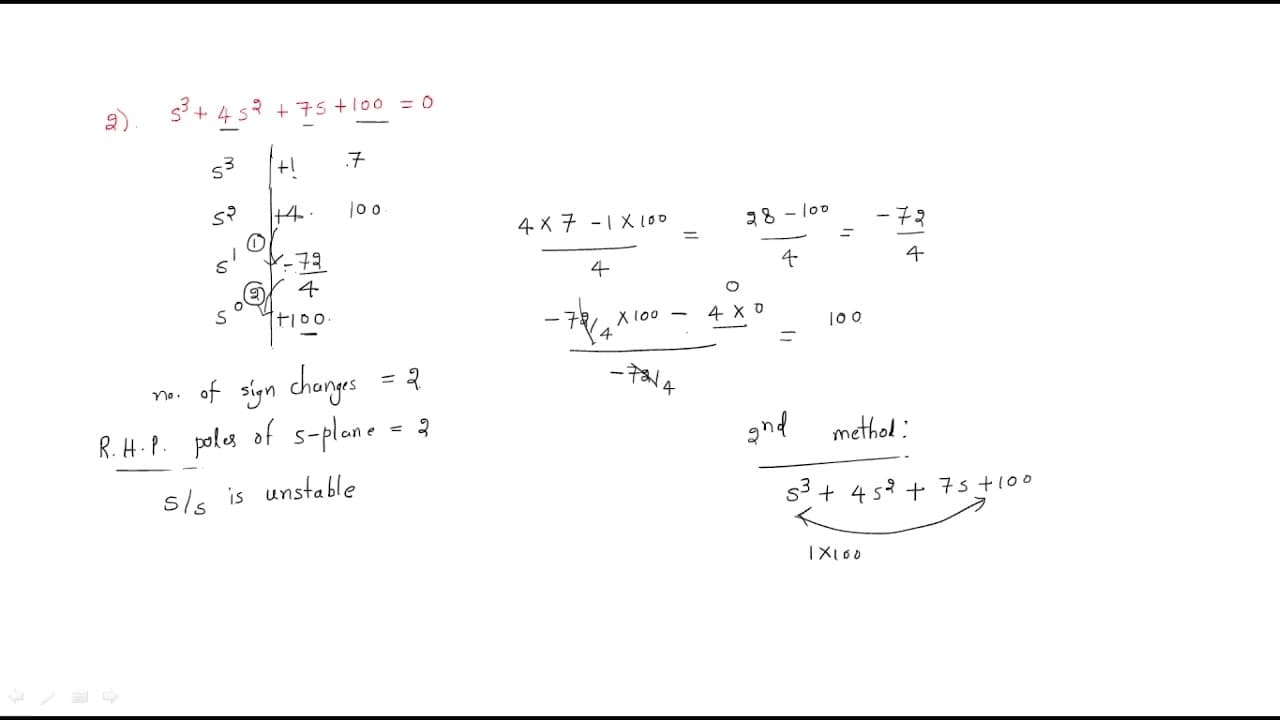
The discussion revolves around determining system stability using right-hand plane pole analysis.
Transcript
hello everyone in this session we will discuss some more problems regarding the rh criteria here the problem is s cube 4s square 7s plus 100 so same procedure here just write the rh table that is s cube s square s power 1 and s power 0 so here write the coefficients s cube has 1 and s square has 4 sq by 7 and it has the 100 it has the 100 okay now ... Read More
Key Insights
- 🎮 The Routh-Hurwitz criterion is essential in determining the stability of dynamic systems and is widely applied in control engineering.
- 🥺 Coefficients used in the Routh table reflect the characteristics of the system; careful manipulation can lead to insights about stability.
- 🗯️ A system is unstable if it possesses more than one pole in the right half plane, necessitating adjustments to system design for stability.
- 🎮 Marginal stability signifies continued oscillation without growth, often observed in control systems where feedback conditions are critical.
- 🫚 The calculations for natural frequency involve extracting roots related to oscillating behavior, which are pivotal in characterizing system dynamics.
- 🎮 Emphasis on determining the bounded output response is crucial for system stability analysis, especially for feedback control.
Install to Summarize YouTube Videos and Get Transcripts
Explore YouTube Video Summarizer or Get YouTube Transcript Extractor
Questions & Answers
Q: What is the Routh-Hurwitz criterion and how is it applied in stability analysis?
The Routh-Hurwitz criterion is a mathematical criterion used to determine the stability of a linear time-invariant (LTI) system by analyzing the coefficients of its characteristic polynomial. By constructing the Routh table, it evaluates the number of sign changes in the first column, indicating the number of right-hand plane poles, which determines stability conditions.
Q: How do sign changes in the Routh table relate to system stability?
In the Routh table, the number of sign changes in the first column reflects the number of poles located in the right-hand plane. Each sign change indicates a pole in the right half of the s-plane, with a system being stable if there are no sign changes, marginally stable with one sign change, and unstable with two or more sign changes.
Q: What does it mean for a system to be marginally stable?
A marginally stable system has its poles on the imaginary axis, resulting in persistent oscillations without growing or decaying. This indicates that the system responds to bounded input with bounded output, but without a definitive steady-state behavior. The presence of zero coefficients in the Routh table usually indicates marginal stability.
Q: How do you find the natural frequency of oscillation from a characteristic equation?
To find the natural frequency of oscillation, the characteristic equation is first set up and even powers of s are isolated. By solving for the imaginary parts, the values of s lead to the calculation of the frequency through the square root of negative values divided by real coefficients. The positive root yields the natural frequency of oscillation used in system dynamics.
Summary & Key Takeaways
-
The content explains how to analyze a polynomial's stability using the right-hand plane pole technique and discusses calculations for determining the coefficients associated with the characteristic equation.
-
It illustrates the use of the Routh-Hurwitz criterion, identifying sign changes in the coefficients to infer system stability and characterize the system as stable, marginally stable, or unstable.
-
Additional examples highlight the process of calculating the natural frequency of oscillation as well as conditions leading to marginal stability, stressing the significance of having bounded outputs for system stability.
Read in Other Languages (beta)
Share This Summary 📚
Summarize YouTube Videos and Get Video Transcripts with 1-Click
Try YouTube Summary with ChatGPT & Claude or YouTube Transcript Generator