10.4 Absorption and Emission of Photons
TL;DR
In special relativity, the emission and absorption of photons involve the conservation of energy and momentum and occur at specific energy values.
Transcript
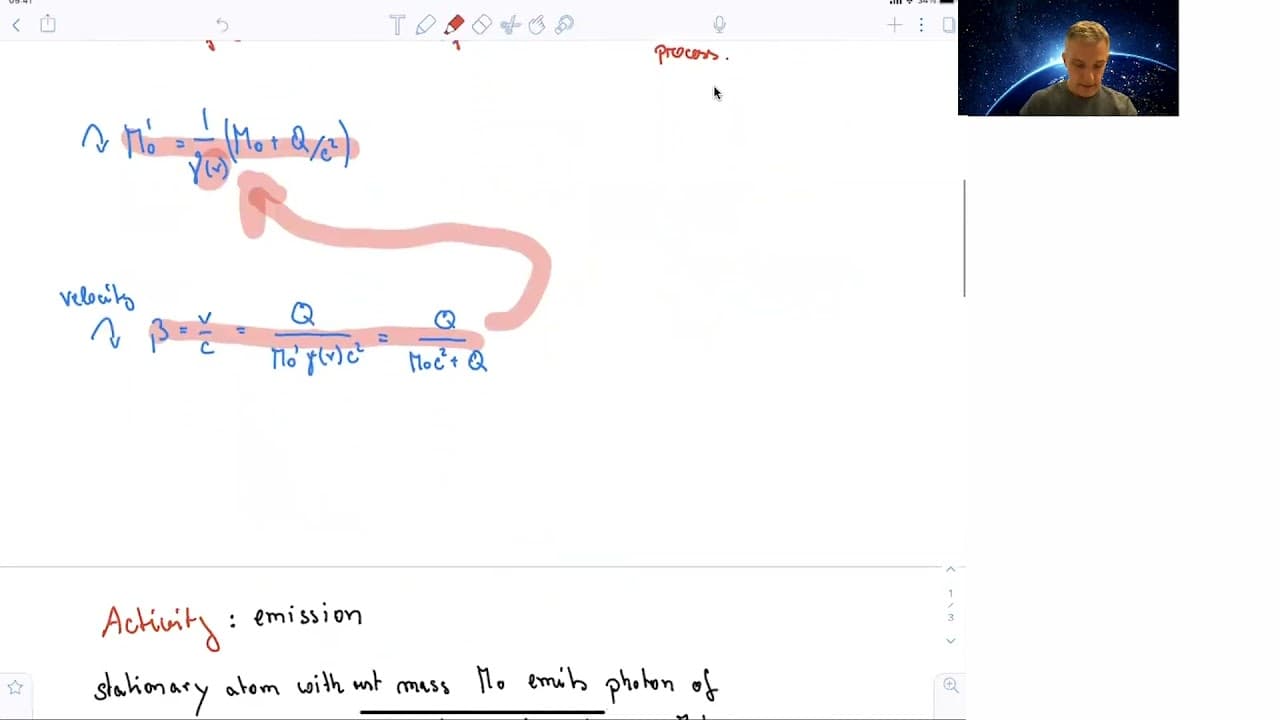
MARKUS KLUTE: Welcome back to 8.20 Special Relativity. In this section, we're going to talk about the emission and the absorption of photons. So you can think about a scenario where you have an atom which emits a photon, like in this picture here. And to create a new atom, which we call the atom prime, in the absorption process, you have a collisio... Read More
Key Insights
- 🫀 Absorption of photons involves the collision of a stationary atom and a photon, resulting in a new atom with a different mass and velocity.
- 👶 Energy and momentum conservation equations can be used to determine the mass and velocity of the new particle.
- 🫀 Emission of photons occurs when a stationary atom emits a photon, creating a new atom with a different mass and velocity.
- ❓ The energy of the emitted photon can be calculated using the invariants of the four-vector and energy and momentum relations.
- 🗯️ Reabsorption of a photon can only happen if the particles are moving with the right velocity.
- ❓ Special relativity provides insights into the precise energy values required for absorption and emission of photons.
- ❓ The physics involved in absorption and emission of photons are governed by the conservation of energy and momentum.
Install to Summarize YouTube Videos and Get Transcripts
Explore YouTube Video Summarizer or Get YouTube Transcript Extractor
Questions & Answers
Q: How can we find the mass and velocity of a new particle produced through the absorption of a photon?
The mass and velocity can be determined by writing energy and momentum equations, taking into account the initial mass, energy of the photon, and conservation of energy and momentum. Solving for the velocity and substituting it back in can give us the mass as a function of the mass of the initial particle and energy of the photon.
Q: What is the energy of the photon emitted during the emission process?
The energy of the emitted photon can be calculated using the invariants of the four-vector, energy, and momentum relations. By manipulating the equations, we find that the energy of the photon is equal to the difference in masses multiplied by a factor, which is always smaller than the difference in masses.
Q: Can any atom reabsorb a previously emitted photon?
No, reabsorption of a photon can only occur if the particles are moving with the right velocity. If an atom is at rest and a photon is emitted, a neighboring atom at rest is unable to reabsorb the photon. Specific conditions must be met for reabsorption to happen.
Q: What does special relativity tell us about the physics involved in absorption and emission of photons?
Special relativity reveals that the absorption and emission of photons are governed by the conservation of energy and momentum. It also shows that these processes only occur at precise energy values, and reabsorption can only happen if the particles are moving with the correct velocity.
Summary & Key Takeaways
-
In the process of absorption, a stationary atom collides with a photon, creating a new atom with a different mass and velocity.
-
The mass and velocity of the new particle can be determined by using energy and momentum conservation equations.
-
In the process of emission, a stationary atom emits a photon, resulting in a new atom with a different mass and velocity. The energy of the photon can be calculated using the invariants of the four-vector.
Read in Other Languages (beta)
Share This Summary 📚
Summarize YouTube Videos and Get Video Transcripts with 1-Click
Try YouTube Summary with ChatGPT & Claude or YouTube Transcript Generator
Explore More Summaries from MIT OpenCourseWare 📚



Summarize YouTube Videos and Get Video Transcripts with 1-Click
Try YouTube Summary with ChatGPT & Claude or YouTube Transcript Generator