What Is Latch-Up in CMOS Circuits and How to Prevent It?
TL;DR
Latch-up in CMOS circuits occurs when a low-resistance path forms between VDD and VSS due to parasitic transistors, leading to unwanted static current flow. To prevent latch-up, reduce substrate and well resistances, utilize buried layers, and implement guard rings to stabilize the circuitry.
Transcript
hi everyone I am going to explain about one important feature that is latch up in SEMA circuits so what do you mean by large chapter what do you mean by Latch up is nothing but existence of a low resistance path between vdd and VSS existence of a low resistance path between bdd and VSS this low resistance path is existed because of the what is the ... Read More
Key Insights
- 💐 Latch-up is primarily characterized by the formation of unintended low-resistance paths between power and ground in SEMA circuits, facilitating static current flow.
- 🎨 The design of CMOS circuits often inadvertently incorporates parasitic transistors that can exacerbate latch-up scenarios if not carefully managed.
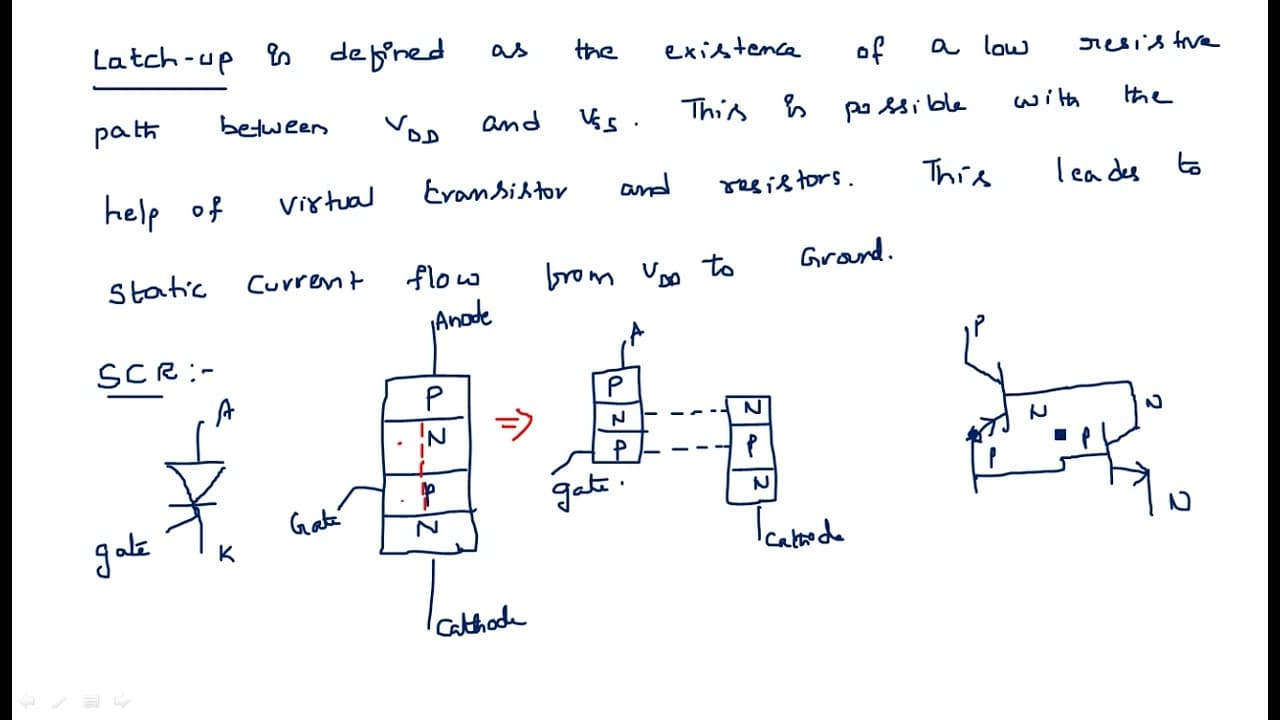
- ❓ The architecture of the Silicon Control Rectifier is a conceptual model that illustrates the complexities involved in understanding latch-up in integrated circuits.
- 🎨 Effective management of substrate and well resistances is crucial in designing CMOS circuits that are resilient against latch-up.
- 😋 Mitigating latch-up requires a multifaceted approach, including structural modifications like buried layers and guard rings.
- 🥺 The existence of virtual components in SEMA circuitry can lead to significant changes in the operational behavior of integrated devices, highlighting the need for careful design.
- 🥹 Higher holding times within devices can help manage latch-up scenarios by providing necessary delays for stable operation.
Install to Summarize YouTube Videos and Get Transcripts
Explore YouTube Video Summarizer or Get YouTube Transcript Extractor
Questions & Answers
Q: What is latch-up in SEMA circuits?
Latch-up refers to the creation of a low-resistance path between VDD (supply voltage) and VSS (ground) in SEMA circuits. This condition arises due to parasitic elements like virtual transistors and resistors in the construction of CMOS devices, resulting in unwanted static current flow that can compromise circuit functionality.
Q: How does a Silicon Control Rectifier (SCR) relate to latch-up?
SCR is a three-terminal device crucial in understanding latch-up. Its structure consists of alternating P and N regions, forming PNP and NPN transistors. In latch-up scenarios, these components can inadvertently connect, leading to low-resistance paths that mirror behaviors seen in SCRs during abnormal operation, resulting in potential circuit failures.
Q: What are some methods to prevent latch-up in CMOS circuits?
Preventing latch-up involves strategies such as reducing substrate and well resistance to minimize unwanted interconnections. Additionally, introducing buried layers and implementing guard rings can help stabilize the environment for transistors, mitigating the risk of latch-up by curbing excess carrier generation in active regions.
Q: Why is substrate and well resistance important in the context of latch-up?
Substrate and well resistances contribute significantly to the latch-up issue, as higher resistance can lead to an increased likelihood of parasitic current paths being established. Lowering these resistances ensures that current is more effectively routed through intended pathways, minimizing the chances of unwanted static current flow and maintaining stable circuit operation.
Summary & Key Takeaways
-
Latch-up is defined as a low-resistance path existing between VDD and VSS in SEMA circuits caused by virtual transistors and resistors, which can lead to static current flow.
-
The Silicon Control Rectifier (SCR) is introduced as a three-terminal device related to latch-up issues, featuring unique internal architecture with PNP and NPN transistors.
-
To mitigate latch-up problems, strategies include reducing substrate and well resistance, utilizing buried layers, and employing guard rings to stabilize transistor behavior in CMOS technology.
Read in Other Languages (beta)
Share This Summary 📚
Summarize YouTube Videos and Get Video Transcripts with 1-Click
Try YouTube Summary with ChatGPT & Claude or YouTube Transcript Generator