Voluntary Disclosure When Private Information and Proprietary Costs Are Jointly Determined
TL;DR
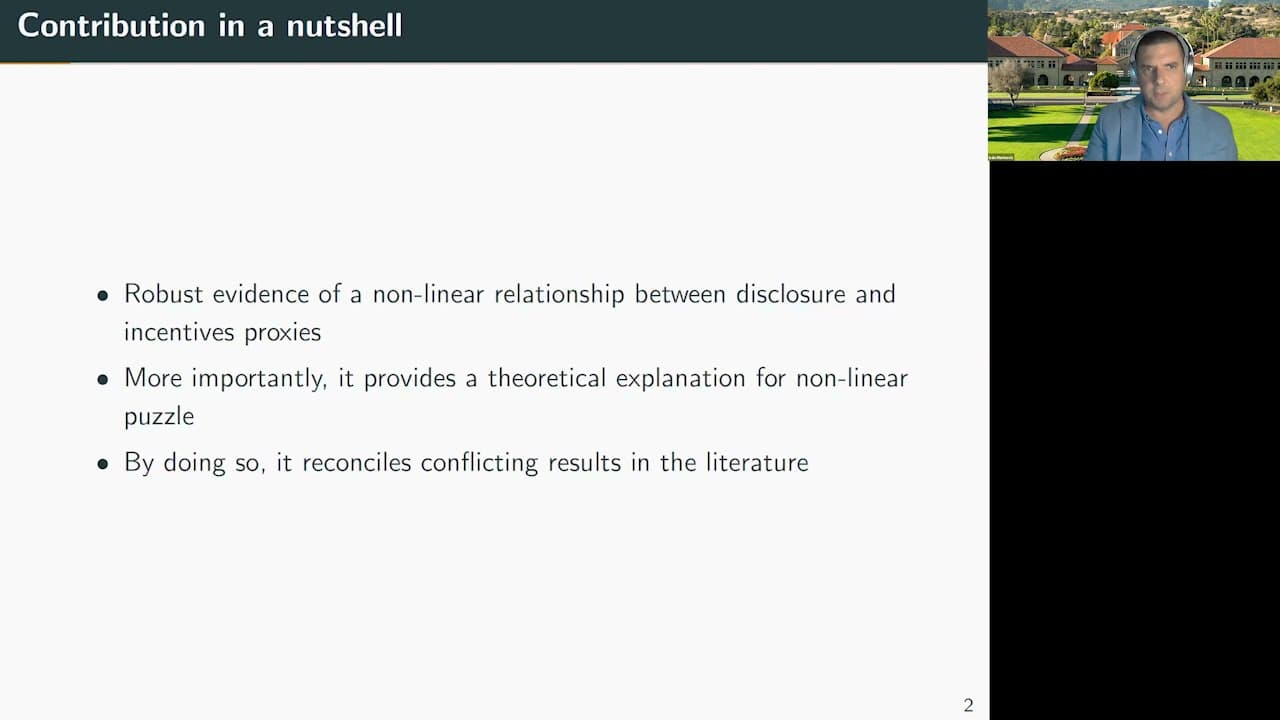
This paper explores the mixed empirical evidence on voluntary disclosure and proposes a model that combines private information and proprietary costs to explain the presence of an inverse U-shaped relation in the data.
Transcript
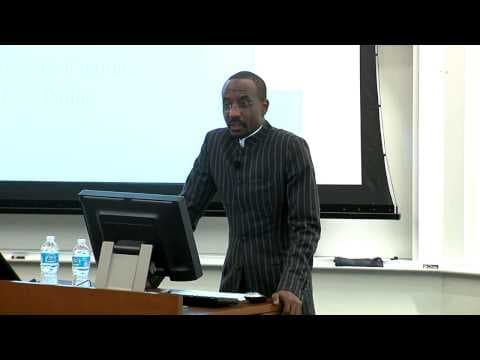
hello welcome welcome back everyone and thank you for your attention uh we're going to go ahead and get started again my name is kevin smith i'm one of the faculty here at stanford i'll be moderating this session section and just before we begin i want to thank stefan huber who is going to be behind the scenes helping me to curate the questions uh ... Read More
Key Insights
- 🧩 The mixed empirical evidence on voluntary disclosure is a puzzle given the clear theoretical predictions.
- 🔒 Combining private information and proprietary costs can explain the presence of an inverse U-shaped relation in voluntary disclosure.
- 🧑🏭 The paper highlights the need to consider the joint determination of these factors, rather than focusing on individual variables, to understand the complex dynamics of voluntary disclosure.
Install to Summarize YouTube Videos and Get Transcripts
Explore YouTube Video Summarizer or Get YouTube Transcript Extractor
Questions & Answers
Q: Why is the mixed empirical evidence on voluntary disclosure a puzzle?
The empirical literature on voluntary disclosure has failed to find consistent evidence on the relation between private information and proprietary costs, even though theory suggests a clear relationship. This inconsistency is puzzling and requires further investigation.
Q: How does the paper propose to address the mixed results in voluntary disclosure literature?
The paper proposes a model that combines private information and proprietary costs, suggesting that their joint determination leads to an inverse U-shaped relation in voluntary disclosure. By considering both factors simultaneously, the paper aims to explain the mixed empirical evidence observed in prior studies.
Q: What is the main takeaway of this paper?
The main takeaway is that the presence of multiple countervailing forces, such as private information and proprietary costs, can explain the observed inverse U-shaped relation in voluntary disclosure. This challenges the assumption that there is a unidirectional relationship and suggests that more complex interactions between these forces are at play.
Q: Can the presence of two frictions alone explain the inverse U-shaped relation in voluntary disclosure?
While the presence of two frictions, private information and proprietary costs, is necessary to explain the inverse U-shaped relation, it is not sufficient. The functional forms of these frictions can vary, and different shapes can emerge. However, the paper argues that their joint presence and interaction can explain the observed inverse U-shaped relation in the data.
Summary & Key Takeaways
-
The paper aims to explain the mixed results in the empirical literature on voluntary disclosure, which has failed to find consistent evidence on the relation between private information and proprietary costs.
-
The authors propose a model that combines the two factors, suggesting that their joint determination leads to an inverse U-shaped relation between voluntary disclosure and those factors.
-
Using data on capital investments and major customers, the authors find robust evidence supporting the existence of an inverse U-shaped relation in voluntary disclosure.
Read in Other Languages (beta)
Share This Summary 📚
Summarize YouTube Videos and Get Video Transcripts with 1-Click
Try YouTube Summary with ChatGPT & Claude or YouTube Transcript Generator
Explore More Summaries from Stanford Graduate School of Business 📚

Summarize YouTube Videos and Get Video Transcripts with 1-Click
Try YouTube Summary with ChatGPT & Claude or YouTube Transcript Generator