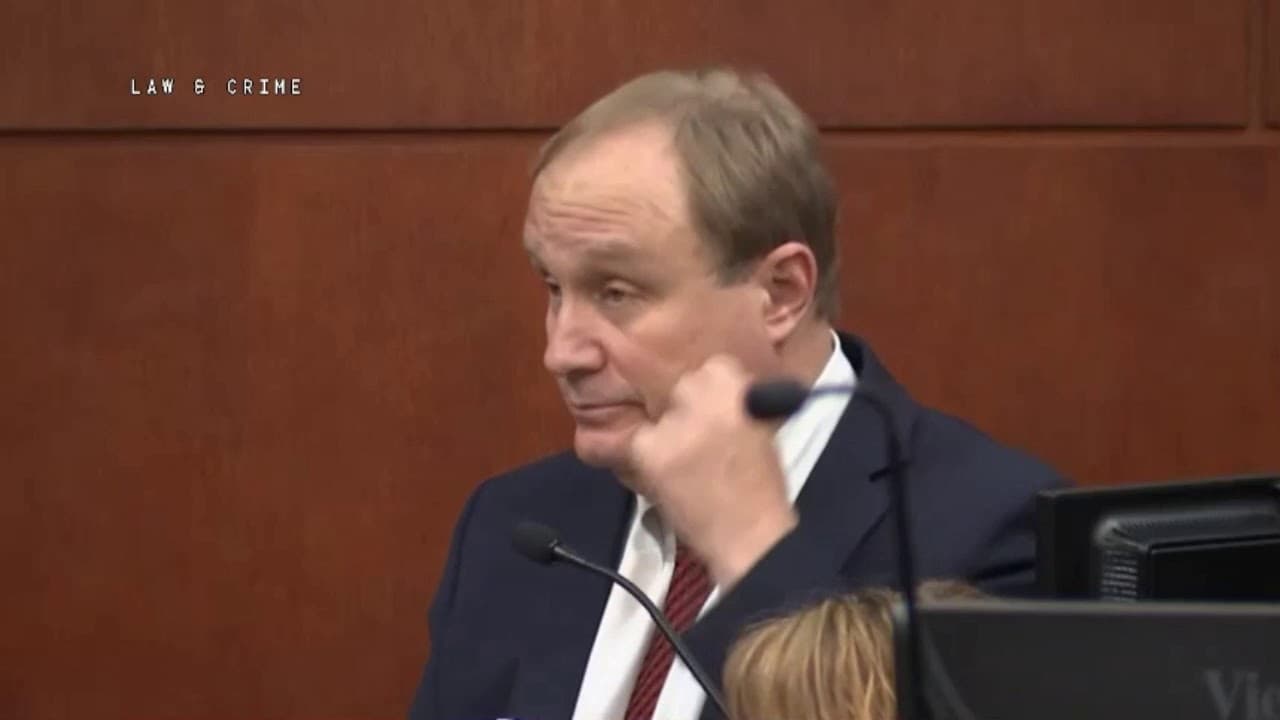
James Colley Trial Day 2 Part 2 Dr Jeffrey Danzinger Testifies
TL;DR
Forensic psychiatrist provides expert testimony on defendant's state of mind, refuting impairment claims.
Transcript
aspect of the defense for the penalty phase so I believe would be not only relevant unduly prejudicial and it's hearsay I'm sorry I don't mean to cut you but yes under the case law if hearsay is permitted as long as the defendant's constitutional rights for confrontation or are not violated there's no way we can cross-examine unfortunately miss Kal... Read More
Key Insights
- 🤯 Forensic psychiatrists provide comprehensive evaluations in death penalty cases, considering drug effects, state of mind, and rational decision-making.
- 😀 Evaluation of psychological testing results alongside face-to-face interviews offers a well-rounded assessment of the defendant's mental state.
- 🤨 Contradictions in defendant's recount of events and external testimonies raise doubts about impairment claims, suggesting deliberate actions.
Install to Summarize YouTube Videos and Get Transcripts
Explore YouTube Video Summarizer or Get YouTube Transcript Extractor
Questions & Answers
Q: How does the forensic psychiatrist differentiate between drug-induced impairment and rational decision-making based on the defendant's timeline?
The psychiatrist analyzes the defendant's behavior, interviews, and testimonies to determine coherence, logic, and clarity close to the crime, indicating rational decision-making rather than impairment.
Q: What role did psychological testing play in the forensic psychiatrist's evaluation of the defendant's state of mind?
Psychological tests like MMPI and PAI were used to generate hypotheses on the defendant's mental state, compared with face-to-face interviews and medical records for a comprehensive assessment.
Q: What contradictions were found in the defendant's recount of events surrounding the crimes in relation to his state of mind?
Discrepancies between the defendant's behaviors, testimonies, and memory lapses raise doubts about impairment claims, suggesting deliberate actions and rational decision-making.
Q: How did the forensic psychiatrist incorporate external observations and testimonies in evaluating the defendant's state of mind?
The psychiatrist considered judge, lawyer, and other professional testimonies along with the defendant's own accounts to paint a comprehensive picture of the defendant's behavior and mental state.
Summary & Key Takeaways
-
Forensic psychiatrist discusses his expertise in psychiatric practice, drug studies, and testimony in death penalty cases.
-
Defendant's timeline recounted before, during, and after the crimes, questioning state of impairment.
-
Evaluation and psychological testing results presented, indicating no impairment at time of crimes.
Read in Other Languages (beta)
Share This Summary 📚
Summarize YouTube Videos and Get Video Transcripts with 1-Click
Try YouTube Summary with ChatGPT & Claude or YouTube Transcript Generator
Explore More Summaries from Law&Crime Network 📚


Summarize YouTube Videos and Get Video Transcripts with 1-Click
Try YouTube Summary with ChatGPT & Claude or YouTube Transcript Generator