The Future for Higher Education in Vietnam
TL;DR
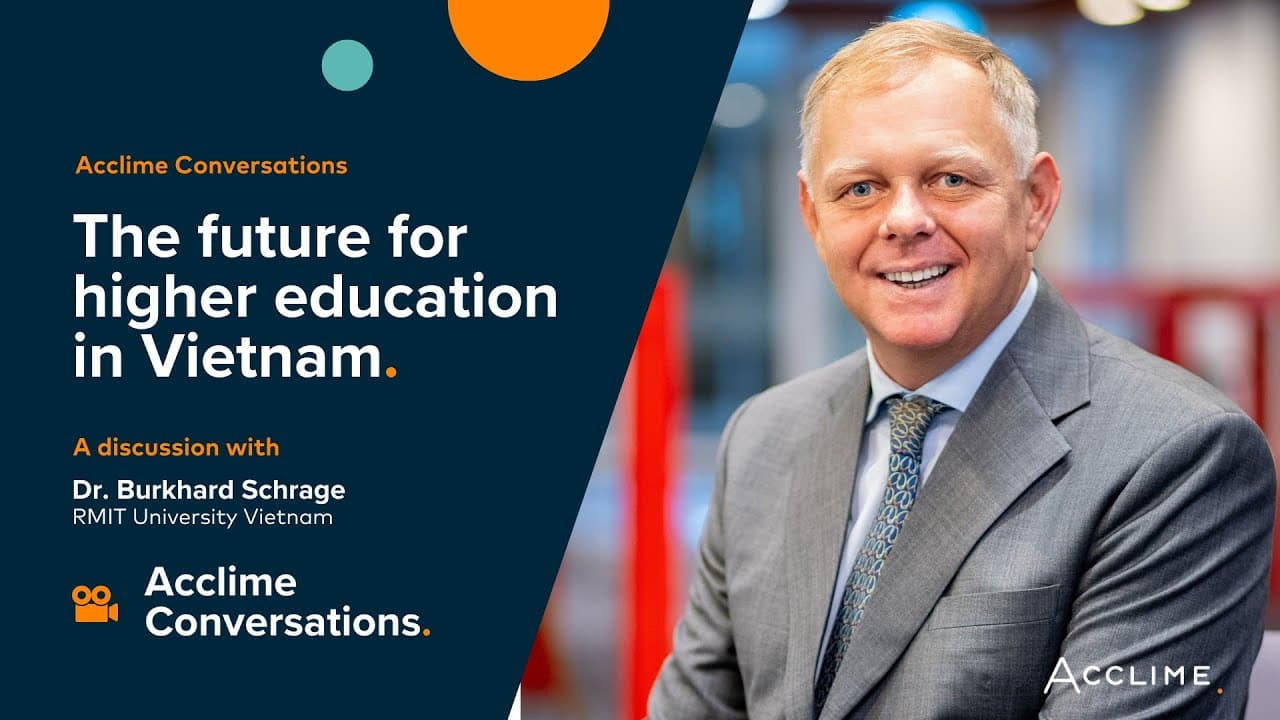
Dr. Schrage discusses Vietnam's education system and economic potential.
Transcript
foreign conversations where we talk to the business people that matter in Vietnam today I'm interviewing here Dr Burkhart strange who is the senior program manager for MBA Executive MBA the business program and he's a senior lecturer at rmit University Vietnam and business entrepreneur at large and we'll also learn a bit about that Burkhardt welcom... Read More
Key Insights
- Dr. Burkhard Schrage has a diverse background, having worked in investment banking and academia across several countries before settling in Vietnam, where he now focuses on strategic management and corporate governance at RMIT.
- Vietnam's education system is unique in that its students are highly committed to contributing to their country, contrasting with other nations where students often seek opportunities abroad.
- RMIT Vietnam is distinguished by its focus on applied learning and real-life applications, offering world-class facilities and a curriculum that includes local context and examples.
- A significant gap in Vietnam's education system is the lack of soft skills and critical analysis, which RMIT aims to address through its programs and industry advisory boards.
- Vietnam is experiencing rapid growth in academic research output, surpassing regional counterparts like Singapore, indicating a rising prominence in knowledge creation.
- The Vietnamese economy is heavily reliant on trade, with a significant portion of its GDP linked to the agricultural sector, which requires modernization and efficiency improvements.
- AI and digital transformation are seen as crucial for Vietnam's future, with RMIT playing a role in supporting these developments through research and education.
- Vietnam's future economic growth is expected to be driven by the service industry, with potential in areas like tourism, coding, and new technology development, supported by a strong educational foundation.
Install to Summarize YouTube Videos and Get Transcripts
Explore YouTube Video Summarizer or Get YouTube Transcript Extractor
Questions & Answers
Q: What is Dr. Schrage's background before joining RMIT Vietnam?
Dr. Schrage has a diverse background, having worked in investment banking and academia across several countries, including Germany, France, the United States, Brazil, and Singapore. His experience spans privatization programs, emerging markets, and strategic management, which he now applies in his role at RMIT Vietnam.
Q: How does RMIT Vietnam differentiate itself in the education sector?
RMIT Vietnam differentiates itself through its focus on applied learning, world-class facilities, and integration of local context into the curriculum. It emphasizes real-life applications and practical skills, contrasting with traditional Vietnamese universities that are more theory-focused. This approach aims to address gaps in soft skills and critical thinking.
Q: What are the key gaps in Vietnam's education system according to Dr. Schrage?
Dr. Schrage identifies a lack of soft skills and critical analysis as key gaps in Vietnam's education system. The high school system is individualistic, with little exposure to teamwork and presentation skills. RMIT aims to address these gaps through its programs and industry advisory boards, enhancing students' abilities to work in teams and think critically.
Q: How is Vietnam's academic research output changing?
Vietnam's academic research output is rapidly increasing, surpassing regional counterparts like Singapore. Over the past 20 years, the country has seen significant growth in the production of new knowledge, indicating a rising prominence in academic research. This trend is supported by a strong educational foundation and a focus on science-oriented topics.
Q: What role does AI play in Vietnam's education and economy?
AI is seen as a crucial component for Vietnam's future, with potential to narrow the digital divide and enhance communication and productivity. RMIT embraces AI in its educational approach, using it to support teaching and learning. The technology is expected to benefit Vietnam by providing access to knowledge and improving digital communication.
Q: What is the economic outlook for Vietnam according to Dr. Schrage?
Dr. Schrage sees Vietnam's future economic growth driven by the service industry, with potential in tourism, coding, and new technology development. The country is heavily reliant on trade and agriculture, which requires modernization. Infrastructure improvements and legal reforms are necessary for sustained growth beyond the next decade.
Q: How does RMIT Vietnam contribute to the development of business leaders?
RMIT Vietnam aims to develop business leaders by providing education that is responsive to industry demands. The university's programs focus on applied learning and practical skills, preparing students to meet the needs of the Vietnamese economy. RMIT's impact is measured through surveys and job placement rates, indicating high demand for its graduates.
Q: What are the challenges and opportunities in Vietnam's agricultural sector?
Vietnam's agricultural sector faces challenges in modernization and efficiency, with small farm sizes and a need for improved productivity. However, there are opportunities for innovation and impact investments, such as using technology to enhance agricultural practices. The government aims to maintain a significant agricultural presence while improving efficiency and sustainability.
Summary & Key Takeaways
-
Dr. Schrage's diverse background in investment banking and academia across multiple countries informs his current role at RMIT Vietnam, where he focuses on strategic management and corporate governance. He highlights Vietnam's unique position in higher education, with students committed to contributing to their country's development.
-
RMIT Vietnam stands out for its applied learning approach, integrating real-life applications and local context into its curriculum. Despite the country's rapid advancement in academic research, gaps remain in soft skills and critical analysis, which RMIT aims to address through its programs.
-
Vietnam's economy, heavily reliant on trade and agriculture, faces challenges in modernization and efficiency. AI and digital transformation are crucial for future growth, with the service industry poised to drive economic development. RMIT supports these efforts through education and research initiatives.
Read in Other Languages (beta)
Share This Summary 📚
Summarize YouTube Videos and Get Video Transcripts with 1-Click
Try YouTube Summary with ChatGPT & Claude or YouTube Transcript Generator
Explore More Summaries from Acclime Vietnam 📚

Summarize YouTube Videos and Get Video Transcripts with 1-Click
Try YouTube Summary with ChatGPT & Claude or YouTube Transcript Generator