What Are the Origins of the Digital Universe and AI?

TL;DR
The origins of the digital universe and AI trace back to early computing pioneers like Alan Turing, Julian Bigelow, and Norbert Wiener, who shaped the foundations of digital logic and programming. George Dyson explains that the von Neumann architecture revolutionized computing and explores Nils Baricelli's numerical organisms, which could influence the evolution of AI and technology within our digital landscape.
Transcript
good evening I'm Alexander Rose I'm the executive director here at long now thank you all for making it out on a rainy night the rain we need so badly here as many of you know before these talks we often screen what we call a long short a short film about long term thinking or at least that exemplifies long term thinking the one that we've chosen t... Read More
Key Insights
- ❓ The development of digital computing was influenced by the contributions of Norbert Wiener, Julian Bigelow, and Alan Turing.
- 👻 The von Neumann architecture revolutionized computer design, allowing for the efficient storage and manipulation of binary information.
- 🛰️ Nils Baricelli's experiments with numerical organisms offer insights into the potential for artificial intelligence and the evolution of technology within a digital universe.
- ⚾ Time-based computing and template-based addressing could lead to new approaches in programming and the development of more complex and efficient systems.
Install to Summarize YouTube Videos and Get Transcripts
Explore YouTube Video Summarizer or Get YouTube Transcript Extractor
Questions & Answers
Q: What is the significance of the book assigned to UC Berkeley students?
The book, written by George Dyson, delves into the origins and potential future of artificial intelligence and long-term thinking, making it a valuable read for students interested in these subjects.
Q: How did Julian Bigelow contribute to the development of digital computing?
Bigelow played a crucial role in building the first electronic digital computer, working closely with Norbert Wiener and John von Neumann. He also pioneered the concept of template-based addressing, which could revolutionize programming in the future.
Q: What is Nils Baricelli's vision for a digital universe?
Baricelli's experiments with numerical organisms and evolutionary simulations led him to propose a digital universe in which computer programs can interact and evolve like biological organisms. He believed that this could lead to truly artificial intelligence and new forms of technology.
Q: How does the von Neumann architecture impact digital computing?
The von Neumann architecture, developed by John von Neumann and implemented by Julian Bigelow, introduced the concept of storing instructions and data in the same memory. This standardized architecture is still the foundation for most modern computers, allowing for the manipulation and processing of binary information.
Summary & Key Takeaways
-
Alexander Rose introduces the content with a short film exemplifying long-term thinking.
-
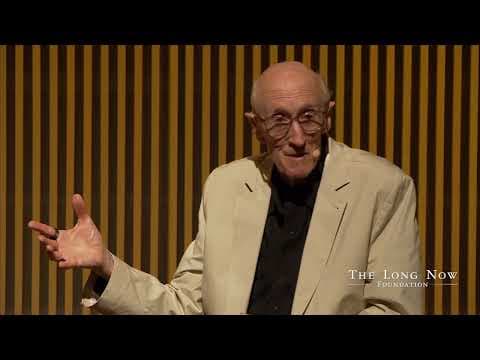
Stuart Brand discusses George Dyson's book, which is now assigned reading for all UC Berkeley students.
-
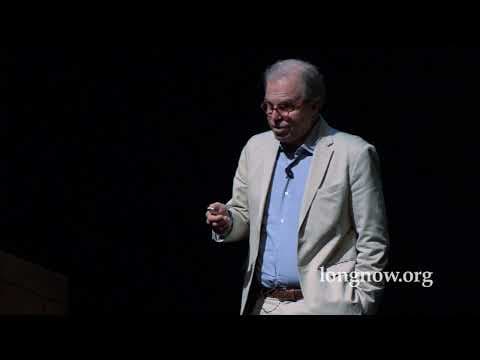
George Dyson presents a talk on the origins of AI and the story of friar bacon's attempt to build a sentient AI.
-
Dyson then delves into the early years of digital computing, the influence of Norbert Wiener and Julian Bigelow, and the significance of Alan Turing's work.
-
He discusses the development of the von Neumann architecture and its impact on digital computing.
-
Dyson explores Nils Baricelli's concept of a digital universe and the potential for artificial intelligence and genetic coding to evolve within it.
Read in Other Languages (beta)
Share This Summary 📚
Summarize YouTube Videos and Get Video Transcripts with 1-Click
Try YouTube Summary with ChatGPT & Claude or YouTube Transcript Generator
Explore More Summaries from Long Now Seminars 📚
Summarize YouTube Videos and Get Video Transcripts with 1-Click
Try YouTube Summary with ChatGPT & Claude or YouTube Transcript Generator