Multiplexer | Introduction | 4x1 Mux | STLD | Lec-95
TL;DR
A multiplexer selects one input from multiple options and outputs it based on selection lines.
Transcript
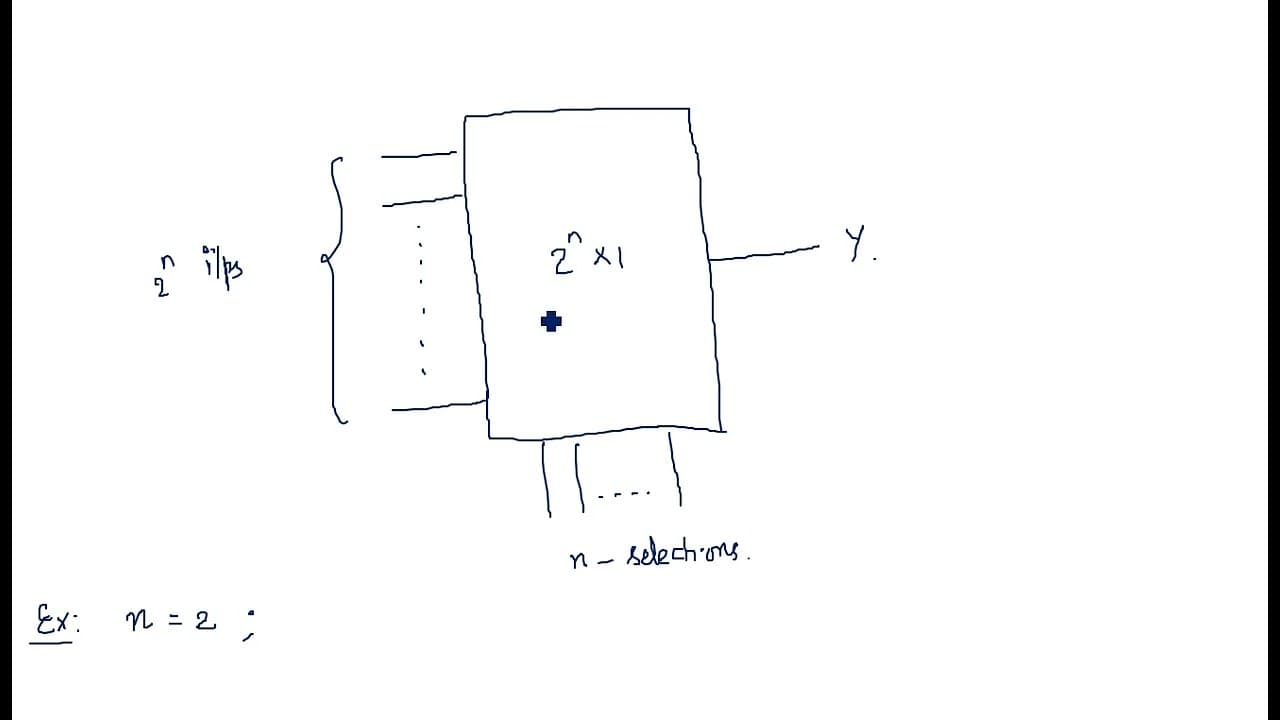
hi everyone in this video I'm going to tell you about multiplexer multiplexer is also known as a data selector it is also known as it is also known as data selector data selector so what is mean by data selector or what do you mean by multiplexor here at the input of a multiplexor we are having 2 power n number of inputs out of these two power and ... Read More
Key Insights
- 🫥 A multiplexer, or data selector, can manage numerous inputs through selection lines to output a single data stream.
- 🔢 The mathematical representation of a multiplexer’s size, 2^n by 1, directly relates to its number of selection lines and inputs.
- 🚰 The two common types of multiplexers are 2x1 and 4x1, each with unique truth tables governing input-output relationships.
- 🫥 Selection lines play a critical role in determining which input is sent to the output, influencing the multiplexer’s operational logic.
- 👷 A combination of AND, OR, and NOT gates is generally used to construct internal logic circuits of multiplexers.
- 🎨 Understanding Boolean equations helps in designing multiplexers and predicting how they function in varying scenarios.
- 🖱️ Multiplexers find extensive use in telecommunications, signal processing, and computing where multiple signals need to be handled efficiently.
Install to Summarize YouTube Videos and Get Transcripts
Explore YouTube Video Summarizer or Get YouTube Transcript Extractor
Questions & Answers
Q: What is the primary function of a multiplexer?
The primary function of a multiplexer is to select one input from multiple sources based on selection lines and send that input to a single output. It effectively acts as a data selector, managing which input is used in a circuit depending on the active selection lines.
Q: How are the size and inputs of a multiplexer determined?
The size of a multiplexer is determined as 2^n by 1, meaning it can handle 2^n number of inputs with one output. Here, n reflects the number of selection lines. For instance, with 2 selection lines (n=2), it accommodates 4 inputs (2^2=4) with one corresponding output.
Q: Can you explain how a 2x1 multiplexer operates?
A 2x1 multiplexer operates using one selection line that determines which of the two inputs gets sent to the output. If the selection line is 0, the output corresponds to the first input; if it's 1, the output will reflect the second input. This is often visualized in a truth table format.
Q: What are the characteristics of a 4x1 multiplexer?
A 4x1 multiplexer has four inputs and two selection lines. It routes one input to the output based on the combination of the selection lines. The corresponding truth table shows which input gets selected based on the binary values of the selection lines, effectively controlling the data flow.
Q: What Boolean expression corresponds to a 2x1 multiplexer?
The Boolean expression for a 2x1 multiplexer can be represented as Y = M0' · S' + M1 · S, where M0 and M1 are the inputs and S is the selection line. This shows how the output will change depending on the status of the selection line, ensuring proper data selection.
Q: What is the relevance of selection lines in multiplexers?
Selection lines are crucial in multiplexers as they dictate which input is passed to the output. Each combination of selection line values corresponds to a specific input, allowing the multiplexer to function effectively as a data selector, managing input selection dynamically in electronic circuits.
Q: How can multiplexers be utilized in practical applications?
Multiplexers are widely used in digital circuits for routing data, processing signals, and reducing the number of lines required for various inputs. They are essential in communication systems, data acquisition, and even in implementing functional logic in integrated circuits where complex input management is needed.
Q: What distinguishes a multiplexer from a demultiplexer?
A multiplexer selects one of many inputs to forward to a single output, while a demultiplexer takes a single input and channels it to one of many outputs. They perform opposite functions: a multiplexer consolidates inputs, whereas a demultiplexer distributes an input signal across multiple outputs.
Summary & Key Takeaways
-
A multiplexer, also known as a data selector, can handle 2^n inputs and outputs a selected input based on n selection lines.
-
The size of the multiplexer is denoted as 2^n by 1, where n represents the number of selection lines, determining how many inputs can be managed.
-
Multiplexers can be configured in sizes like 2x1 or 4x1, with specific truth tables defining how selection lines correspond to inputs and controlling output flow.
Read in Other Languages (beta)
Share This Summary 📚
Summarize YouTube Videos and Get Video Transcripts with 1-Click
Try YouTube Summary with ChatGPT & Claude or YouTube Transcript Generator