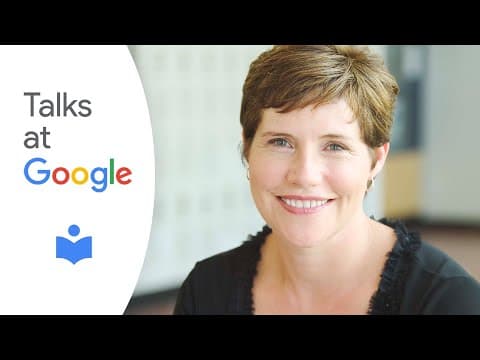
Chantel Prat | How Every Brain Is Different and How to Understand Yours | Talks at Google

TL;DR
Neuroscientist Chantel Prat discusses the challenges of understanding and appreciating individual differences, how our brains are wired to connect with similar minds, the impact of curiosity and threat on our ability to understand others, and the role of subjective realities in shaping our perspectives.
Transcript
WILL AJAYI: Hello, everybody. All righty, we are thrilled, thrilled, thrilled, thrilled, to welcome professor Chantel Prat to discuss her book, "The Neuroscience of You-- How Every Brain is Different and How to Understand Yours." And Dr. Prat is a professor at the University of Washington with appointments in multiple departments to include psychol... Read More
Key Insights
- 🧠 Brains of individuals with similar patterns of connectivity tend to form social connections, highlighting the importance of shared perspectives.
- 🤯 Understanding the minds of others requires both mirroring and theory of mind, allowing us to simulate and appreciate different perspectives.
- 🧠 Different brains construct different versions of reality, influenced by limited perception and personal experiences.
- 🧑💼 There are strengths and trade-offs associated with different learning styles, such as choosing or avoiding behavior.
- 🧠 Our brain's interpretation of reality is a subjective process, highlighting the importance of understanding different perspectives.
Install to Summarize YouTube Videos and Get Transcripts
Explore YouTube Video Summarizer or Get YouTube Transcript Extractor
Questions & Answers
Q: Can we have both choosing and avoiding learning styles?
Yes, individuals can exhibit both choosing and avoiding learning styles, with different strengths depending on the context. The brain's basal ganglia plays a key role in determining behavioral preferences.
Q: How can we address implicit bias?
Addressing implicit bias requires self-awareness, recognizing that our values and perspectives are shaped by our subjective realities. Building trusting relationships and promoting experiences that challenge our biases can help foster understanding and personal growth.
Q: Is free will an illusion?
Most neuroscientists believe that free will is an illusion, as our conscious minds only have limited access to the factors driving our behaviors. However, individuals can still be intentional about their experiences and challenge their own beliefs.
Summary & Key Takeaways
-
Brains of a feather flock together: Social neuroscientists have found evidence that people with similar brain patterns are more likely to be friends, highlighting the role of mirroring and shared perspectives in social connections.
-
Theory of mind and understanding others: Theory of mind, learned through effortful processes, allows us to simulate the minds of others and understand different perspectives. It is a valuable tool for reversing engineering the minds of others.
-
Different perspectives and subjective realities: Different brains construct different perspectives and realities, influenced by our limited perception and experiences. Understanding this gap between objective reality and our brain's interpretation can foster curiosity and openness to others.
-
Choose or avoid: People tend to fall into two learning styles—choosers and avoiders. Choosers quickly optimize their behavior based on reward expectations, while avoiders excel at recognizing and avoiding negative outcomes. Both styles have strengths and trade-offs.
Read in Other Languages (beta)
Share This Summary 📚
Summarize YouTube Videos and Get Video Transcripts with 1-Click
Try YouTube Summary with ChatGPT & Claude or YouTube Transcript Generator
Explore More Summaries from Talks at Google 📚
Summarize YouTube Videos and Get Video Transcripts with 1-Click
Try YouTube Summary with ChatGPT & Claude or YouTube Transcript Generator