3- Phase Induction Motor | Speed Control from Rotor side | Lec-55
TL;DR
The session explains three methods for controlling the speed of three-phase induction motors.
Transcript
hello everyone in this session we will discuss about the the next method of the three-phase induction motor speed control changing the number of stator poles by changing the number of stator poles we can control the speed of the three-phase induction motor how we can control the speed of the induction motor means here the simple thing you know the ... Read More
Key Insights
- 🐎 Changing the number of stator poles is a practical method for speed control, directly influencing the synchronous speed.
- 💈 This approach has limitations in smoothness of control and costs, requiring multiple winding setups for different pole configurations.
- 👻 The pole amplitude modulation technique allows for varying speeds through complex sinusoidal modulation techniques compared to fixed-step changes.
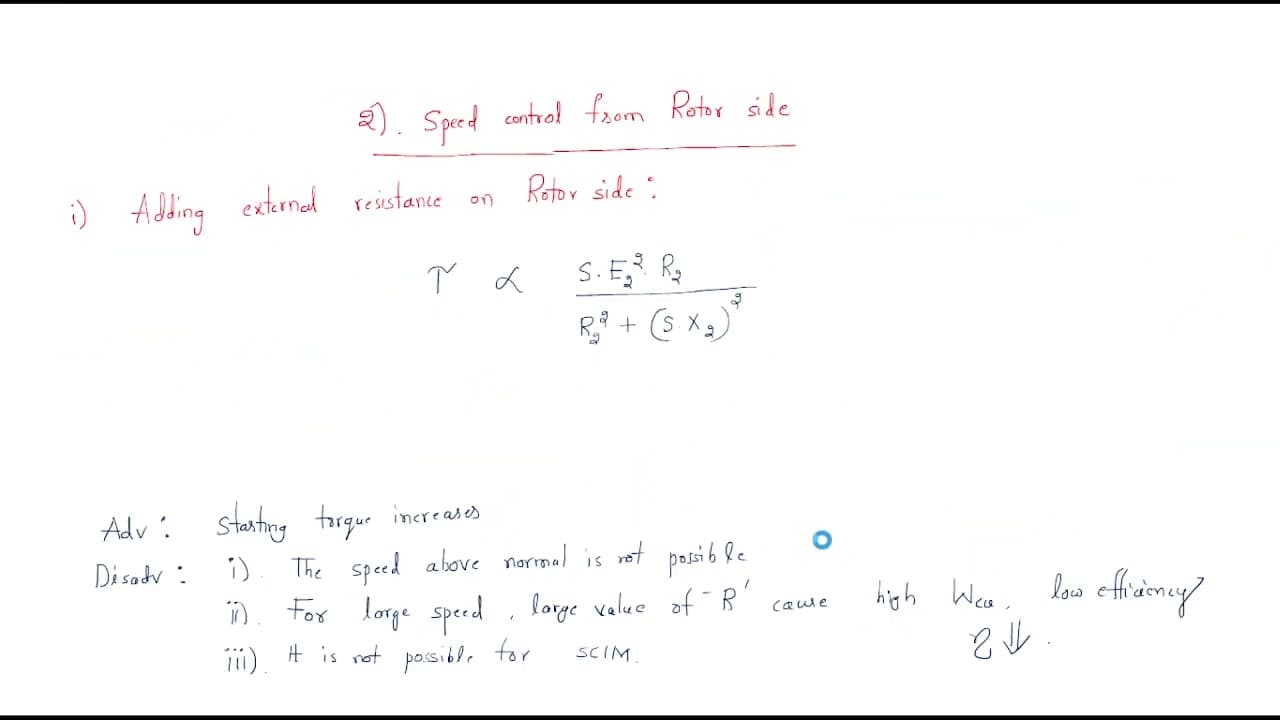
- 💋 External resistance addition in stator and rotor circuits directly impacts torque, slip, and speed, offering another avenue for control.
- ✋ The efficiency of induction motors can be compromised due to increased copper losses when using high resistance values in rotor circuits.
- 🧑🦼 Each speed control method discussed has specific applications and limitations, making them suitable for particular types of induction motors.
- 💋 Understanding the relationship between torque, slip, and speed is crucial for effective motor operation and control strategies.
Install to Summarize YouTube Videos and Get Transcripts
Explore YouTube Video Summarizer or Get YouTube Transcript Extractor
Questions & Answers
Q: What is the primary method discussed for controlling the speed of three-phase induction motors?
The primary method discussed is changing the number of stator poles in the motor. By increasing or decreasing the number of poles, the synchronous speed of the motor can be adjusted accordingly. For instance, raising the poles lowers the speed, while reducing poles increases it, allowing for different operational speeds as needed.
Q: Why is smooth speed control not achievable with the pole-changing method?
Smooth speed control is unattainable in this method because the speed changes occur in fixed steps as the number of poles is altered. This results in specific, discrete speeds (e.g., 3000, 1500, 750 RPM) rather than a gradual transition. Therefore, there can't be intermediate speeds, and precise speed adjustments are limited.
Q: Are there any limitations associated with the technique of changing the number of stator poles?
Yes, the technique has several limitations, including higher costs due to the need for multiple winding sets for different pole configurations. Additionally, it is only applicable to squirrel cage induction motors, as slip ring motors do not support this method effectively due to their design characteristics.
Q: What is the purpose of adding external resistance in the stator circuit for speed control?
Adding external resistance in the stator circuit lowers the supply voltage, which directly affects the torque and slip of the motor. This results in an increase in slip, leading to a decrease in speed. However, it is essential to maintain the torque constant to ensure the motor continues operating under load.
Q: How does the pole amplitude modulation technique differ from changing stator poles?
The pole amplitude modulation technique involves modulating the original sinusoidal magnetomotive force (MMF) with another sinusoidal MMF that has a different number of poles. This method enables different speed control options and allows for more flexible speed variations instead of discrete speed steps.
Q: What are some challenges faced when using the rotor-side speed control method?
Challenges include an inability to reach speeds above normal, as adding resistance will only decrease speed. Additionally, using large resistances can lead to high copper losses, reducing efficiency significantly. Lastly, this method is only suitable for slip ring induction motors and not for squirrel cage types.
Q: Can the techniques mentioned apply to all types of induction motors?
No, these techniques are particularly tailored for squirrel cage and slip ring induction motors. The specifics of each method may suit only certain motor types due to differences in design and function, limiting their broad applicability across all induction motor configurations.
Q: What are the advantages of adding external resistance in rotor circuits?
Adding external resistance in the rotor circuit increases starting torque, which is beneficial during initial motor start-up. However, it can lead to greater slip and decreased speed during operation. Nonetheless, this method can prolong motor life by reducing mechanical stress on components during the startup phase.
Summary & Key Takeaways
-
The session discusses methods for controlling the speed of three-phase induction motors by changing the number of stator poles, emphasizing the relationship between pole quantity and motor speed.
-
It explains the advantages and disadvantages of this pole-changing technique, highlighting its applicability primarily to squirrel cage induction motors and issues with smooth speed control.
-
Additional techniques for speed control are introduced, including pole amplitude modulation and adding external resistances, detailing their effects on torque and speed stability.
Read in Other Languages (beta)
Share This Summary 📚
Summarize YouTube Videos and Get Video Transcripts with 1-Click
Try YouTube Summary with ChatGPT & Claude or YouTube Transcript Generator