Line Graph | Companies Income | Data Interpretation | Reasoning | Part - 01 | Bharath Kumar
TL;DR
An overview of interpreting line graphs for income analysis.
Transcript
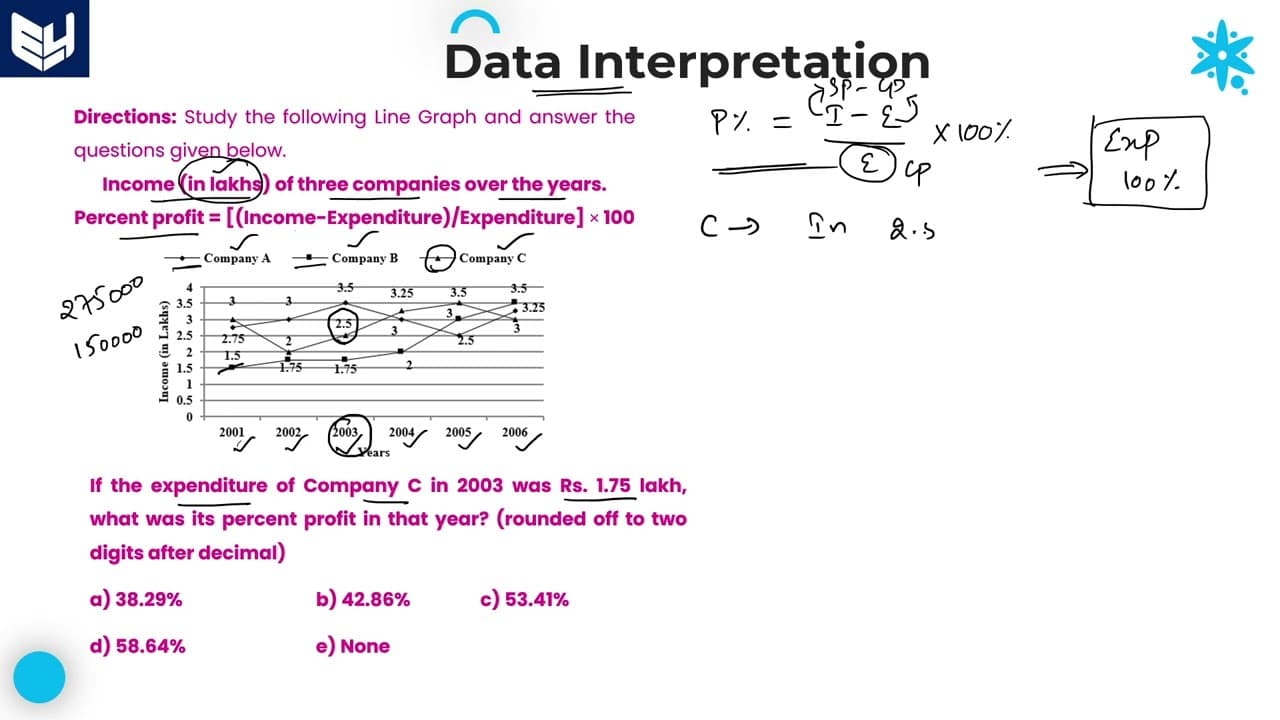
hi everyone welcome to the session in this session I am going to start a a line graph data interpretation here I am going to start a line graph data and preparation first of all we need to read the information carefully and then we need to go for the questions Here If You observe carefully whatever the information which is provided for this data an... Read More
Key Insights
- 🫥 Interpreting income data from line graphs requires careful attention, particularly distinguishing between different companies’ graphical representations.
- 😫 Remember to set expenditure as a baseline of 100% when calculating profit percentages for clarity in financial analyses.
- 🧑⚕️ The formula for profit percentage utilizes both income and expenditure to evaluate financial health, emphasizing the importance of both variables.
- 🍹 Average income calculations are straightforward: sum the yearly incomes divided by the total years, providing a quick metric for performance evaluation.
- 🦻 Year-over-year income changes serve as a valuable tool for identifying growth trends, aiding in strategic planning and forecasting.
- 🎵 Always verify that the given values in a graph are accurately noted to avoid miscalculating or misinterpreting financial data.
- 🦻 Understanding the methodology behind calculating averages and percentages significantly aids in analytical problem-solving around financial statements.
Install to Summarize YouTube Videos and Get Transcripts
Explore YouTube Video Summarizer or Get YouTube Transcript Extractor
Questions & Answers
Q: What is the primary difference between line graphs and bar graphs as discussed in the session?
The primary difference is that line graphs display data points connected by lines to show trends over time, while bar graphs represent data using bars, making it easier to compare discrete values. This change allows for better visual tracking of income trends across different years for multiple companies.
Q: How do you calculate profit percentage using the provided formula?
To calculate profit percentage, you subtract expenditure from income, divide the result by expenditure, and then multiply by 100. The formula is given as: Profit Percentage = (Income - Expenditure) / Expenditure * 100. This approach helps assess the profitability relative to the costs incurred.
Q: What steps should be taken to find the average income of company A over the given years?
To find the average income, you sum the income values for each year and then divide by the number of years. For company A, the income for each year is added together, resulting in a total, which is then divided by six (the number of years) to obtain the average.
Q: In calculating the percentage increase in income for Company B, what method was used?
The percentage increase is calculated using the formula: (Difference between current income and previous income / Previous income) * 100. This gives the proportional increase in income from one year to the next, providing insight into financial growth trends.
Q: What information is necessary for calculating the expenditure based on profit percentage?
To calculate expenditure when given profit percentage, you need the income amount. By rearranging the profit percentage formula, if income is 120% of expenditure, one can determine expenditure as: Expenditure = Income / 1.2, allowing for the insight into the costs incurred for that income level.
Q: How is the highest percentage increase in income determined for Company C?
To find the highest percentage increase, you compare the year-over-year differences in income for Company C, calculating the percentage change relative to the previous year's value. By evaluating these changes, it's straightforward to identify which year had the most significant increase.
Q: Why is it important to accurately read and interpret the line graph data?
Accurate reading and interpretation of line graph data ensure that the analysis reflects true financial performance. Misreading values or ignoring the shape of the graph could lead to incorrect calculations and conclusions regarding a company's income trends and profitability.
Q: What role does understanding expenditure play in interpreting profit percentage?
Understanding expenditure is crucial since it defines the base for calculating profit percentage. If the expenditure is misestimated or not set to 100% for comparative purposes, the calculated profit percentage will be incorrect, leading to faulty financial insights and potential decision-making errors.
Summary & Key Takeaways
-
The session focuses on interpreting line graphs that present the income of three companies over several years, highlighting the differences from bar graphs.
-
Key formulas for calculating profit percentage and understanding income versus expenditure concepts are emphasized, with particular attention to the importance of reading data accurately.
-
Several example questions are provided to illustrate practical applications of these concepts in calculating averages, percentages, and interpreting trends.
Read in Other Languages (beta)
Share This Summary 📚
Summarize YouTube Videos and Get Video Transcripts with 1-Click
Try YouTube Summary with ChatGPT & Claude or YouTube Transcript Generator