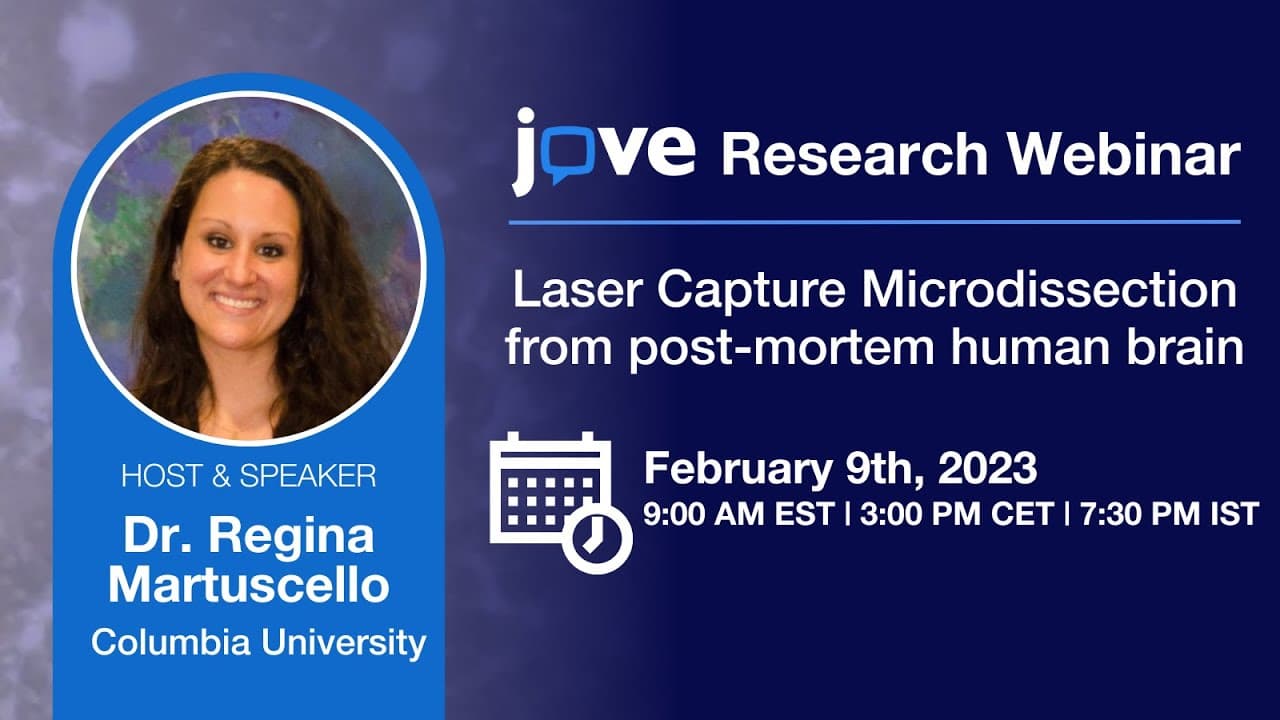
Laser Capture Microdissection from post-mortem human brain
TL;DR
Webinar on laser capture microdissection for RNA isolation from human brain.
Transcript
okay thank you for joining us today everyone um so today we have a webinar by um uh Regina martisello a um she's at Columbia University um and so so her group uh published with us a few years back um and she's going to be talking about some some recent updates in the in the technique that she published on which was um laser capture micro dissection... Read More
Key Insights
- Laser capture microdissection (LCM) uses specialized microscopes with UV lasers to isolate specific cells, such as Purkinje cells, from post-mortem human brain tissue for RNA sequencing.
- Two main types of microscopes are used: Zeiss, which uses a top-down model with a puff of air, and Leica, which employs a gravity model. Both have advantages depending on the application.
- The protocol focuses on obtaining high-quality RNA without the use of stains or dyes, relying on tissue morphology for cell identification.
- Proper preparation, including cleaning of materials and ensuring high RNA Integrity Number (RIN), is crucial for successful LCM and RNA sequencing.
- Challenges in post-mortem brain tissue include ice crystal formation, which can damage tissue morphology, and the variability in post-mortem intervals affecting RNA quality.
- Alternative staining protocols, such as using Crystal Violet or a shunted hematoxylin-eosin (H&E) protocol, can be employed if visualization is difficult without dyes.
- For proteomics, a different protocol using liquid chromatography/mass spectrometry (LC/MS) grade water and specific collection materials is required.
- Storing collected RNA samples at -80°C allows for batch processing and long-term preservation before RNA extraction.
Install to Summarize YouTube Videos and Get Transcripts
Explore YouTube Video Summarizer or Get YouTube Transcript Extractor
Questions & Answers
Q: How does laser capture microdissection work?
Laser capture microdissection (LCM) involves using specialized microscopes equipped with UV lasers to isolate specific cells from tissue samples. The technique allows for precise cutting and collection of cells, such as Purkinje cells, without the need for stains or dyes. The Zeiss microscope uses a top-down approach with a puff of air, while the Leica uses a gravity-based method.
Q: What are the key challenges in working with post-mortem human brain tissue?
Key challenges include ice crystal formation, which can damage tissue morphology, and variability in post-mortem intervals that affect RNA quality. Ice crystals form when water in the tissue expands during freezing, creating a honeycomb-like appearance that hinders visualization. Ensuring high RNA Integrity Number (RIN) is crucial for successful sequencing.
Q: What alternatives exist if visualization is difficult without dyes?
If visualization is difficult without dyes, alternative staining protocols can be employed. These include using Crystal Violet or a shunted hematoxylin-eosin (H&E) protocol. These methods enhance visualization while aiming to preserve RNA quality. However, the stainless protocol is preferred for its ability to maintain high RNA integrity.
Q: How can RNA samples be preserved for long-term storage?
RNA samples can be preserved for long-term storage by storing them at -80°C. This allows for batch processing and maintains RNA integrity before extraction. It is important to ensure that samples are properly sealed and handled to avoid degradation. The use of appropriate buffers and preservatives, such as RLT buffer with betamercaptoethanol, is recommended.
Q: What are the benefits of using a stainless protocol for RNA isolation?
The benefits of using a stainless protocol for RNA isolation include avoiding the use of stains or dyes, which can interfere with RNA quality. This approach relies on tissue morphology for cell identification, ensuring high-quality RNA suitable for sequencing. It is particularly useful for isolating rare cell populations like Purkinje cells in post-mortem brain tissue.
Q: What considerations are necessary for proteomic analysis using LCM?
For proteomic analysis using LCM, it is important to use liquid chromatography/mass spectrometry (LC/MS) grade water for all staining and fixation processes. Collection materials should be low adhesion caps filled with water, and glass slides with metal frames are preferred. Immediate laser capture after staining is recommended to preserve protein integrity.
Q: How does the Zeiss microscope differ from the Leica in LCM?
The Zeiss microscope uses a top-down model with a puff of air to propel tissue into a collection cap above the slide, while the Leica employs a gravity-based model with the collection cap below the slide. The Zeiss offers more options for UV energy and focus, and its opaque caps enhance visualization by allowing the eyepiece to view through the cap.
Q: What is the importance of RNA Integrity Number (RIN) in LCM?
The RNA Integrity Number (RIN) is crucial in LCM as it indicates the quality of RNA extracted from tissue samples. A high RIN, typically above 7, ensures that the RNA is intact and suitable for sequencing. Starting with high-quality tissue with a high RIN is essential for obtaining reliable and accurate sequencing results, especially in post-mortem brain studies.
Summary & Key Takeaways
-
Dr. Regina T. Martuscello presented a webinar on laser capture microdissection (LCM) techniques for isolating RNA from Purkinje cells in post-mortem human brain tissue, focusing on a stainless protocol that relies on tissue morphology.
-
The presentation covered the use of Zeiss and Leica microscopes, emphasizing the importance of starting with high-quality tissue and proper preparation to ensure successful RNA sequencing.
-
Challenges such as ice crystal formation and variability in post-mortem intervals were discussed, along with alternative staining protocols and considerations for proteomic analysis using LCM.
Read in Other Languages (beta)
Share This Summary 📚
Summarize YouTube Videos and Get Video Transcripts with 1-Click
Try YouTube Summary with ChatGPT & Claude or YouTube Transcript Generator