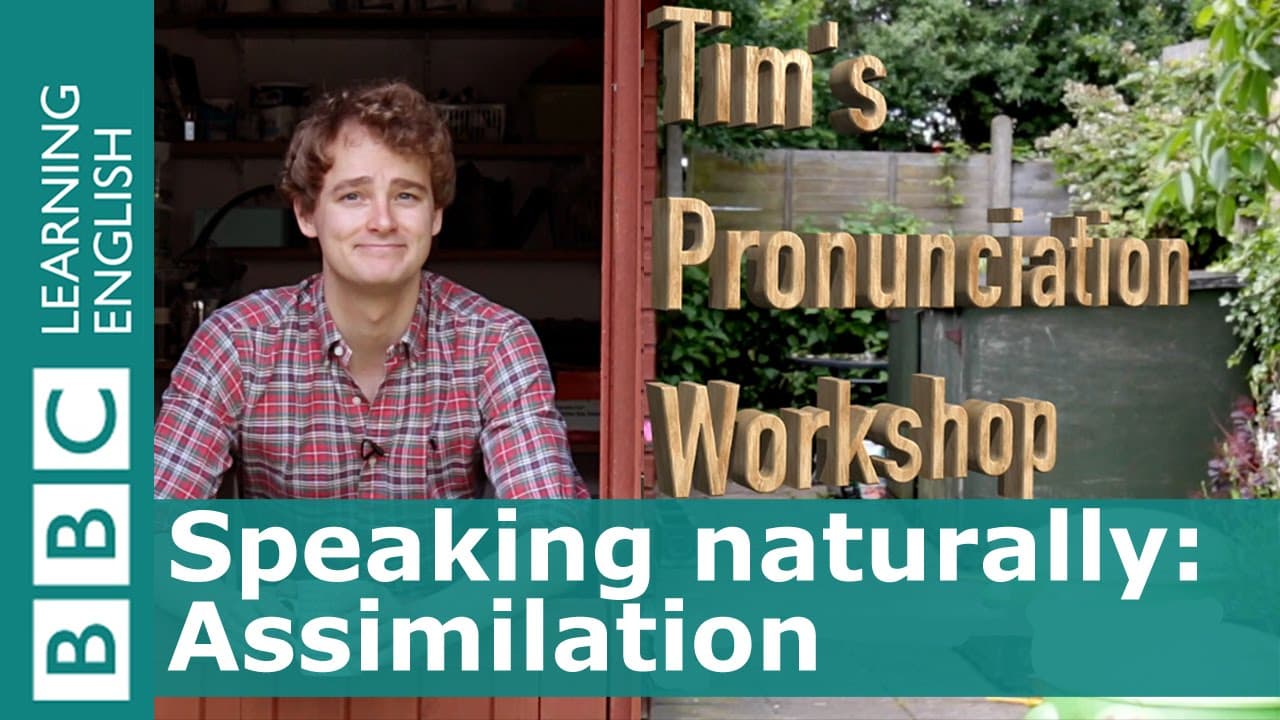
👄 Tim's Pronunciation Workshop: Assimilation of /t/ and /p/
TL;DR
Tim explains assimilation of /t/ to /p/ in English speech.
Transcript
Hi. I'm Tim and this is my Pronunciation workshop. Here I'm going to show you how English is really spoken. It'll help you become a better listener and a more fluent speaker. Come on, let's go inside. Here's a question for you: When is a tea not a tea? Well, this is the answer. What is it? And what colour is it? Let's go to the streets of London to... Read More
Key Insights
- The workshop focuses on how English sounds change in fluent speech, specifically the assimilation of /t/ to /p/.
- When a word ending in /t/ is followed by a word beginning with /p/, the /t/ sound is pronounced like a /p/.
- The example 'white piece of paper' demonstrates how 'white' is pronounced with a modified /t/ sound.
- Assimilation is a common phonetic process in everyday speech, affecting how words are heard and understood.
- Tim uses real-world examples from London streets to illustrate the concept of assimilation.
- Listeners are encouraged to practice the pronunciation change to improve their English fluency.
- The workshop is part of a series aimed at enhancing English pronunciation skills for non-native speakers.
- Additional resources and episodes are available on the BBC Learning English website for further learning.
Install to Summarize YouTube Videos and Get Transcripts
Explore YouTube Video Summarizer or Get YouTube Transcript Extractor
Questions & Answers
Q: What is the main focus of Tim's Pronunciation Workshop?
The main focus of Tim's Pronunciation Workshop is to demonstrate how English sounds change in fluent speech through the process of assimilation. Specifically, the workshop highlights how the /t/ sound in words can be modified to sound like a /p/ when followed by words beginning with /p/, as in the phrase 'white piece of paper.'
Q: How does the assimilation of /t/ to /p/ occur in speech?
Assimilation of /t/ to /p/ occurs when a word ending in the /t/ sound is immediately followed by a word starting with the /p/ sound. In fluent speech, the /t/ is not pronounced distinctly but rather takes on the characteristics of the following /p/. This results in a blending of sounds, making the /t/ sound almost like a /p/.
Q: Why is understanding assimilation important for English learners?
Understanding assimilation is crucial for English learners because it helps them comprehend and produce natural-sounding speech. Assimilation affects how words are pronounced in everyday conversation, and recognizing these changes can improve both listening skills and pronunciation accuracy, leading to more effective communication in English.
Q: What example does Tim use to illustrate assimilation?
Tim uses the example 'white piece of paper' to illustrate assimilation. In this phrase, the word 'white' ends with a /t/ sound, which is followed by 'piece' starting with a /p/ sound. In fluent speech, the /t/ is assimilated, making it sound more like a /p/, demonstrating how sounds change in natural conversation.
Q: What resources does Tim suggest for further learning?
Tim suggests visiting the BBC Learning English website for further learning resources. The website offers additional episodes of the Pronunciation Workshop series, along with various educational materials designed to help learners improve their English pronunciation, listening skills, and overall fluency.
Q: How does Tim encourage viewers to practice assimilation?
Tim encourages viewers to practice assimilation by listening to examples and repeating the phrases to mimic the pronunciation changes. This active practice helps learners internalize the sound modifications and apply them in their own speech, enhancing their ability to communicate more naturally in English.
Q: What is the significance of using real-world examples in the workshop?
Using real-world examples in the workshop is significant because it provides learners with authentic contexts in which assimilation occurs. Hearing how native speakers naturally modify sounds in everyday settings, like the streets of London, helps learners understand the practical application of pronunciation changes and prepares them for real-life communication.
Q: What additional topics are covered in the Pronunciation Workshop series?
The Pronunciation Workshop series covers a variety of topics related to English pronunciation, including the pronunciation of words like 'was' and 'were,' the linking /j/ sound, and consonant-vowel linking. These episodes provide comprehensive insights into different aspects of English phonetics, aiding learners in achieving clearer and more fluent speech.
Summary & Key Takeaways
-
Tim's Pronunciation Workshop explores the phonetic process of assimilation, where the /t/ sound in 'white' changes to a /p/ sound when followed by 'piece.' This change is common in fluent English speech, and understanding it can improve listening and speaking skills.
-
Real-world examples from London illustrate how assimilation affects pronunciation. Tim encourages viewers to practice this change themselves, offering resources for further learning on the BBC Learning English platform.
-
The episode is part of a broader series designed to help non-native speakers become more fluent and accurate in English pronunciation. Viewers can access more episodes and learning materials online to continue their language development.
Read in Other Languages (beta)
Share This Summary 📚
Summarize YouTube Videos and Get Video Transcripts with 1-Click
Try YouTube Summary with ChatGPT & Claude or YouTube Transcript Generator
Explore More Summaries from BBC Learning English 📚

Summarize YouTube Videos and Get Video Transcripts with 1-Click
Try YouTube Summary with ChatGPT & Claude or YouTube Transcript Generator