Number Systems | Decimal Number System | STLD | Lec-01
TL;DR
Switching Theory and Logic Design explores binary logic, circuits, and number systems in electronic engineering.
Transcript
hi everyone from this video I'm going to start a new subject that is switching Theory and logic design switching Theory and logic design generally Falls in second year of btech for either Triple E or EC students okay most commonly EC students are having the subject and the subject is very easy to understand but difficult to pass sometimes okay beca... Read More
Key Insights
- ⚡ Switching Theory and Logic Design introduces essential concepts in binary voltage states critical for digital electronics.
- 🎰 The transition from simple binary representations to complex configurations like finite state machines demonstrates the subject's depth.
- 🎨 Logic gates are integral to circuit design, providing the foundation for logical operations and system functions in electronics.
- #️⃣ Binary representation of decimal numbers is crucial for students to understand number systems and data manipulation in technology.
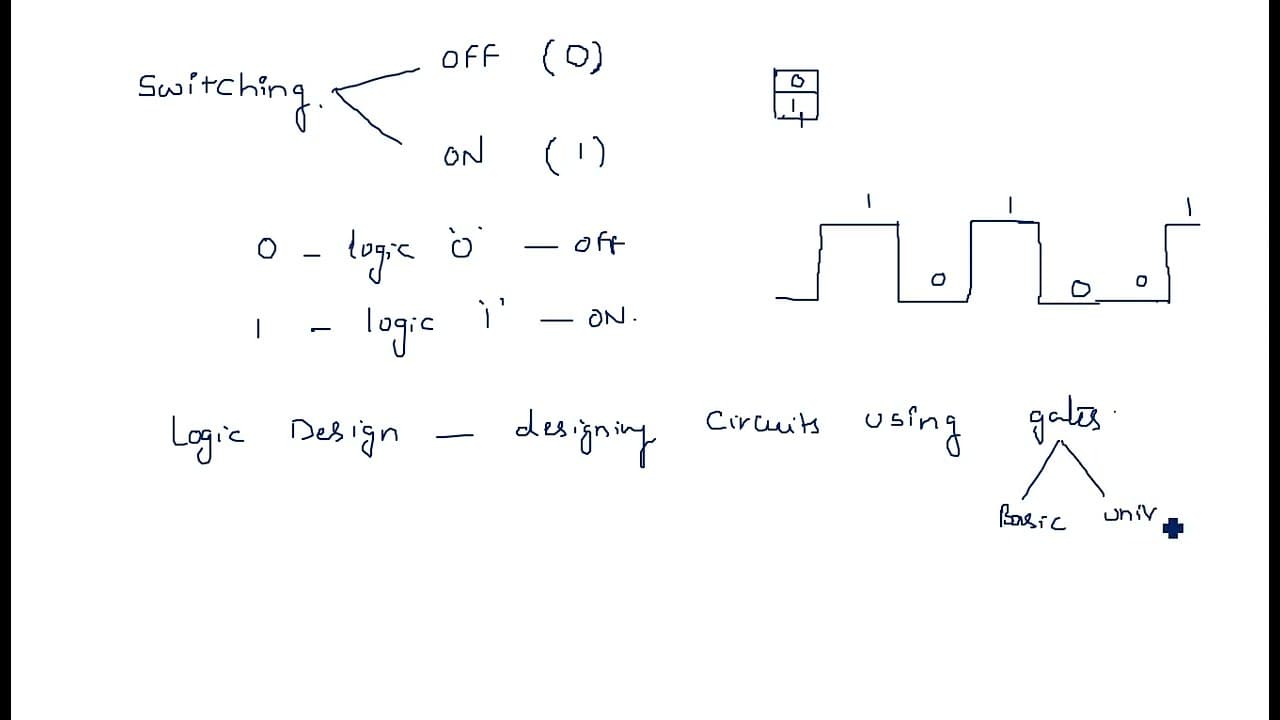
- ⌛ Understanding waveforms helps depict how binary states behave over time, which is fundamental for electronic signal processing.
- #️⃣ The course emphasizes the importance of mastering circuits and number systems to ensure success in advanced electronic topics.
- 🌍 Real-world applications of switching theory include device control systems, data processing, and electronic communication protocols.
Install to Summarize YouTube Videos and Get Transcripts
Explore YouTube Video Summarizer or Get YouTube Transcript Extractor
Questions & Answers
Q: What is the significance of switching theory in electronic devices?
Switching theory is fundamental in electronic devices as it defines how binary states (0s and 1s) allow for complex communication and data processing. Each binary digit corresponds to an electrical state in devices, enabling them to perform operations based on logical combinations of these states, which is critical for circuit design and function.
Q: How do logic gates function in switching theory?
Logic gates are the building blocks of digital circuits in switching theory. They operate based on binary inputs and produce specific outputs. For example, an AND gate outputs true (1) only if all inputs are true, whereas an OR gate outputs true if at least one input is true. Understanding how these gates interact is vital for designing complex circuits like adders and multiplexers.
Q: Can you explain the binary to decimal conversion process?
Converting binary to decimal involves evaluating the binary representation using powers of 2. Each bit in the binary number represents a power of 2, starting from the right (0th position). To convert, multiply each bit by 2 raised to its position and sum the results. For example, the binary number 1101 equals 12^3 + 12^2 + 02^1 + 12^0, resulting in 13.
Q: Why can switching theory be deemed difficult to pass?
Switching theory encompasses abstract concepts that require a strong grasp of binary logic, circuit design, and mathematical representations. Although the fundamental ideas (0s and 1s) may seem simple, applying this knowledge to real-world problems, including analyzing and designing complex circuits, often presents challenges in understanding and exam performance.
Q: What types of number systems are covered in switching theory?
The primary number systems discussed in switching theory include binary (base-2), decimal (base-10), octal (base-8), and hexadecimal (base-16). Each system has its own method of representation and conversion techniques, which are crucial for understanding how data is processed and represented in digital electronics.
Q: How do flip-flops relate to switching theory?
Flip-flops are fundamental components used in sequential circuits within switching theory, storing binary data as 0s or 1s. They maintain state based on clock signals and enable devices to perform tasks such as memory storage, data synchronization, and state machines, making them essential for designing more complex circuits.
Q: What are universal gates and why are they important?
Universal gates, such as NAND and NOR gates, can be used to create any logical function without needing other types of gates. They are important because they simplify circuit design by reducing the number of different components required. Understanding how to utilize these gates efficiently is a core aspect of logic design in switching theory.
Summary & Key Takeaways
-
Switching Theory and Logic Design is primarily studied in the second year by ECE students, focusing on binary logic (0s and 1s) and complex devices like flip-flops and counters.
-
The subject emphasizes understanding logic gates, such as AND, OR, and NOT, to design logical circuits effectively, outlining the necessary knowledge for succeeding in examinations.
-
Basic concepts include representing decimal numbers in binary, understanding waveform representations, and the importance of number systems in computing, including binary, octal, and hexadecimal systems.
Read in Other Languages (beta)
Share This Summary 📚
Summarize YouTube Videos and Get Video Transcripts with 1-Click
Try YouTube Summary with ChatGPT & Claude or YouTube Transcript Generator