Priority Encoder | Decimal to BCD | Truth Table | STLD | Lec-89
TL;DR
This video explains the function and operation of a decimal to BCD priority encoder.
Transcript
hi everyone in this video I'm going to explain about a decimal to BCD priority encoder in previous videos I have explained about decimal to BCD encoder we have seen in the earlier videos decimal to BCD encoder there we have not concentrated on the priority based okay we have taken whichever is the whichever is the um highlighted one activated the c... Read More
Key Insights
- 🔠 A decimal to BCD priority encoder efficiently encodes decimal inputs into binary output, prioritizing the highest value when inputs are activated.
- 🤩 Understanding the difference between normal and priority encoders is key for applications requiring precise binary representations, especially in digital circuit designs.
- 👻 The output of a priority encoder allows for streamlined numeric processing in digital systems, vital for tasks involving numeric calculations and data representation.
- ☢️ The active high and active low configurations in encoder design affect how inputs are interpreted, influencing practical applications and performance outcomes.
- 🚰 Truth tables illustrate how distinct activated inputs relate directly to specific binary outputs, providing clarity in understanding encoder functionality.
- 📡 The need for precision in high-priority signal processing is essential in advanced computing and digital electronics applications, especially when managing multiple active signals.
- 🌍 Real-world applications for BCD priority encoders can include integrated circuits, calculators, and various digital interfaces requiring efficiency and accuracy.
Install to Summarize YouTube Videos and Get Transcripts
Explore YouTube Video Summarizer or Get YouTube Transcript Extractor
Questions & Answers
Q: What is a priority encoder and how does it differ from a standard encoder?
A priority encoder processes multiple inputs to generate a binary output based on which input signal has the highest priority. Unlike a standard encoder, which only outputs the value of the first activated input, a priority encoder will always output the highest decimal number activated when several inputs are high, ignoring others.
Q: What is the significance of the BCD format in this encoding process?
BCD, or Binary-Coded Decimal, represents decimal numbers in binary form, where each digit is encapsulated in its own four-bit representation. This format simplifies the process of digital representation and manipulation of numeric data in computing systems, making it easier to encode decimal numbers directly without conversion to binary.
Q: How does the truth table for a decimal to BCD priority encoder function?
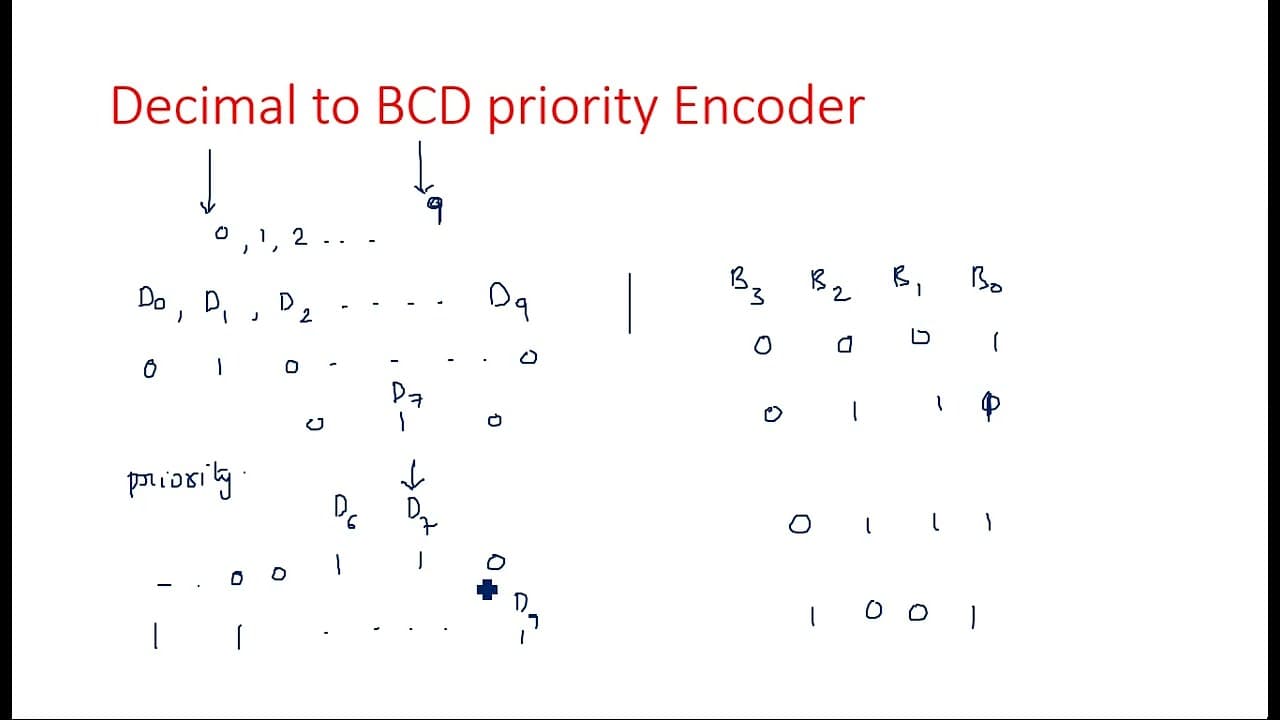
The truth table outlines the relationship between activated decimal inputs (D0-D9) and their corresponding BCD outputs (B0-B3). Each entry shows the output depending on which input is activated, with priority given to higher decimal numbers when multiple inputs are active, ensuring only one binary code is output based on the highest input.
Q: Can you explain the output expressions for the BCD outputs based on the inputs?
Output expressions for BCD outputs, like B3 and B2, depend on combinations of activated inputs. For example, B3 is true when D8 or D9 is activated, while B2 is true for D4 through D7. This logical structure allows for efficient representation and prioritization of activated inputs to generate the correct BCD output.
Summary & Key Takeaways
-
The video introduces the concept of a decimal to BCD (Binary-Coded Decimal) priority encoder, highlighting its differences from a regular encoder by emphasizing priority in output selection based on activated inputs.
-
It discusses the functional design, detailing the input range (0-9) and the output format that compresses decimal numbers into a four-bit binary format based on which input has higher priority when multiple are activated.
-
The presentation also includes the creation of truth tables to illustrate how the highest activated decimal input determines the corresponding binary output and explains the logic behind setting expressions for each binary output bit.
Read in Other Languages (beta)
Share This Summary 📚
Summarize YouTube Videos and Get Video Transcripts with 1-Click
Try YouTube Summary with ChatGPT & Claude or YouTube Transcript Generator