What IS Angular Momentum?
TL;DR
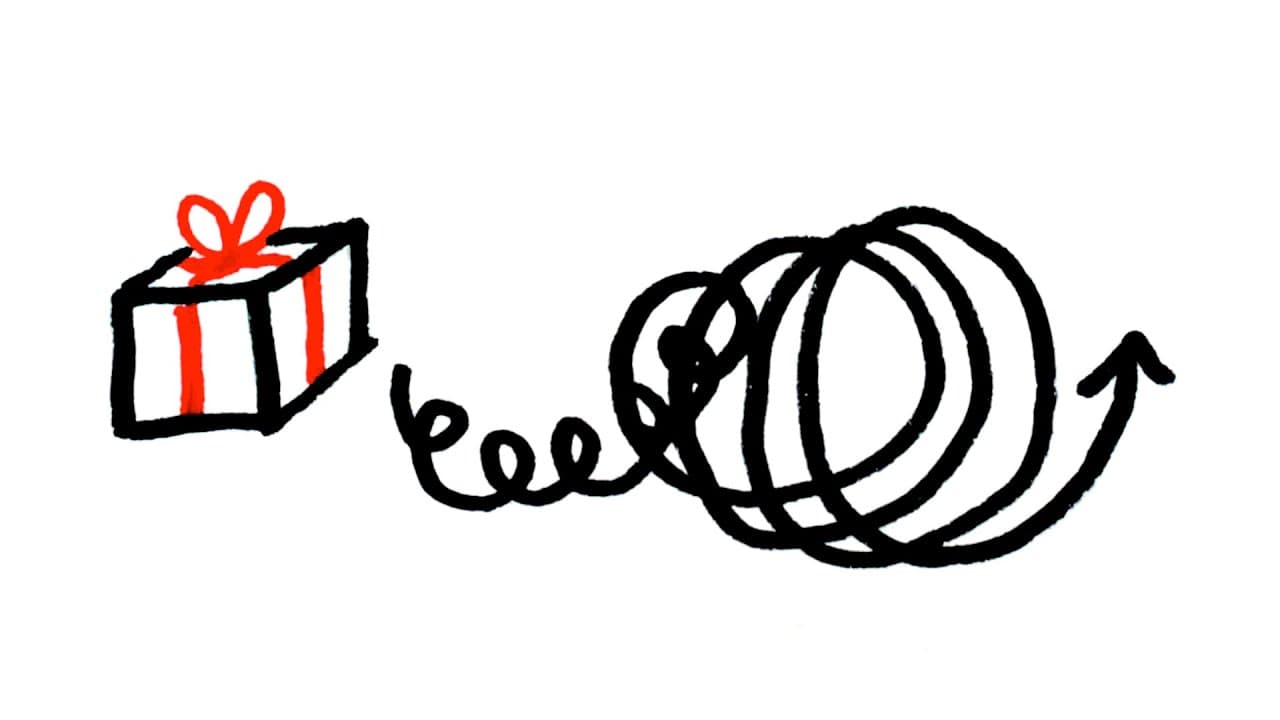
Angular momentum is a concept that describes the oomph objects have when they move in circles, and it remains constant even when they appear to not move at all.
Transcript
Physics, at its most basic, is just a description of the motion of the stuff in our universe. “This planet goes this way, that rocket goes that way” – except that some – in fact, many – objects move without moving. Or, more precisely, they move without going anywhere. I’m talking objects that spin, revolve, rotate, pirouette, orbit, circle, gyrate,... Read More
Key Insights
- ❓ Physics describes the motion of objects in the universe, including objects that seemingly do not move.
- 📐 Angular momentum is a concept that accounts for the oomph objects have when they move in circles.
- 🖐️ The total angular momentum of interacting objects remains constant unless external factors come into play.
- 📐 Gravitational interactions contribute to the conservation of angular momentum.
- 📐 Even in the absence of rotation, angular momentum is still conserved.
- ⭕ Calculating angular momentum involves considering an object's speed along the circle, the size of the circle, and the object's mass.
- 🥹 The conservation of angular momentum holds true in both literal and figurative circle-like motions.
Install to Summarize YouTube Videos and Get Transcripts
Explore YouTube Video Summarizer or Get YouTube Transcript Extractor
Questions & Answers
Q: What is angular momentum and how is it different from linear momentum?
Angular momentum is a concept that describes the oomph objects have when they move in circles, while linear momentum describes the oomph objects have when they move in straight lines. Linear momentum depends on an object's mass and velocity, while angular momentum depends on an object's mass, velocity along the circle, and the size of the circle.
Q: How is angular momentum related to the gravitational interactions between objects?
When objects interact gravitationally, their individual angular momenta can be added up to obtain a total angular momentum. This total angular momentum remains constant over time unless external objects interfere. Therefore, even if the sun and the rest of the solar system were to disappear suddenly, the earth would still have the same angular momentum about the point where the sun was located.
Q: Can you provide an example of calculating angular momentum?
Sure! Let's consider a 2-kilogram bicycle wheel with a diameter of 60 cm moving at 20 km per hour. The angular momentum can be calculated by multiplying the speed along the circle by the size of the circle (diameter), the mass of the object, and the units of kilogram meters squared per second. In this example, the angular momentum would be approximately 7 kilogram meters squared per second.
Q: What happens to angular momentum when an object is not rotating?
Even when objects are not rotating at all, angular momentum is still conserved. This means that the total angular momentum of a system remains constant, even if individual objects within the system are not rotating. The beauty of the conservation of angular momentum lies in its ability to hold true regardless of an object's rotation status.
Summary & Key Takeaways
-
Physics describes the motion of objects in our universe, including objects that appear to move without going anywhere.
-
Angular momentum is a way to account for the oomph objects have when they move in circles, whether literally or figuratively.
-
The total angular momentum of interacting objects remains constant over time unless external factors interfere.
Read in Other Languages (beta)
Share This Summary 📚
Summarize YouTube Videos and Get Video Transcripts with 1-Click
Try YouTube Summary with ChatGPT & Claude or YouTube Transcript Generator
Explore More Summaries from minutephysics 📚




Summarize YouTube Videos and Get Video Transcripts with 1-Click
Try YouTube Summary with ChatGPT & Claude or YouTube Transcript Generator