Products
Features
YouTube Video Summarizer
Summarize YouTube videos
Web & PDF Highlighter
Highlight web pages & PDFs
Chat with PDF
Ask any PDF questions with AI
Ask AI Clone
Chat with your highlights & memories
Audio Transcriber
Transcribe audio files to text
Glasp Reader
Read and highlight articles
Kindle Highlight Export
Export your Kindle highlights
Idea Hatch
Hatch ideas from your highlights
Integrations
Obsidian Plugin
Notion Integration
Pocket Integration
Instapaper Integration
Medium Integration
Readwise Integration
Snipd Integration
Hypothesis Integration
Apps & Extensions
Chrome Extension
Safari Extension
Edge Add-ons
Firefox Add-ons
iOS App
Android App
Discover
Discover
Ideas
Discover new ideas and insights
Articles
Curated articles and insights
Books
Book recommendations by great minds
Posts
Essays and notes from readers
Quotes
Inspiring quotes collection
Videos
Curated videos and summaries
Explore Glasp
Glasp Newsletter
Weekly insights and updates
Glasp Talk
Interview series with great minds
Glasp Blog
Latest news and articles
Glasp Use Cases
Learn how others use Glasp
Build & Support
Glasp API
Access Glasp's API for developers
MCP Connector
Connect Glasp to Claude & ChatGPT
Community
Glasp Reddit Community
Students
Student discount and benefits
FAQs
Frequently Asked Questions
AboutPricing
DashboardLog inSign up

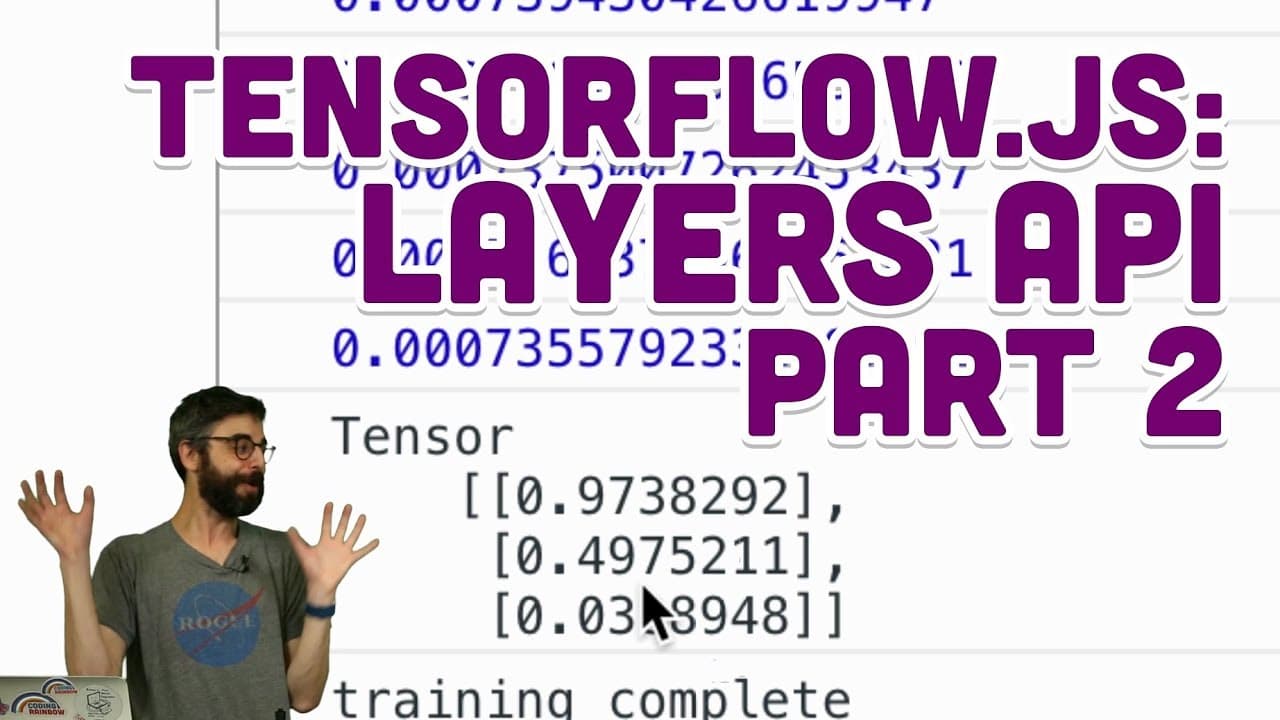
6.6: TensorFlow.js: Layers API Part 2 - Intelligence and Learning
34.6K views
•
June 6, 2018
by
The Coding Train
YouTube video player
6.6: TensorFlow.js: Layers API Part 2 - Intelligence and Learning

TL;DR

Training and predicting with TensorFlow.js Layers API using dummy data, asynchronous functions, and configuring model parameters.

Transcript

all right welcome to tend to flow dais the layers API tutorial part 2 so previous previously on its flow test layers API part 1 I created this model using TF dot sequential TF layers and model dot compile with with a training without with a loss function and an optimizer now let's just review that really quickly before I go on to the next step whic... Read More

Key Insights

  • 🌸 Understanding the TensorFlow.js Layers API involves creating a model structure, defining layers, and configuring loss function and optimizer.
  • 🔀 Model training with the fit function requires input data and corresponding output, with parameters like epochs and shuffle enhancing training efficiency.
  • ❓ Asynchronous nature of JavaScript functions is managed using await and async keywords, ensuring sequential execution of tasks.
  • ☠️ Configurable training parameters like batch size, epochs, and learning rate impact model training performance and convergence.

Install to Summarize YouTube Videos and Get Transcripts

Explore YouTube Video Summarizer or Get YouTube Transcript Extractor

Questions & Answers

Q: How do you create a model with TensorFlow.js Layers API?

To create a model, you add layers using dense and other types, define a loss function, and choose an optimizer for training.

Q: What is the purpose of the fit function in TensorFlow.js?

The fit function is used to train the model by adjusting weights based on input data (X) and corresponding output (Y), optimizing model performance.

Q: How does the shuffle parameter impact model training?

Setting shuffle to true in fit function shuffles the input data for every epoch, preventing the model from learning the order of data and improving training.

Q: What role does the await keyword play in asynchronous functions?

The await keyword helps in handling asynchronous tasks by pausing code execution until a promise is resolved, ensuring sequential operations in JavaScript.

Summary & Key Takeaways

  • Walkthrough of creating a model with TensorFlow.js Layers API, adding layers, loss function, and optimizer.

  • Training the model with dummy data, exploring fit function, configuring training parameters, and handling asynchronous workflow.

  • Predicting outcomes using model.predict, addressing issues, and optimizing training through shuffle and epochs.


Read in Other Languages (beta)

English

Share This Summary 📚

Summarize YouTube Videos and Get Video Transcripts with 1-Click

Download browser extensions on:

Try YouTube Summary with ChatGPT & Claude or YouTube Transcript Generator

Explore More Summaries from The Coding Train 📚

ITP/IMA Winter Show 2019 thumbnail
ITP/IMA Winter Show 2019
The Coding Train
8.1: Fractals - The Nature of Code thumbnail
8.1: Fractals - The Nature of Code
The Coding Train
9.4: Genetic Algorithm: Looking at Code - The Nature of Code thumbnail
9.4: Genetic Algorithm: Looking at Code - The Nature of Code
The Coding Train
Classifying Poses with ml5.js Part 2 thumbnail
Classifying Poses with ml5.js Part 2
The Coding Train
Coding Challenge #126: Toothpicks thumbnail
Coding Challenge #126: Toothpicks
The Coding Train
Computer Mouse Conference Demos! (node.js + tensorflow.js) thumbnail
Computer Mouse Conference Demos! (node.js + tensorflow.js)
The Coding Train

Summarize YouTube Videos and Get Video Transcripts with 1-Click

Download browser extensions on:

Try YouTube Summary with ChatGPT & Claude or YouTube Transcript Generator

Apps & Extensions

  • Chrome Extension
  • Safari Extension
  • Edge Add-ons
  • Firefox Add-ons
  • iOS App
  • Android App

Key Features

  • YouTube Video Summarizer
  • Web & PDF Summarizer
  • Web & PDF Highlighter
  • Chat with PDF
  • Ask AI Clone
  • Audio Transcriber
  • Glasp Reader
  • Kindle Highlight Export
  • Idea Hatch

Integrations

  • Obsidian Plugin
  • Notion Integration
  • Pocket Integration
  • Instapaper Integration
  • Medium Integration
  • Readwise Integration
  • Snipd Integration
  • Hypothesis Integration

More Features

  • APIs
  • MCP Connector
  • Blog & Post
  • Embed Links
  • Image Highlight
  • Personality Test
  • Quote Shots

Company

  • About us
  • Blog
  • Community
  • FAQs
  • Job Board
  • Newsletter
  • Pricing
Terms

•

Privacy

•

Guidelines

© 2026 Glasp Inc. All rights reserved.