L26.7 Expected Time to Absorption
TL;DR
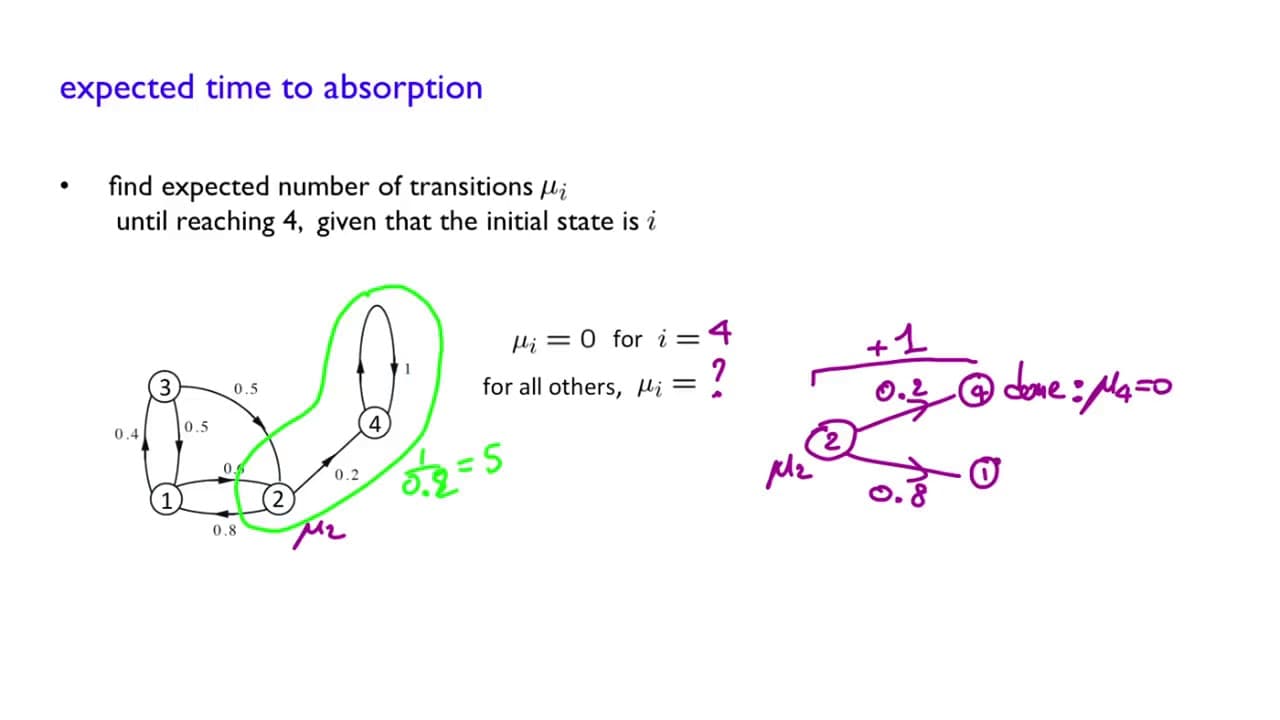
The video explains how to calculate the expected number of transitions to reach an absorbing state in a Markov chain.
Transcript
In this video, let us look at a second quantity of interest that has to do with absorbing states. Now that we know how to calculate the probability of getting to a given absorbing state, we would like to know how long it would take to get to it. Let us first deal with that question when we have only one absorbing state. Let us consider the followin... Read More
Key Insights
- ⛓️ Markov chains can have absorbing states, which are states that once reached, the system remains in indefinitely.
- ⌛ The expected time to reach an absorbing state in a Markov chain can be calculated by solving a system of linear equations.
- ⌛ The expected time to absorption may vary depending on the starting state, as the number of transitions required can differ.
- ⌛ By combining multiple absorbing states into one mega state, the expected time to any absorbing state can be calculated.
Install to Summarize YouTube Videos and Get Transcripts
Explore YouTube Video Summarizer or Get YouTube Transcript Extractor
Questions & Answers
Q: What is an absorbing state in a Markov chain?
An absorbing state in a Markov chain is a state from which there is no possibility of moving to any other state. Once reached, the system remains in the absorbing state indefinitely.
Q: How is the expected time to reach an absorbing state calculated?
The expected time to absorption is calculated by solving a system of equations. Each equation represents the expected number of transitions from a given state until reaching the absorbing state, conditioned on the starting state.
Q: Can the expected time to absorption be different depending on the starting state?
Yes, the expected time to absorption can vary depending on the starting state. Different starting states may result in different random variables representing the number of transitions until reaching the absorbing state.
Q: What technique is used to calculate the expected time to absorption?
The technique used to calculate the expected time to absorption involves building a tree of possible transitions from each state and using the total expectation theorem to combine the results.
Summary & Key Takeaways
-
The video introduces the concept of absorbing states in Markov chains and focuses on calculating the expected time to reach an absorbing state.
-
The expected time to reach an absorbing state is defined as the expected number of transitions until reaching that state.
-
The video demonstrates the calculation of the expected time to absorption for a simple Markov chain with one absorbing state.
Read in Other Languages (beta)
Share This Summary 📚
Summarize YouTube Videos and Get Video Transcripts with 1-Click
Try YouTube Summary with ChatGPT & Claude or YouTube Transcript Generator
Explore More Summaries from MIT OpenCourseWare 📚



Summarize YouTube Videos and Get Video Transcripts with 1-Click
Try YouTube Summary with ChatGPT & Claude or YouTube Transcript Generator