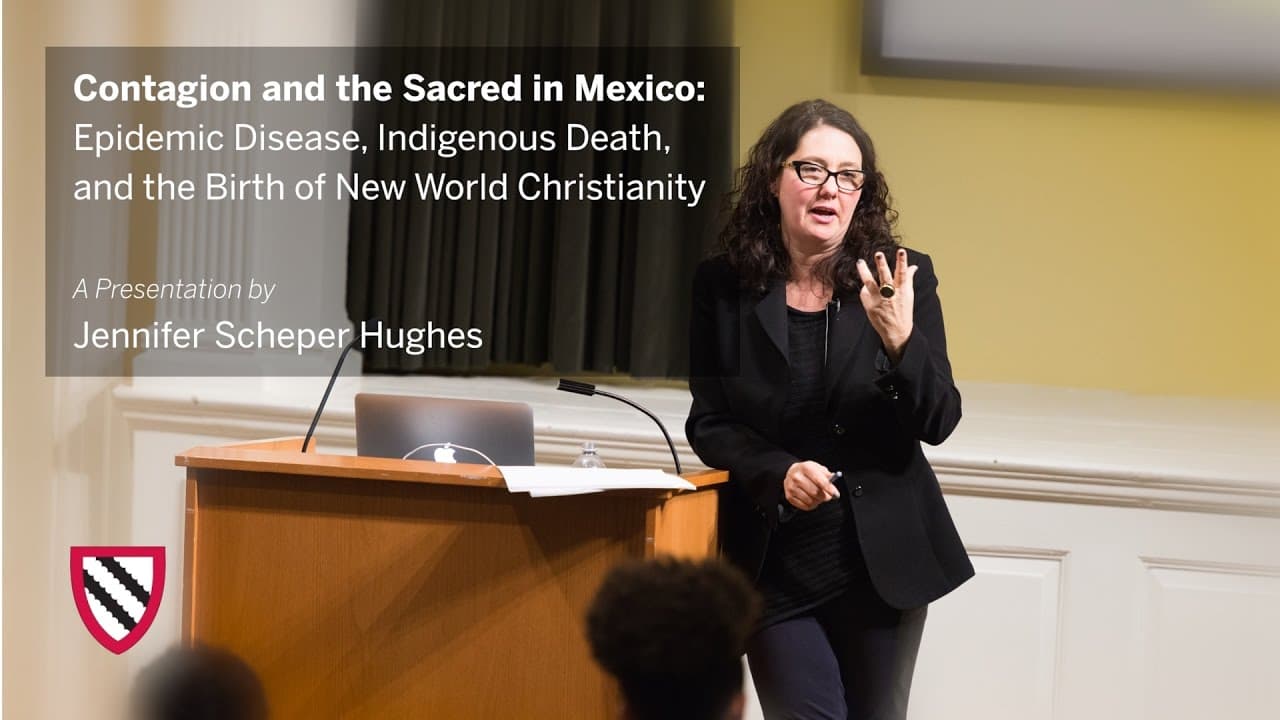
Jennifer Scheper Hughes | Contagion and the Sacred in Mexico || Radcliffe Institute
TL;DR
This analysis delves into the aftermath of the 16th century mortality crisis, examining how it shaped the Christian imagination in Mexico and the resilience shown by indigenous Christian communities in the face of collapse and catastrophe.
Transcript
- Thank you very much, Judy. And thank you all of you beautiful people for being here today. I want to begin by just offering my thanks and my gratitude to the Radcliffe, really an extraordinary opportunity, I think we all feel, to have our work honored in this way and to really discover what these projects are. And so in that spirit, most of what ... Read More
Key Insights
- 💋 The mortality crisis in the 16th century marked a cataclysmic event that shaped both geological and religious landscapes, as well as indigenous cartography.
- 😑 The Christian church emerged as a salvaged religion, redefining itself as the Ecclesia ex Mortuis in relation to the death event and collapse of indigenous communities.
- 🧑🚒 Indigenous Christian communities showed resilience and fought to conserve their faith amidst the devastation, projecting themselves into a Christian future within their local landscapes.
Install to Summarize YouTube Videos and Get Transcripts
Explore YouTube Video Summarizer or Get YouTube Transcript Extractor
Questions & Answers
Q: How did the mortality crisis in the 16th century shape the Christian imagination in Mexico?
The mortality crisis led to the emergence of the Ecclesia ex Mortuis, a salvaged religion that oriented itself in relation to the death event. The Christian church had to redefine itself after witnessing the depopulation and collapse of indigenous communities.
Q: How did indigenous Christian communities respond to the mortality crisis?
Indigenous Christian communities fought to conserve their faith in the wake of the crisis. They mapped Christian symbols onto their local cosmological imagination, creating a projection of local communities into the future within a Christian landscape. This represented a proffered covenant for a way forward amidst the devastation.
Q: How did the Christian church shape itself after the mortality crisis?
The church retreated from indigenous communities and focused on consolidating its personnel in urban areas. The rise of Baroque Christianity and the origins of Mestizo Christianity were influenced by this reconstitution of the Christian church after the collapse.
Q: How did the mortality crisis affect the perception of roads and landscapes in Mexico?
The mortality crisis led to the perception of roads as empty and abandoned, symbolizing the loss of the indigenous population. Indigenous communities mapped Christian architecture and symbols onto their local landscapes, representing a sovereign Christianity bounded territorially within the altepetl, the ethnic state.
Summary & Key Takeaways
-
The 16th century mortality crisis in Mexico led to a near extermination of the indigenous population and marked the beginning of the Anthropocene, the era dominated by human impact on climate and the environment.
-
The Christian church, referred to as the Ecclesia ex Mortuis, emerged from the disaster of colonialism and collapse as a salvaged religion, reshaping its identity and defining itself in relation to the death event.
-
Indigenous Christian communities fought to conserve their faith and reconstitute themselves amidst the devastation, as the mendicant orders retreated from missionary efforts.
Read in Other Languages (beta)
Share This Summary 📚
Summarize YouTube Videos and Get Video Transcripts with 1-Click
Try YouTube Summary with ChatGPT & Claude or YouTube Transcript Generator
Explore More Summaries from Harvard University 📚



Summarize YouTube Videos and Get Video Transcripts with 1-Click
Try YouTube Summary with ChatGPT & Claude or YouTube Transcript Generator