The Lost Penis Enigma
TL;DR
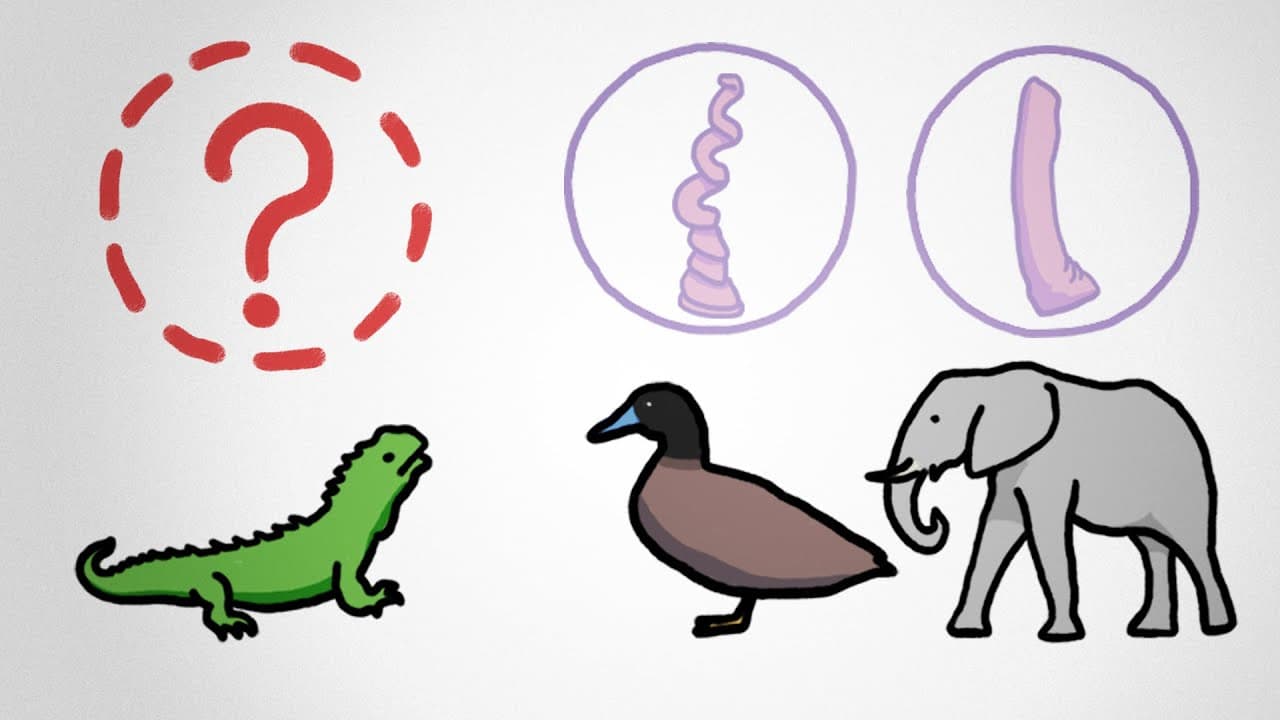
The diversity of penises in mammals, birds, and reptiles raises the question of whether they arose multiple times through convergent evolution or have a common origin.
Transcript
Hi this is David from MinuteEarth, and this is the evolutionary tree of mammals, birds and reptiles, the animals collectively known as the amniotes. And these are their penises. As you can see, these sperm delivery devices are incredibly diverse: from the snake with its hemipenes, to the lake duck with its giant corkscrew, to the echidna with its f... Read More
Key Insights
- 🤑 The amniote penis is incredibly diverse, ranging from snakes with hemipenes to ducks with corkscrew-shaped ones.
- 🌲 The amniote penis may have arisen through convergent evolution in different branches of the evolutionary tree.
- 🐦 Clues from embryonic development suggest a common origin for amniote penises, as even penis-less birds have embryonic penis nubs.
- ❓ Tuataras, a protected reptile species, were confirmed to have embryonic penis nubs, providing further evidence of a common genesis for amniote penises.
- 🍸 Some amniotes, like humans, temporarily develop tails and penises during embryonic development, only for them to regress later.
- 📔 The book "Phallacy: Life Lessons from the Animal Penis" explores the evolutionary history and diversity of penises across various animal species.
- 🛟 Penises with many features serve specific reproductive functions, while featureless penises occur in species that go through extensive pre-mating behaviors.
Install to Summarize YouTube Videos and Get Transcripts
Explore YouTube Video Summarizer or Get YouTube Transcript Extractor
Questions & Answers
Q: Are penises the result of convergent evolution or a common origin?
The diversity of penises in amniotes led to a debate over whether they evolved independently or have a single origin. Clues from embryonic development suggest a common origin.
Q: Do all amniotes have some version of a penis during embryonic development?
While many penis-less birds had embryonic penis nubs, tuataras, a protected reptile species, remained a mystery. Recently, slides of embryonic tuataras confirmed the presence of a penis nub, supporting a common genesis for amniote penises.
Q: How did some amniotes lose their penises while others evolved different variations?
Some amniotes, like humans, lose their tails during development, similarly to how some lose their penises. Others, like snakes or ducks, evolved unique penises with adaptations for specific reproductive behaviors.
Q: What is the significance of the book "Phallacy: Life Lessons from the Animal Penis"?
The video is partially based on the book "Phallacy," which explores the fascinating world of animal penises and provides insights into the evolutionary history and diversity of penises across species.
Summary & Key Takeaways
-
The amniote penis is incredibly diverse, with various animals having different types of penises or lacking them altogether.
-
The question arises as to whether the amniote penis evolved independently multiple times or has a single origin.
-
Clues from embryonic development suggest a common origin for amniote penises, with some animals losing them while others evolved different variations.
Read in Other Languages (beta)
Share This Summary 📚
Summarize YouTube Videos and Get Video Transcripts with 1-Click
Try YouTube Summary with ChatGPT & Claude or YouTube Transcript Generator
Explore More Summaries from MinuteEarth 📚



Summarize YouTube Videos and Get Video Transcripts with 1-Click
Try YouTube Summary with ChatGPT & Claude or YouTube Transcript Generator