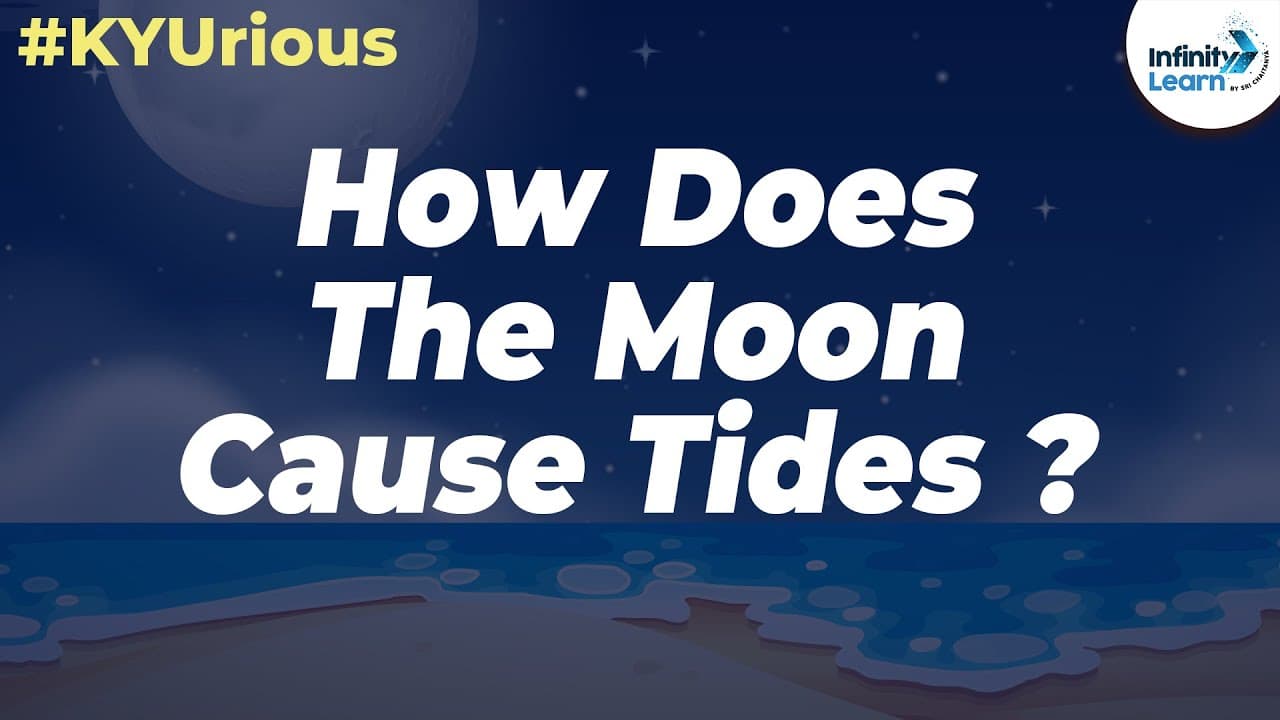
KYU Box Season 3 | Qpisode 5 | How does the Moon cause Tides?| Don't Memorise
TL;DR
Tides are caused by the gravitational force of the moon, leading to the rise and fall of sea levels.
Transcript
why wasn't the moon hungry because it was full have you ever spent a day at the beach if yes then you must have observed the variations in the level of the sea near the shore this periodic rise and fall of sea levels are called tides when the water rises to its highest level covering much of the shore it's called a high tide and when the water fall... Read More
Key Insights
- 🥮 Tides occur due to the gravitational force of the moon pulling on the earth's oceans.
- 😚 The moon's closer proximity to certain regions of the earth leads to stronger gravitational pull and higher tides.
- 😘 The movement of water from high tide regions creates low tide regions.
- 🥳 Tides change throughout the day due to the earth's rotation.
- 😑 The sun also contributes to tidal forces, although to a lesser extent than the moon.
- 😎 Tides can vary in intensity depending on the alignment of the sun, moon, and earth.
- 😘 High tides and low tides have different effects on coastal ecosystems and human activities.
Install to Summarize YouTube Videos and Get Transcripts
Explore YouTube Video Summarizer or Get YouTube Transcript Extractor
Questions & Answers
Q: What causes tides?
Tides are primarily caused by the gravitational force of the moon, which attracts the earth's oceans and creates high and low tides.
Q: How does the moon's gravitational pull affect tides?
The moon's gravitational pull is stronger on the side of the earth closer to it, resulting in high tides, while the gravitational pull is weaker on the opposite side, causing low tides.
Q: Do tides occur only once a day?
No, there are typically two high tides and two low tides during a day due to the rotation of the earth, causing the regions experiencing tides to change.
Q: Does the sun also influence the formation of tides?
Yes, the sun also exerts a gravitational pull on the earth, but its effect on tides is smaller compared to the moon's. The combined influence of the sun and moon can cause more extreme tides during certain phases.
Summary & Key Takeaways
-
Tides are the periodic rise and fall of sea levels, with high tides when the water covers much of the shore and low tides when the shore is exposed.
-
Tides are primarily caused by the gravitational force of the moon, which exerts a pull on the earth's oceans.
-
The moon's gravitational pull is stronger on the sides of the earth closer to it, leading to high tides, while low tides are formed when water rushes out from high tide regions.
Read in Other Languages (beta)
Share This Summary 📚
Summarize YouTube Videos and Get Video Transcripts with 1-Click
Try YouTube Summary with ChatGPT & Claude or YouTube Transcript Generator
Explore More Summaries from Infinity Learn NEET 📚

Summarize YouTube Videos and Get Video Transcripts with 1-Click
Try YouTube Summary with ChatGPT & Claude or YouTube Transcript Generator