Maximize Your Leg Press Gains: Key Foot Position Tips
TL;DR
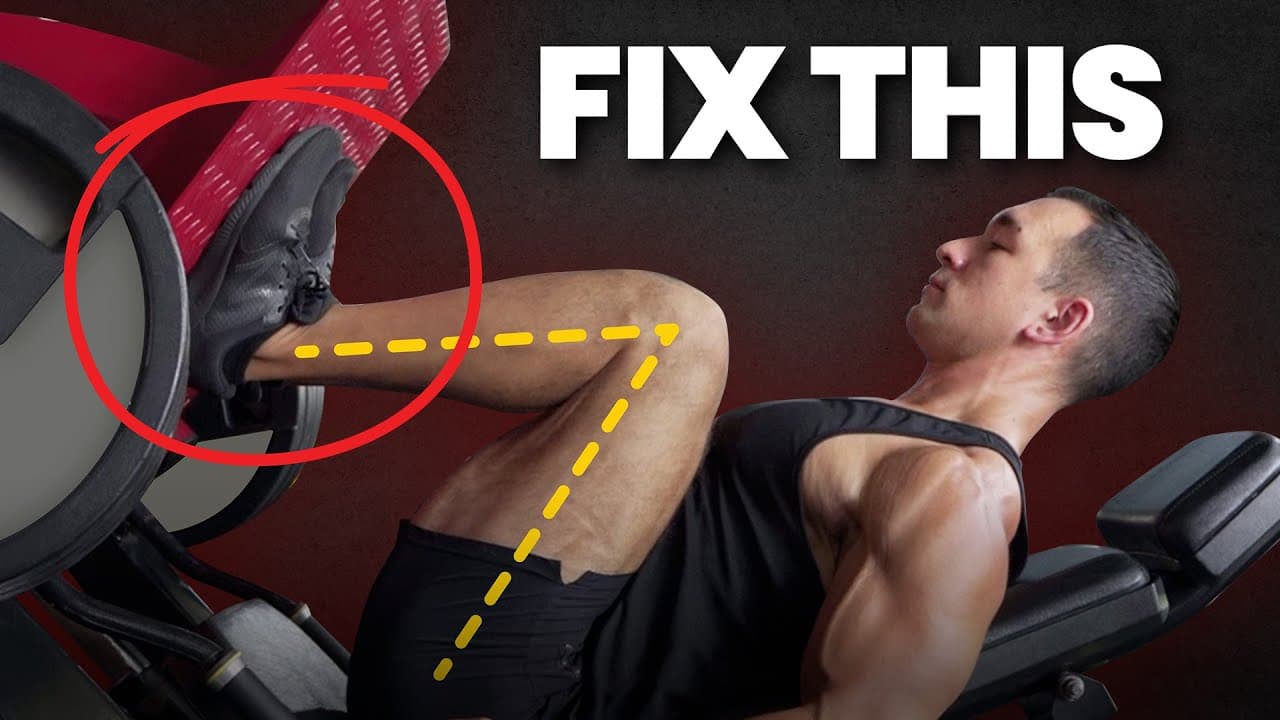
To optimize leg press effectiveness, adjust your foot positioning based on the muscle group you want to target. A lower foot placement emphasizes quads, while a narrower stance enhances glute activation. For adductor focus, use a wider stance with toes pointed out. Remember, to effectively train hamstrings, include dedicated exercises like leg curls instead of relying on the leg press.
Transcript
Just squat, bro. You'll always see at least one person who leaves that exact comment anytime someone posts content related to the leg press. And while basic freeeight squatting variations are still highly effective when it comes to lower body training, machine exercises like the leg press are perfectly viable options as well. In fact, if your prima... Read More
Key Insights
- Machine exercises like the leg press are effective for muscle hypertrophy due to their stability and ability to target specific muscles without balance concerns.
- Foot positioning on the leg press can shift emphasis between different muscle groups, such as quads, glutes, and adductors.
- The leg press is not effective for targeting hamstrings due to their dual-joint function, requiring exercises like leg curls for significant growth.
- Using a wide stance with toes pointed outward on the leg press emphasizes the adductors, beneficial for building inner thigh muscles.
- Narrow foot placement higher on the sled targets the glutes by maximizing hip extension during the leg press.
- Lower foot placement on the sled increases knee flexion and extension, emphasizing the quads during leg press exercises.
- Performing single-leg leg presses can increase hip flexion, allowing for a deeper range of motion and better muscle engagement.
- Using lighter weights with lower foot placement can reduce lower back stress while still effectively targeting the quads.
Install to Summarize YouTube Videos and Get Transcripts
Explore YouTube Video Summarizer or Get YouTube Transcript Extractor
Questions & Answers
Q: How does foot positioning affect muscle targeting on the leg press?
Foot positioning on the leg press significantly impacts which muscles are targeted. A wide stance with toes pointed outward emphasizes the adductors, while a narrow stance with feet higher on the sled targets the glutes. Lower foot placement increases knee flexion and extension, focusing on the quads. Adjusting foot position allows for targeted muscle engagement, enhancing workout effectiveness.
Q: Why is the leg press not effective for hamstring growth?
The leg press is not effective for hamstring growth because the hamstrings act on two joints, the knee and hip, simultaneously. During a leg press, the hamstrings experience minimal change in length, resulting in insufficient tension for growth. Effective hamstring exercises involve knee flexion or hip extension with fixed positions, such as leg curls or Romanian deadlifts.
Q: How can the leg press be used to target the adductors?
To target the adductors on the leg press, use a wide stance with your feet positioned around the middle of the sled and toes pointed outward. This positioning places the adductors, particularly the adductor magnus, in a strong position to move the weight, effectively engaging them during the exercise for muscle growth.
Q: What is the best foot position on the leg press for targeting glutes?
For targeting the glutes on the leg press, place your feet higher on the sled with a narrow stance, about hip-width apart. This position maximizes hip extension, which is the primary function of the glute muscles. Although the range of motion may be shorter, it effectively engages the glutes for growth.
Q: How does lower foot placement on the leg press benefit quad targeting?
Lower foot placement on the sled during the leg press increases knee flexion and extension, effectively targeting the quads. This position allows for a more focused engagement of the quads, enhancing muscle activation. Additionally, using lighter weights with this placement can reduce lower back stress while still achieving significant quad engagement.
Q: What advantages does single-leg leg pressing offer?
Single-leg leg pressing offers the advantage of increased hip flexion, allowing for a deeper range of motion. This deeper engagement enhances muscle activation and can lead to better overall muscle development. Additionally, focusing on one leg at a time can help address muscle imbalances and improve unilateral strength and coordination.
Q: Why is it important to not sacrifice range of motion for heavier weights on the leg press?
Sacrificing range of motion for heavier weights on the leg press can compromise muscle engagement and growth. Full range of motion ensures that muscles are effectively lengthened and shortened, maximizing tension and hypertrophy. Prioritizing controlled movements with appropriate weight allows for better muscle activation and reduces the risk of injury.
Q: What resources are available for a comprehensive muscle-building program?
For a comprehensive muscle-building program, the Train Wise app offers step-by-step training plans, exercise selection, and execution guidance for every muscle group. It also provides customized nutrition targets, progress tracking tools, and community support. This app is designed to optimize muscle growth and efficiency in training, making it a valuable resource for fitness enthusiasts.
Summary & Key Takeaways
-
The leg press is a valuable machine exercise for muscle growth, offering stability and the ability to target specific muscles without balance issues. Foot positioning is crucial in shifting emphasis between quads, glutes, and adductors, while targeting hamstrings requires different exercises.
-
Wide stance with outward-pointed toes on the leg press emphasizes adductors, beneficial for building inner thighs. Narrow foot placement higher on the sled targets glutes by maximizing hip extension, while lower foot placement emphasizes quads through increased knee flexion and extension.
-
Single-leg leg presses allow for a deeper range of motion, enhancing muscle engagement. Lighter weights with lower foot placement reduce lower back stress but still effectively target quads. A comprehensive program with exercise selection and nutrition guidance is available via the Train Wise app.
Read in Other Languages (beta)
Share This Summary 📚
Summarize YouTube Videos and Get Video Transcripts with 1-Click
Try YouTube Summary with ChatGPT & Claude or YouTube Transcript Generator
Explore More Summaries from Sean Nalewanyj 📚
Summarize YouTube Videos and Get Video Transcripts with 1-Click
Try YouTube Summary with ChatGPT & Claude or YouTube Transcript Generator