What Are Partition Numbers and Euler's Pentagonal Theorem?
TL;DR
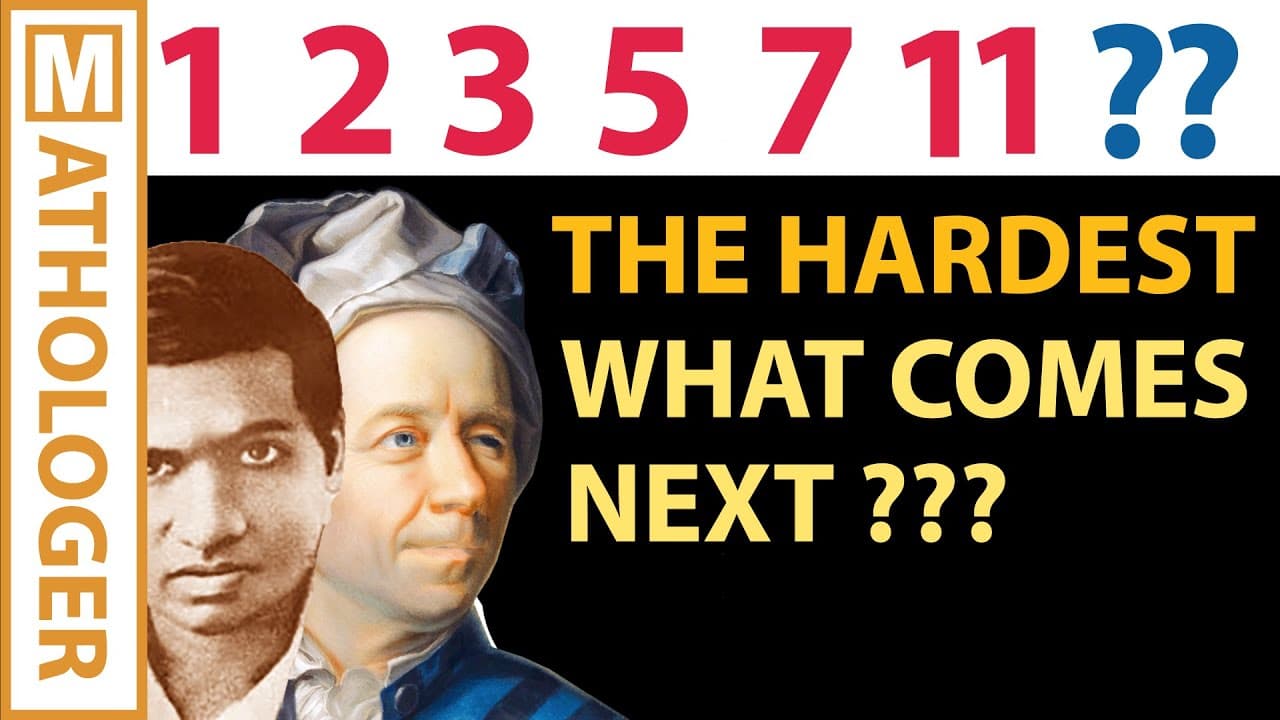
Partition numbers represent the different ways to express a positive integer as a sum of other positive integers. Euler's pentagonal number theorem identifies connections between odd and even distinct partitions, showing that their difference is zero for non-pentagonal numbers but one for pentagonal numbers. A recursive formula can calculate partition numbers using previous values and properties derived from pentagonal numbers.
Transcript
Welcome to another Mathologer video okay to begin, thank you very much Jesko Mathis and Aaron Prince for your very funny comments on my sun deprived complexion. Basically Nosferatu right? It's these comments that inspired this brand new Mathologer t-shirt that you all will be looking at for the rest of this video. Like it? Okay, so you've... Read More
Key Insights
- 🖐️ Distinct partitions play a crucial role in understanding the properties of partition numbers.
- #️⃣ Euler’s pentagonal number theorem reveals the connections between pentagonal numbers and the differences in the number of odd and even distinct partitions for non-pentagonal numbers.
- #️⃣ The recursive formula provides a systematic approach to calculating partition numbers by leveraging the relationships between pentagonal numbers and previous values.
- 💄 Ferrers diagrams offer a visual representation of partitions, making it easier to comprehend and analyze their patterns and properties.
Install to Summarize YouTube Videos and Get Transcripts
Explore YouTube Video Summarizer or Get YouTube Transcript Extractor
Questions & Answers
Q: Why is it important to consider distinct partitions in the study of partition numbers?
Examining distinct partitions helps identify patterns and relationships within the set of all possible partitions. It allows for the exploration of mathematical theorems like Euler’s pentagonal number theorem.
Q: How does Euler’s pentagonal number theorem influence the calculation of partition numbers?
Euler’s theorem provides insights into the differences between the number of even and odd distinct partitions for non-pentagonal numbers. This information is crucial in understanding the recursive formula used to determine partition numbers.
Q: How are the patterns in partition numbers related to pentagonal numbers?
By transforming Ferrers diagrams and analyzing the arrangements of dots, the relationships between partition numbers and pentagonal numbers become apparent. The length of the bottom row and the diagonal play a significant role in determining whether a number is pentagonal.
Q: What is the significance of the recursive formula in calculating partition numbers?
The recursive formula allows for the calculation of partition numbers using previously determined values. By incorporating the properties of pentagonal numbers, the formula efficiently generates partition numbers for increasingly large integers.
Summary & Key Takeaways
-
The video introduces the concept of partition numbers, which represent the different ways to express a number as a sum of positive integers.
-
Euler’s pentagonal number theorem is explained, demonstrating how certain exceptions to the pairing of partitions are connected to pentagonal numbers.
-
A recursive formula is presented, exemplifying how partition numbers can be calculated using previous values and the properties of pentagonal numbers.
Read in Other Languages (beta)
Share This Summary 📚
Summarize YouTube Videos and Get Video Transcripts with 1-Click
Try YouTube Summary with ChatGPT & Claude or YouTube Transcript Generator
Explore More Summaries from Mathologer 📚

Summarize YouTube Videos and Get Video Transcripts with 1-Click
Try YouTube Summary with ChatGPT & Claude or YouTube Transcript Generator