Contrastive Learning for Unpaired Image-to-Image Translation
TL;DR
Researchers apply contrastive learning to achieve unpaired image translation using GAN frameworks effectively.
Transcript
contrastive learning has seen a boom of interest in self-supervised learning techniques especially in computer vision with papers like simclr moco and bootstrap your own latent these learning algorithms map representations of positive keys to be similar and negative keys to be dissimilar researchers from uc berkeley and adobe research designed a mo... Read More
Key Insights
- 🤳 Contrastive learning has gained traction in self-supervised learning, particularly benefiting computer vision applications.
- 🖤 The research employs a GAN framework to facilitate unpaired image translation effectively, addressing the challenge of lacking direct image pairs.
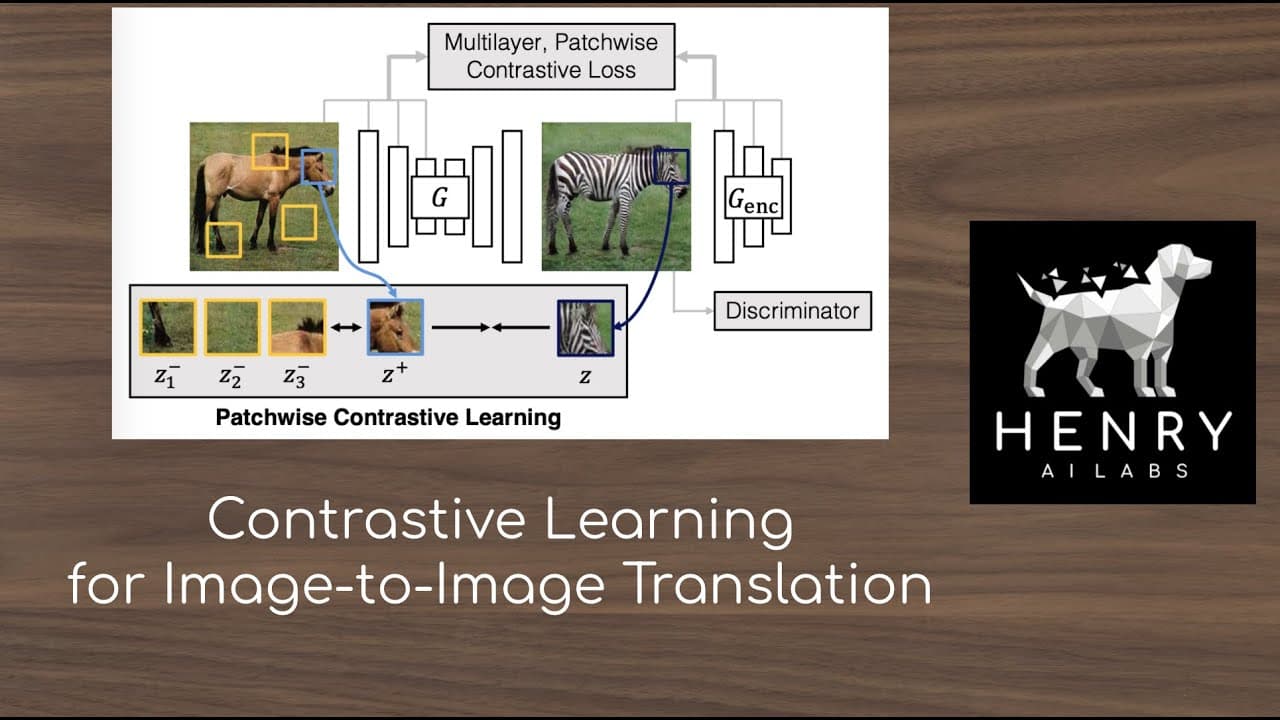
- 🥳 Patch-level loss is essential for maintaining detail during image transformations, helping the model differentiate between relevant body parts and backgrounds.
- 🥺 The method improves on traditional cycle consistency approaches by allowing direct comparisons within the same image for training, leading to better learning outcomes.
- 💯 Metrics such as FID scores demonstrate the model's efficacy, indicating the quality of generated images is superior to baseline methods.
- 🈸 The adaptability of the model for different translation tasks showcases its potential across various domains, from artistic generation to practical applications in robotics.
- 💨 Domain similarity measurements offer a new way to assess generalization difficulty in machine learning, providing insights into transfer learning performance.
Install to Summarize YouTube Videos and Get Transcripts
Explore YouTube Video Summarizer or Get YouTube Transcript Extractor
Questions & Answers
Q: What role does contrastive learning play in unpaired image-to-image translation?
Contrastive learning helps in mapping similar image patches to a close embedding space while pushing dissimilar patches apart. In unpaired image translation, the algorithm learns to generate corresponding images from a different domain without requiring exact pairs. This comparison of patches allows the model to maintain essential features while transforming images, emphasizing similarity in output representations, which is critical for achieving realistic translations.
Q: How does the model use patches for learning in the image translation process?
The model utilizes patch-level comparisons, where it generates images in a way that corresponding patches from generated and original images are similar, while distinguishing them from other patches in the original image. This technique enables the neural network to focus on localized features, enhancing detail retention and improving the overall quality of translated images, crucial for tasks like translating horses to zebras or photos to paintings.
Q: What advancements do the results show in the study?
The results demonstrate improvements in image quality metrics, showing that employing a contrastive learning approach yields better fidelity in translations. The study also highlights enhancements in training efficiency, indicating that the patch-level considerations outperformed traditional methods, such as cycle consistency, especially in cases where unpaired data is prevalent, proving the method's robustness in real-world applications.
Q: Why is using patches from the same image more effective than using a memory bank of patches?
The research found that deriving negative examples from patches within the same image leads to more effective contrastive learning outcomes compared to using a momentum-encoded data set. Using a single image helps the model focus on intrinsic features directly relevant to the translation task, minimizing noise and reinforcing coherence across generated outputs, thus stabilizing training and improving performance on image translations.
Summary & Key Takeaways
-
Contrastive learning enhances self-supervised techniques, especially in computer vision, to achieve better image translations without paired examples, utilizing methods like SimCLR and MoCo.
-
This study introduces a novel model that leverages contrastive learning within a GAN framework for translating images from one unpaired domain to another, such as horses to zebras.
-
The proposed method introduces a patch-level loss that compares similarity across different image patches, improving the quality and fidelity of generated translations significantly.
Read in Other Languages (beta)
Share This Summary 📚
Summarize YouTube Videos and Get Video Transcripts with 1-Click
Try YouTube Summary with ChatGPT & Claude or YouTube Transcript Generator
Explore More Summaries from Connor Shorten 📚
Summarize YouTube Videos and Get Video Transcripts with 1-Click
Try YouTube Summary with ChatGPT & Claude or YouTube Transcript Generator