How to Compete with Tesla in Autonomous Driving
TL;DR
Helm.ai, led by CEO Vlad Voroninski, is advancing autonomous driving technology by focusing on AI-based simulation and generative AI. Their approach allows automakers to compete with Tesla by offering scalable solutions from partial to full automation. Despite initial skepticism, their commitment to unsupervised learning and deep teaching has led to significant technological breakthroughs and partnerships with major automakers.
Transcript
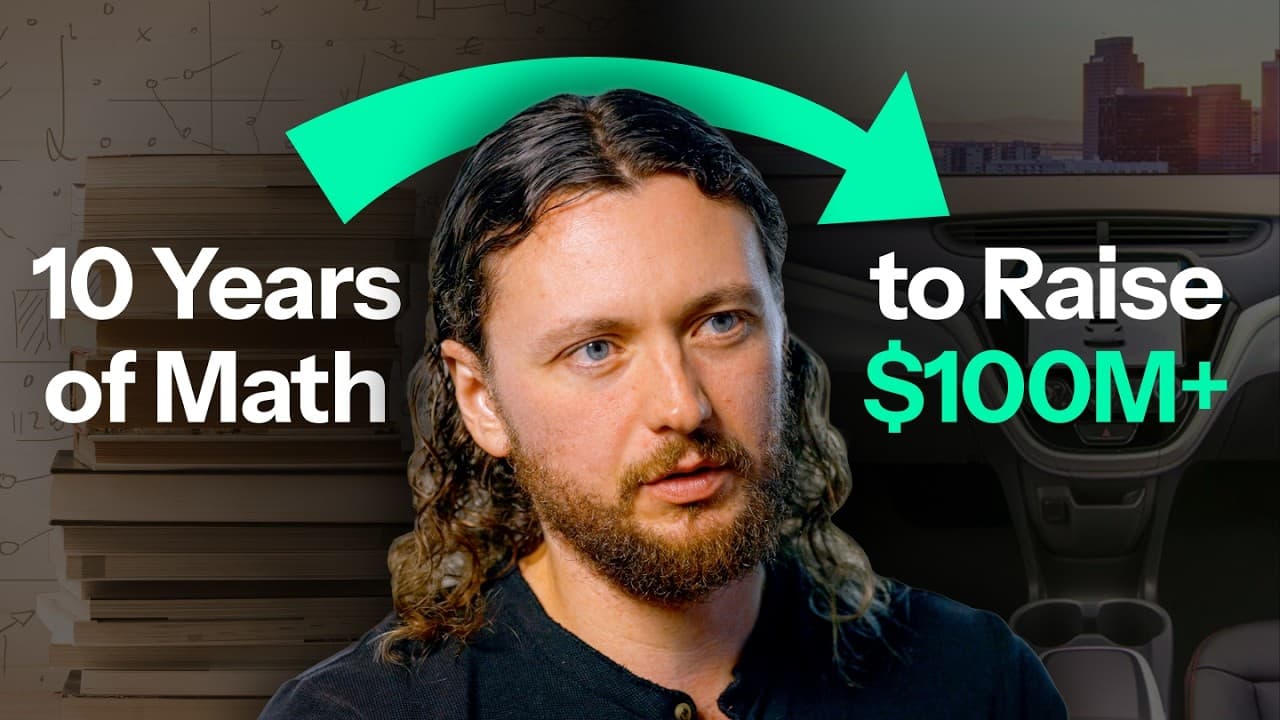
The end goal is achieving fully autonomous driving. We allow automakers to compete with Tesla by bringing to market cutting edge autonomous driving systems. We've raised over $und00 million. We'll see very very scalable commercialization happen. But I would say that starting a company felt like drinking from a fire hose. When we were pitching kind ... Read More
Key Insights
- Helm.ai aims to achieve fully autonomous driving by focusing on AI-based simulation and generative AI.
- The company raised over $100 million to develop cutting-edge autonomous driving systems.
- Helm.ai's approach unifies partial and full automation, allowing automakers to compete with Tesla.
- Generative AI and deep teaching are used to create realistic simulation data for autonomous driving.
- Simulation reduces the need for large fleets by generating critical driving data without real-world deployment.
- Helm.ai's foundation models, Vid Gen and World Gen, simulate video data and the entire driving stack.
- Building trust in deep tech requires demonstrating technology robustness and delivering on contracts.
- Starting a company in this field requires conviction and adaptability to long-term market changes.
Install to Summarize YouTube Videos and Get Transcripts
Explore YouTube Video Summarizer or Get YouTube Transcript Extractor
Questions & Answers
Q: How does Helm.ai enable automakers to compete with Tesla?
Helm.ai provides automakers with cutting-edge autonomous driving systems by focusing on AI-based simulation and generative AI. Their approach unifies partial and full automation, allowing companies to develop scalable solutions without needing extensive real-world fleet deployment. This enables automakers to compete with Tesla by offering advanced, cost-effective autonomous driving technologies.
Q: What role does generative AI play in Helm.ai's technology?
Generative AI is crucial in Helm.ai's technology as it allows the creation of highly realistic simulation data for autonomous driving. By combining generative AI with deep teaching, Helm.ai generates critical driving data without deploying large fleets, thus reducing costs and accelerating the development of autonomous driving systems.
Q: What are Vid Gen and World Gen in Helm.ai's approach?
Vid Gen and World Gen are foundation models developed by Helm.ai for generative AI simulation. Vid Gen creates realistic video data from various camera setups, while World Gen simulates the entire autonomous driving stack. These models enable comprehensive simulation environments, aiding in the development and testing of autonomous driving technologies.
Q: Why is simulation important in developing autonomous driving systems?
Simulation is vital in developing autonomous driving systems as it allows for the generation of critical driving data without the need for extensive real-world fleet deployment. This reduces costs and accelerates technological advancement. AI-based simulation helps address difficult corner cases and improves system robustness by creating diverse driving scenarios.
Q: How does Helm.ai build trust in the deep tech industry?
Helm.ai builds trust in the deep tech industry by demonstrating the robustness of their technology and delivering on production contracts. They emphasize the importance of showcasing technology advancements over time and meeting critical deadlines for production programs. This approach fosters confidence among automakers and partners in their autonomous driving solutions.
Q: What challenges did Helm.ai face in its early development stages?
In its early development stages, Helm.ai faced skepticism regarding its focus on unsupervised learning and partial automation. The company committed to extensive R&D without immediate product development, which was considered risky. However, their conviction in their approach led to significant breakthroughs and partnerships, proving their strategy's long-term viability.
Q: How does Helm.ai's approach differ from other autonomous driving companies?
Helm.ai's approach differs by focusing on unifying partial and full automation through AI-based simulation and generative AI. Unlike companies relying on large fleets, Helm.ai uses simulation to create critical driving data, reducing costs and enhancing scalability. This innovative strategy positions them competitively against established players like Tesla.
Q: What is the significance of deep teaching in Helm.ai's technology?
Deep teaching is significant in Helm.ai's technology as it enhances the accuracy and scalability of AI-based simulation. By integrating deep teaching with generative AI, Helm.ai creates realistic driving scenarios that improve system performance and robustness. This approach enables the efficient development of autonomous driving systems without extensive real-world testing.
Summary & Key Takeaways
-
Helm.ai, founded by Vlad Voroninski, focuses on AI-based simulation to advance autonomous driving technology. By leveraging generative AI, they create scalable solutions that unify partial and full automation, enabling automakers to compete with Tesla. Despite initial challenges, their commitment to unsupervised learning has resulted in significant breakthroughs.
-
The company's innovative approach involves using generative AI and deep teaching to generate realistic simulation data, reducing the need for large fleets. Their foundation models, Vid Gen and World Gen, simulate video data and the entire driving stack, offering a comprehensive solution for autonomous vehicles.
-
Building trust in the deep tech space requires demonstrating the robustness of technology and delivering on production contracts. Helm.ai emphasizes the importance of adaptability and conviction in navigating the competitive landscape, ultimately contributing to the advancement of autonomous driving technology.
Read in Other Languages (beta)
Share This Summary 📚
Summarize YouTube Videos and Get Video Transcripts with 1-Click
Try YouTube Summary with ChatGPT & Claude or YouTube Transcript Generator
Explore More Summaries from EO 📚






Summarize YouTube Videos and Get Video Transcripts with 1-Click
Try YouTube Summary with ChatGPT & Claude or YouTube Transcript Generator