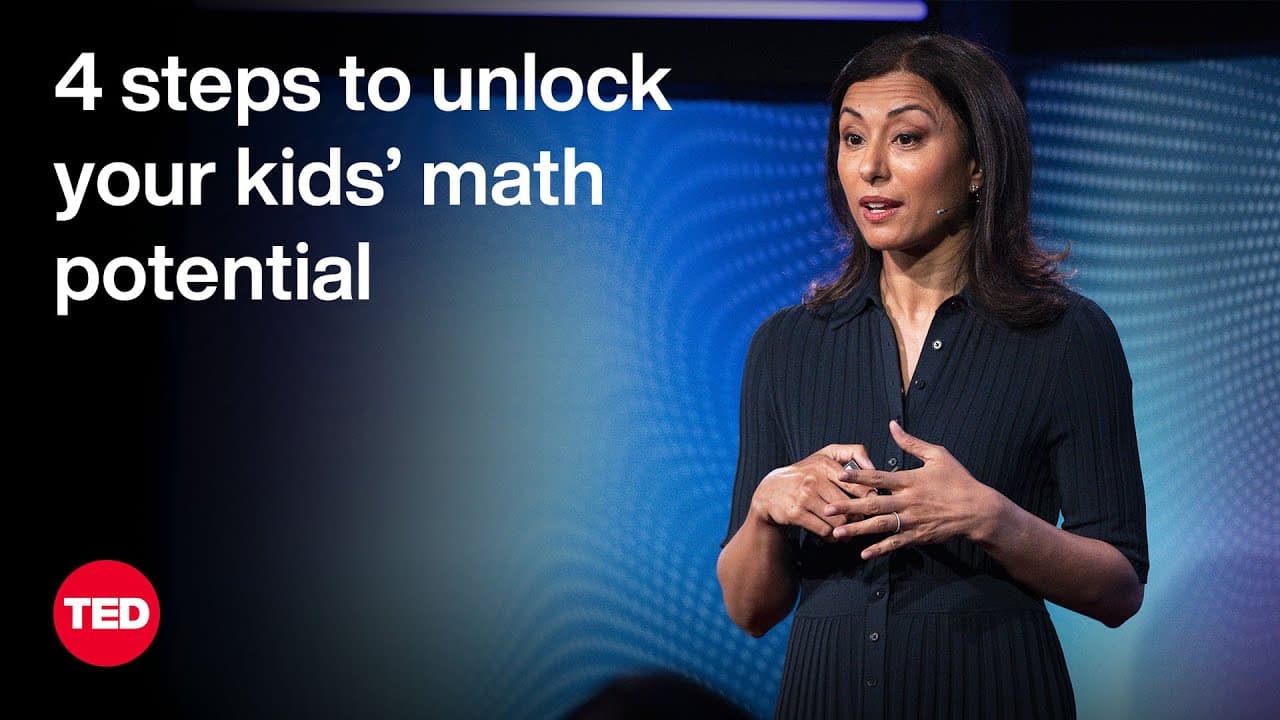
4 Steps to Unlock Your Kid's Math Potential | Shalinee Sharma | TED
TL;DR
Fostering belief, understanding, and fun can transform children's attitudes toward math.
Transcript
Let me get started with this. I'm a mom and I have 13-year-old twin boys. I want to share a vivid memory from when they were in pre-K. A mom came over at pickup to befriend me and she started telling me about her daughter. She said, "She's like me. She's just not a math kid. But your boys, your boys are math kids. We're just not math people." I was... Read More
Key Insights
- 👶 Early labeling of children can significantly hinder their potential in math.
- 🖐️ Belief in a child's ability plays a crucial role in their willingness to engage and persist in learning.
- 🥺 Understanding fundamental concepts rather than just memorizing procedures leads to better long-term outcomes in math.
- 👾 Making math enjoyable through games and real-world application can engage students effectively.
- 🦻 Visualizing math problems can aid comprehension and lessen anxiety.
- 👪 Encouraging a positive outlook on math within families can transform children's attitudes toward the subject.
- 🎓 Addressing gender biases in math education remains an essential challenge.
Install to Summarize YouTube Videos and Get Transcripts
Explore YouTube Video Summarizer or Get YouTube Transcript Extractor
Questions & Answers
Q: Why is labeling children as "not math kids" problematic?
Labeling children as "not math kids" fosters a fixed mindset that inhibits their willingness to engage with math. This mindset can lead to a self-fulfilling prophecy where children may become discouraged and disengaged from math altogether, undermining their potential to learn and excel in the subject.
Q: What role does belief play in a child's math learning journey?
Belief is fundamental in a child's progression in math. When children feel that someone believes in their capability, they are more likely to seek help, put in the effort, and eventually succeed. Confidence gained through encouragement can drastically alter their approach to learning, allowing them to overcome challenges.
Q: How can understanding math concepts improve performance?
Understanding math concepts rather than just memorizing facts leads to improved retention and application. For instance, using visual aids like drawings or real-life examples helps children grasp underlying principles, thereby enabling them to solve problems independently rather than relying solely on memorized formulas.
Q: What strategies can make math more enjoyable for kids?
Making math fun can involve integrating games and playful activities into learning. This can include board games or simple real-life scenarios that involve math, like managing money during a shopping trip. The key is to keep the focus on enjoyment rather than formal instruction to cultivate a love for math.
Q: How might a child's early experiences with math shape their future attitudes?
Early experiences significantly shape children's ongoing attitudes toward math. A positive and supportive math environment can foster a love for learning, while negative experiences can lead to anxiety and aversion. The speaker emphasizes that by nurturing a supportive context, parents can steer children towards a more favorable view of math.
Q: What is the importance of visualization in learning math?
Visualization in math helps children understand concepts in a tangible way. By creating mental images or drawing out problems, children can connect abstract concepts to real-life situations, leading to deeper comprehension, reduced anxiety, and enhanced problem-solving skills.
Q: How can parents influence their children's feelings about math?
Parents can greatly influence their children's feelings toward math by displaying their own attitudes. If parents approach math with curiosity and positivity, children are likely to mimic that attitude. Encouraging children to tackle challenges confidently will help establish a healthy relationship with math.
Q: What does the speaker mean by "giving math a second chance"?
"Giving math a second chance" refers to the opportunity for both parents and children to reshape their experiences with math. It entails adopting a fresh perspective that fosters curiosity and excitement, rather than fear and frustration, allowing everyone to explore and enjoy the subject without preconceived limitations.
Summary & Key Takeaways
-
The speaker reminisces about a pre-K encounter where a mother labeled her child as "not a math kid," a damaging belief that undermines all children's potential in math.
-
As a math learning expert, the speaker emphasizes the importance of changing the narrative from who can learn math to how we effectively teach it, highlighting the necessity of belief, understanding, and enjoyable methods.
-
The speaker outlines four key steps: believe in every child's potential, encourage understanding through visualization, make math practices enjoyable, and allow children to experience math again without fear, fostering a more positive relationship with the subject.
Read in Other Languages (beta)
Share This Summary 📚
Summarize YouTube Videos and Get Video Transcripts with 1-Click
Try YouTube Summary with ChatGPT & Claude or YouTube Transcript Generator
Explore More Summaries from TED 📚



Summarize YouTube Videos and Get Video Transcripts with 1-Click
Try YouTube Summary with ChatGPT & Claude or YouTube Transcript Generator