Velocity Measurement | Speed | Part-2/4 | Electrical Instruments ( EIM ) | Lec - 79
TL;DR
This video explains electromagnetic velocity measurement techniques and their applications.
Transcript
hi everyone in this video I am going to explain about electromagnetic velocity measurement or electromagnetic velocity transducer so in the previous video I have explained what is the difference between velocity and speed and what are the measurements involved in the linear and angular velocity suppose if you want to measure the velocity so two typ... Read More
Key Insights
- 🍧 Electromagnetic velocity measurement can be categorized into linear and angular measurements, each having unique applications.
- 🍉 The design of the transducer significantly influences its effectiveness, particularly in terms of magnetic field interaction.
- 🧲 Both moving magnet and moving coil types have distinct operational mechanisms that affect their usage and reliability in different scenarios.
- 🦾 Maintenance considerations are critical, especially for moving magnet types due to the absence of mechanical contacts.
- 🧑🏭 Applications for velocity measurement must factor in environmental influences, like stray magnetic fields, which can impact data accuracy.
- ❓ Understanding the vector nature of velocity is essential for correctly interpreting measurement outcomes.
- 🅰️ Calibration and measurement limitations underscore the importance of proper selection of transducer types for specific applications.
Install to Summarize YouTube Videos and Get Transcripts
Explore YouTube Video Summarizer or Get YouTube Transcript Extractor
Questions & Answers
Q: What is the primary difference between velocity and speed as discussed in the video?
The primary difference lies in the vector nature of velocity as opposed to speed, which is scalar. Velocity includes both the magnitude of motion and the direction in which an object moves, while speed only measures how fast an object is moving, disregarding direction.
Q: How does the moving magnet type velocity transducer function?
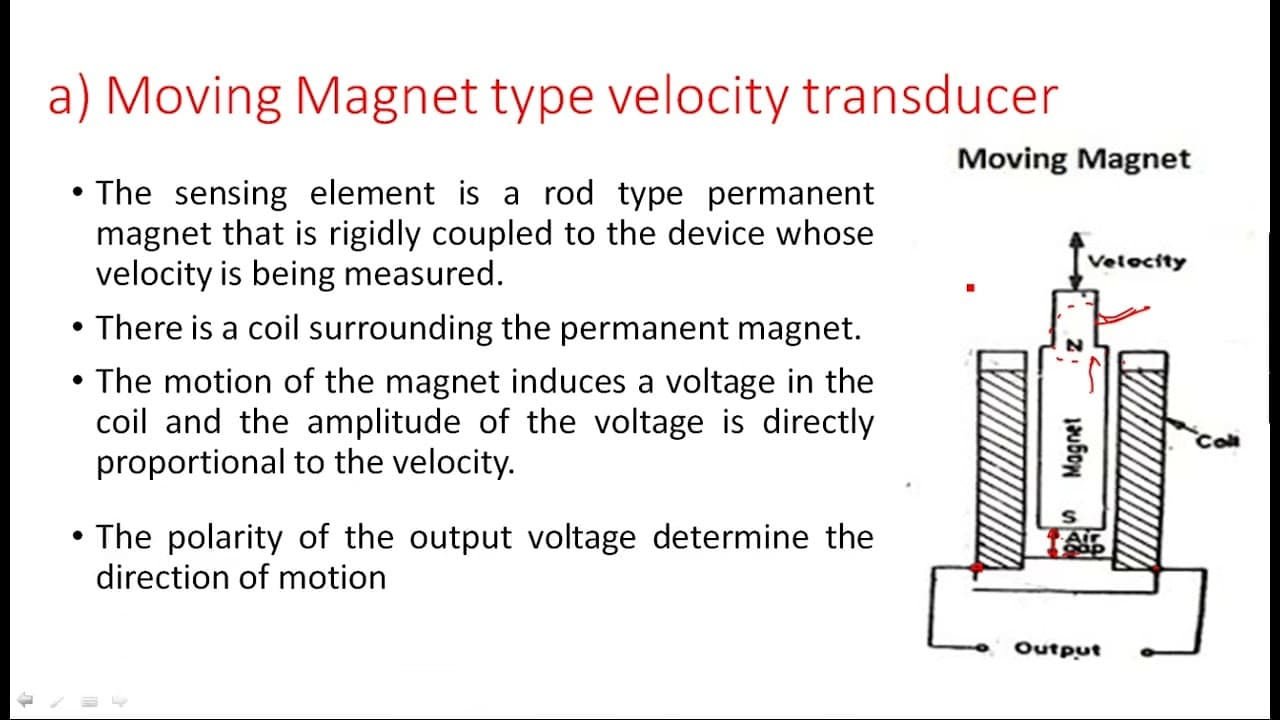
The moving magnet type transducer utilizes a permanent magnet that moves to create a varying air gap, inducing a voltage in a surrounding coil. The voltage produced is directly proportional to the speed of the magnet's movement, allowing for accurate measurement of linear velocity.
Q: What are some advantages of using moving magnet type transducers?
Moving magnet type transducers require negligible maintenance due to the absence of mechanical surfaces and contacts. Furthermore, their output voltage is linearly proportional to the velocity being measured, providing a clear and direct measure of motion without significant distortion.
Q: What challenges do moving magnet type transducers face?
These transducers can be adversely affected by stray magnetic fields, leading to noise and interference in measurements. Additionally, their frequency response is limited, making them unsuitable for measuring vibrations effectively due to potential demagnetization over time.
Q: How does a moving coil type velocity transducer differ from the moving magnet type?
In a moving coil type transducer, the coil moves within a fixed magnetic field, rather than the magnet moving. This setup generates voltage through the coil's motion in the magnetic field, offering a stable structure and potentially improved accuracy compared to the moving magnet type.
Q: What advantages are associated with moving coil type transducers?
Moving coil type transducers present a more secure arrangement as they form a closed magnetic circuit, enhancing measurement stability. They are also housed in anti-magnetic cases, which reduces the influence of external magnetic fields, improving overall performance and accuracy.
Summary & Key Takeaways
-
The video explains the concept of electromagnetic velocity measurement, highlighting the difference between linear and angular velocity measurement methods.
-
It details two types of electromagnetic velocity transducers: moving magnet type and moving coil type, discussing their construction, operation, and output mechanism.
-
Advantages and disadvantages of both types of transducers are covered, emphasizing their reliability, maintenance needs, and operational constraints due to magnetic interference.
Read in Other Languages (beta)
Share This Summary 📚
Summarize YouTube Videos and Get Video Transcripts with 1-Click
Try YouTube Summary with ChatGPT & Claude or YouTube Transcript Generator