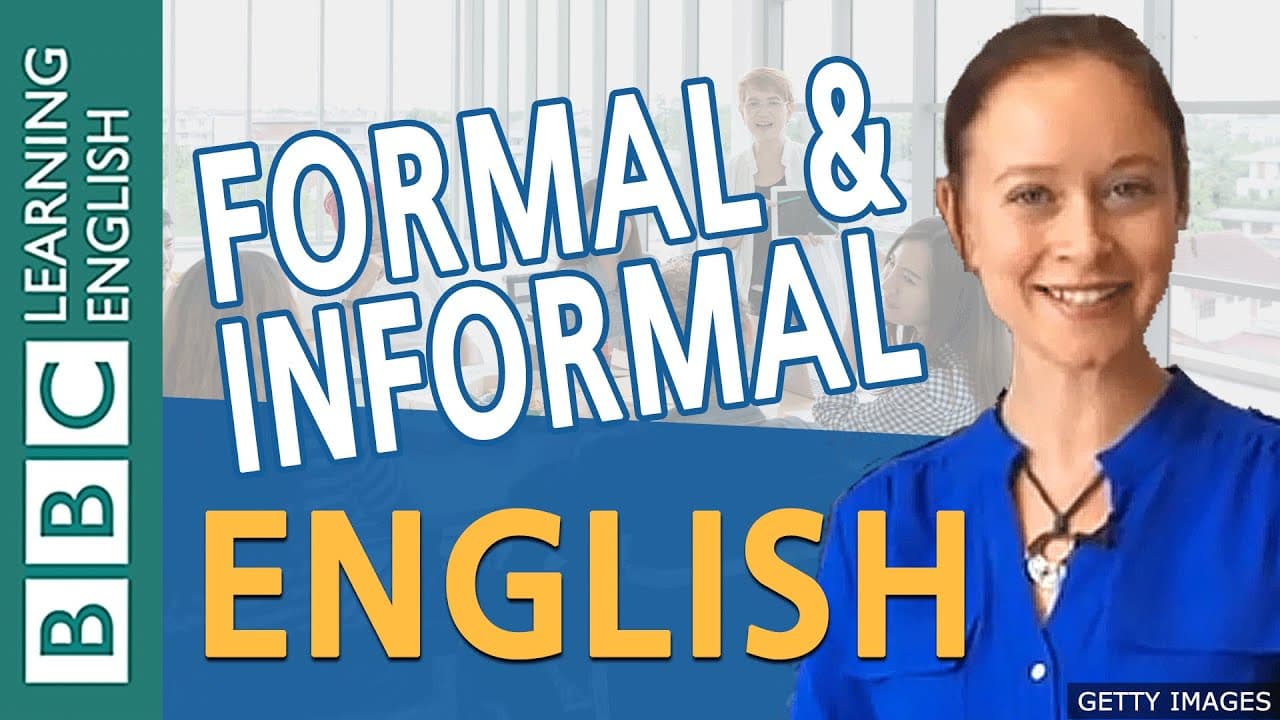
Formal English and informal English - BBC English Masterclass
TL;DR
Learn key differences between formal and informal English.
Transcript
Hi, Sian here for BBC Learning English. In this Masterclass we're going to look at some differences between formal and informal English. Hey, how's it going? Good afternoon, how are you? Sometimes formal and informal can seem like two different languages. In the same way you wouldn't normally wear shorts and a t-shirt to a job interview, if you use... Read More
Key Insights
- Formal and informal English can seem like different languages, impacting impressions in various contexts.
- The choice of vocabulary is crucial; formal English prefers precise words over phrasal verbs.
- Informal language often uses abbreviations and contractions, unsuitable for formal writing.
- Passive structures are more common in formal English, providing a more polished tone.
- Complex sentences are preferred in formal English, enhancing clarity and sophistication.
- Informal English allows for short, simple sentences, suitable for casual conversations.
- Understanding context is key to choosing the right language style, avoiding inappropriate impressions.
- Practicing both styles of English can improve communication skills and adaptability in diverse settings.
Install to Summarize YouTube Videos and Get Transcripts
Explore YouTube Video Summarizer or Get YouTube Transcript Extractor
Questions & Answers
Q: What are the main differences between formal and informal English?
The main differences lie in vocabulary choice, sentence structure, and tone. Formal English uses precise vocabulary, passive structures, and complex sentences to convey professionalism. Informal English, however, favors phrasal verbs, abbreviations, and simple sentences, suited for casual contexts. Understanding these differences helps in choosing the right style.
Q: Why is vocabulary choice important in formal and informal English?
Vocabulary choice is crucial because it sets the tone and level of formality. In formal English, precise and specific words are preferred to convey clarity and professionalism. Informal English, however, often uses common words and phrasal verbs, which may be inappropriate in professional settings. Selecting the right vocabulary ensures effective communication.
Q: How do sentence structures differ in formal and informal English?
In formal English, complex sentence structures are preferred as they convey sophistication and clarity. This includes using passive voice and relative pronouns. In contrast, informal English allows for short, simple sentences, which are more suitable for casual conversations. Understanding these structural differences helps in adapting language to the context.
Q: What role do abbreviations and contractions play in informal English?
Abbreviations and contractions are common in informal English, making communication quicker and more casual. They are suitable for spoken language or informal writing. However, in formal contexts, such as business correspondence, avoiding these forms maintains professionalism and clarity. Recognizing when to use them helps in adapting language appropriately.
Q: Why is it important to understand context in language use?
Context determines the appropriate language style to use. Using overly formal or informal language in the wrong setting can create misunderstandings or negative impressions. Understanding the context, whether casual or professional, helps in choosing the right vocabulary, tone, and structure, ensuring effective communication and positive interactions.
Q: How can passive structures enhance formal English?
Passive structures in formal English provide a polished and objective tone, focusing on actions rather than the subject. This is often preferred in professional writing, such as reports or formal letters, where neutrality and clarity are important. Using passive voice appropriately enhances the formality and impact of the message.
Q: What are the benefits of practicing both formal and informal English?
Practicing both styles enhances adaptability and communication skills across different contexts. It allows individuals to effectively engage in professional settings and casual conversations. Understanding when to switch styles ensures appropriate language use, fostering better relationships and opportunities in diverse environments, from social interactions to career advancements.
Q: How does sentence complexity affect communication in formal English?
Complex sentences in formal English enhance clarity and detail, allowing for nuanced expression of ideas. They often include relative clauses and connectors, providing a comprehensive view of the subject. This complexity is essential in professional writing, where precision and thoroughness are valued, ensuring the message is understood accurately by the audience.
Summary & Key Takeaways
-
This BBC English Masterclass explores the differences between formal and informal English, emphasizing the impact of language choice on impressions. It covers vocabulary selection, sentence structure, and the use of abbreviations, providing practical examples and tips for transitioning between styles.
-
The session highlights four key features that distinguish informal from formal English: vocabulary choice, use of contractions, preference for passive structures, and sentence complexity. It offers guidance on appropriately adjusting language to suit different contexts, such as job applications.
-
By understanding and practicing both formal and informal English, learners can enhance their communication skills. The masterclass provides valuable insights into crafting language that suits various scenarios, from casual conversations to professional correspondence.
Read in Other Languages (beta)
Share This Summary 📚
Summarize YouTube Videos and Get Video Transcripts with 1-Click
Try YouTube Summary with ChatGPT & Claude or YouTube Transcript Generator
Explore More Summaries from BBC Learning English 📚
Summarize YouTube Videos and Get Video Transcripts with 1-Click
Try YouTube Summary with ChatGPT & Claude or YouTube Transcript Generator