Undetermined Coefficients, first order linear differential equation, f(t) is a cosine function
TL;DR
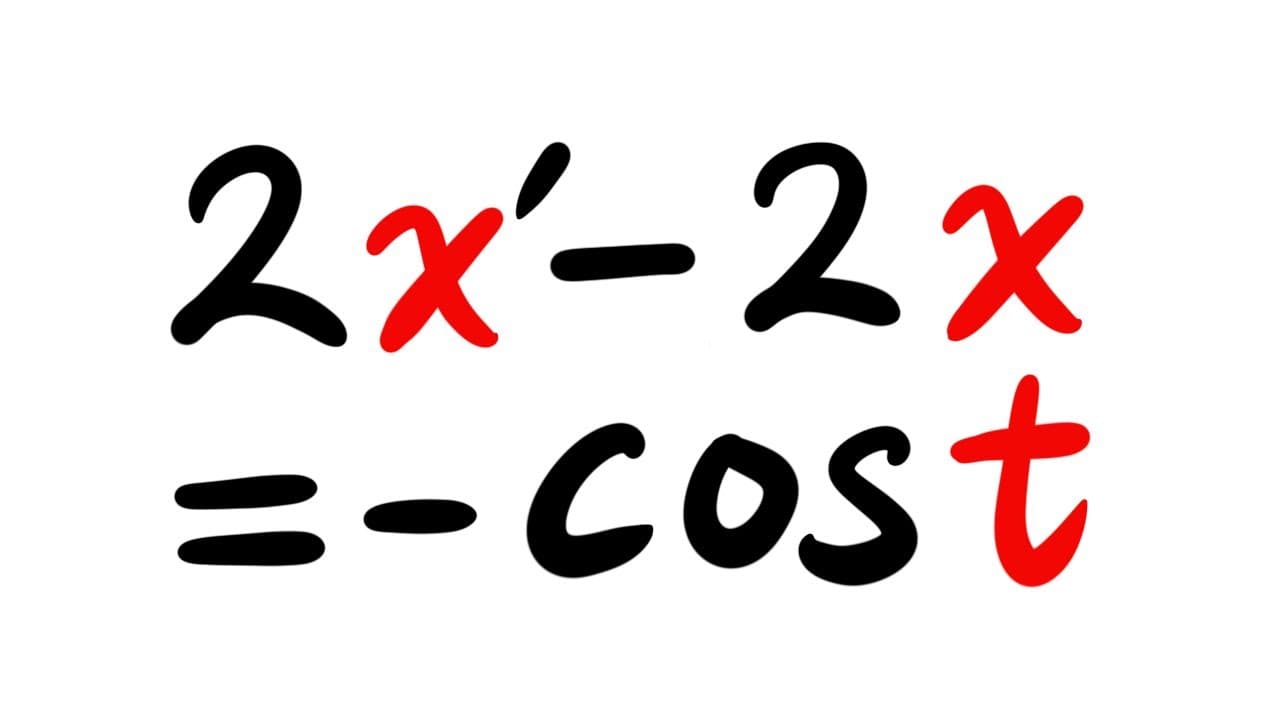
This video demonstrates how to solve a first-order linear differential equation by using the method of undetermined coefficients.
Transcript
in this video I'll show you guys how to stop this first water linear differential equation by I see you know we can do this by integrating factor I will interview you guys because in this video we see we have those constants the two and then the negative two right here right so let me show you guys that we can also use the method of undetermined co... Read More
Key Insights
- 🫱 Homogeneous solutions are found by setting the right-hand side of the equation to zero.
- 🫱 The trial solution for the particular solution should match the form of the right-hand side and include undetermined coefficients.
- 👻 Differentiating and substituting the trial solution into the original equation allows for the determination of the coefficients.
- 🙃 The coefficients can be found by matching the coefficients on both sides of the equation.
- 🪈 The method of undetermined coefficients is a useful technique even for first-order linear differential equations.
- 📔 Linear independence is important to ensure the trial solution covers all possibilities.
- 🍹 The final solution is the sum of the homogeneous solution and the particular solution.
Install to Summarize YouTube Videos and Get Transcripts
Explore YouTube Video Summarizer or Get YouTube Transcript Extractor
Questions & Answers
Q: What is the first step in solving a first-order linear differential equation using the undetermined coefficients method?
The first step is to find the solution to the homogeneous case, where the right-hand side of the equation is equal to zero.
Q: How do you form the trial solution for the particular solution in the method of undetermined coefficients?
The trial solution for the particular solution should have the same form as the right-hand side of the equation, but with undetermined coefficients. In this case, it should include both cosine and sine terms.
Q: Why is it important for the trial solution to be linearly independent from the homogeneous solutions?
The trial solution should be linearly independent from the homogeneous solutions to ensure that it covers all possibilities in finding the particular solution.
Q: How do you determine the coefficients in the trial solution?
The coefficients in the trial solution are determined by differentiating the trial solution, substituting it into the original differential equation, and matching the coefficients on both sides.
Summary & Key Takeaways
-
The video explains how to find the solution to the homogeneous case of a first-order linear differential equation, where the right-hand side is equal to zero.
-
The method of undetermined coefficients is introduced as a technique to find the particular solution to the given differential equation.
-
The process of finding the trial solution, differentiating it, and substituting it into the original differential equation to solve for the coefficients is explained step by step.
Read in Other Languages (beta)
Share This Summary 📚
Summarize YouTube Videos and Get Video Transcripts with 1-Click
Try YouTube Summary with ChatGPT & Claude or YouTube Transcript Generator
Explore More Summaries from blackpenredpen 📚




Summarize YouTube Videos and Get Video Transcripts with 1-Click
Try YouTube Summary with ChatGPT & Claude or YouTube Transcript Generator