Why The US Will Never Pay Off Its Debt
TL;DR
US debt is growing but remains manageable due to strategic borrowing.
Transcript
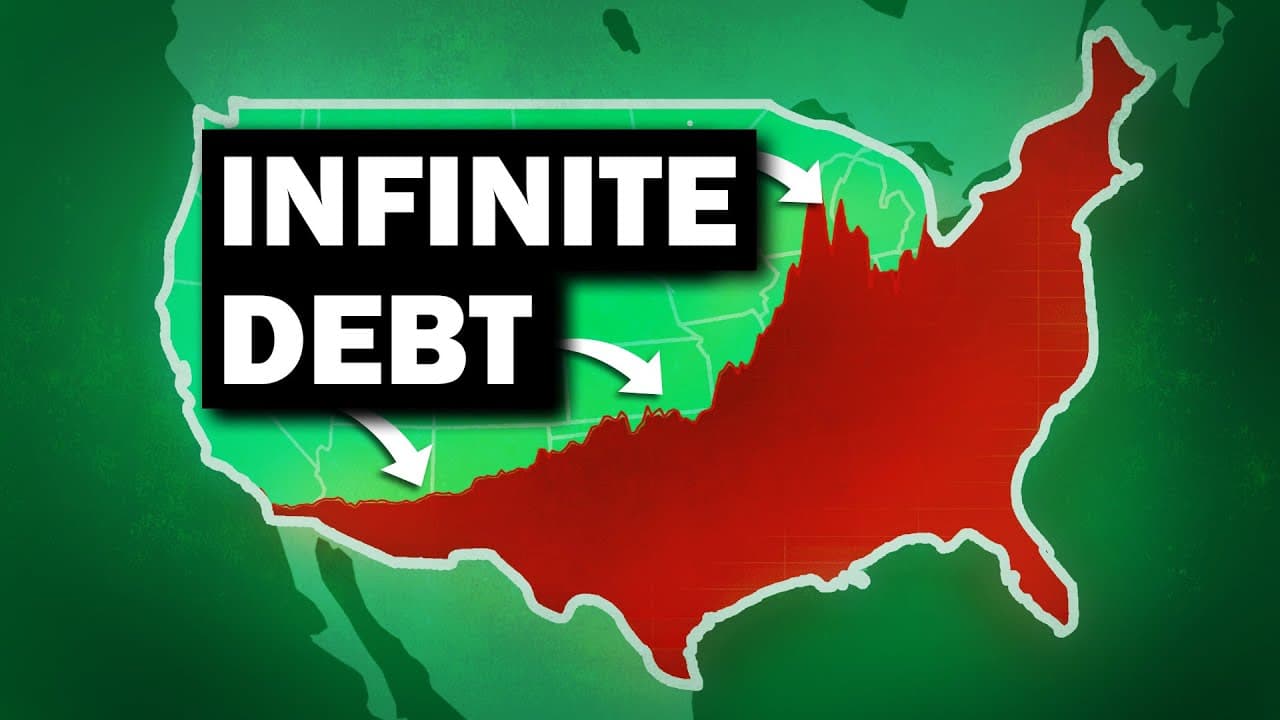
this is a graph looking at the US national debt over time looking at it you'll see the amount is well over3 trillion which is absolutely insane more concerningly this deep increase shows no signs of slowing down in fact it's only getting bigger and bigger from 2023 to 2024 alone it grew in $6.4 billion of new debt every single day a... Read More
Key Insights
- The US national debt is over $35 trillion and continues to grow rapidly, with $6.4 billion added daily from 2023 to 2024.
- The debt-to-GDP ratio is over 100%, indicating that debt exceeds economic activity, raising concerns about financial sustainability.
- Interest payments on the national debt have nearly doubled from 2020 to 2023, surpassing military spending for the first time.
- US debt is categorized into public debt, sold to investors, and intergovernmental debt from programs like Social Security.
- Historical events such as wars and economic policies have significantly contributed to the current debt levels.
- Despite high debt, the US maintains strong creditworthiness due to global confidence in its ability to repay through treasury bonds.
- Maintaining debt interest payments is crucial, but the US can theoretically always pay back its debt by creating more money.
- A US default would have catastrophic global financial implications, undermining confidence in the US dollar and credit ratings.
Install to Summarize YouTube Videos and Get Transcripts
Explore YouTube Video Summarizer or Get YouTube Transcript Extractor
Questions & Answers
Q: What is the current state of the US national debt?
The US national debt has surpassed $35 trillion and continues to grow at an alarming rate. From 2023 to 2024, the country added $6.4 billion in new debt every day. The debt-to-GDP ratio is over 100%, indicating that the debt exceeds the economic activity within the country, raising concerns about financial sustainability.
Q: How does the US maintain its creditworthiness despite high debt levels?
The US maintains its creditworthiness by selling treasury bonds to both individual and institutional investors worldwide. This strategy relies on the global confidence in the US's ability to repay its debt. The US's strong and safe investment reputation allows it to sell securities at low interest rates, sometimes even cheaper than the inflation rate, making the debt effectively cheaper than free.
Q: What historical events have contributed to the current US debt levels?
Historical events such as the American Revolutionary War, the Civil War, World Wars I and II, and economic policies like Reaganomics have significantly contributed to the current US debt levels. These events led to increased borrowing, the introduction of new taxes, and expanded federal government borrowing practices, setting a precedent for financing future conflicts and economic challenges through debt.
Q: Why is the debt-to-GDP ratio an important metric?
The debt-to-GDP ratio is important because it measures the country's debt relative to its economic output. A high ratio indicates that the debt exceeds the economic activity within the country, raising concerns about financial sustainability. It reflects the country's ability to manage and repay its debt through economic growth rather than focusing solely on the debt amount.
Q: What would happen if the US defaulted on its debt?
A US default on its debt would have catastrophic global financial implications. It would undermine confidence in the US dollar and credit ratings, leading to increased borrowing costs, government service cuts, and potential tax hikes. The global financial system relies on the assumption that US treasuries are risk-free, and a default would remove this foundation, causing severe short-term and long-term financial crises worldwide.
Q: How does the US plan to manage its growing debt?
The US plans to manage its growing debt by maintaining investor confidence through the sale of treasury bonds. The government aims to use borrowed funds to invest back into the economy, hoping for enough economic growth to cover the interest on the debt. This strategy relies on the global perception of the US as a strong and safe investment, allowing it to borrow at low interest rates.
Q: What are the potential consequences of raising taxes to pay off the debt?
Raising taxes to pay off the debt could have negative economic consequences. Higher taxes would leave citizens with less disposable income, reducing consumer spending. Companies facing higher taxes might hire fewer workers, make fewer investments, and undertake fewer research projects, slowing economic growth. This could ultimately reduce future tax revenues, making it more challenging to manage the debt.
Q: Why is US debt considered a safe investment despite its size?
US debt is considered a safe investment because of the country's strong creditworthiness and global confidence in its ability to repay. The US has never defaulted on its debt, and its treasury bonds are seen as a risk-free investment. The country's status as the world's reserve currency further strengthens its position, ensuring continued demand for US debt instruments, even as the debt grows.
Summary & Key Takeaways
-
The US national debt has reached over $35 trillion, with rapid daily increases. Despite concerns, the debt-to-GDP ratio is a more critical metric, currently exceeding 100%. Interest payments are now higher than military spending, indicating significant financial challenges ahead.
-
US debt comprises public and intergovernmental debt, with historical events like wars and economic policies contributing to its growth. The US maintains creditworthiness by selling treasury bonds, ensuring continued investor confidence in its repayment capabilities.
-
Though theoretically manageable, a US default on its debt would have devastating global financial consequences. The US's ability to create money to pay off debt is crucial, but maintaining investor confidence remains essential to prevent a financial crisis.
Read in Other Languages (beta)
Share This Summary 📚
Summarize YouTube Videos and Get Video Transcripts with 1-Click
Try YouTube Summary with ChatGPT & Claude or YouTube Transcript Generator
Explore More Summaries from Versed 📚

Summarize YouTube Videos and Get Video Transcripts with 1-Click
Try YouTube Summary with ChatGPT & Claude or YouTube Transcript Generator