The First Animal Ever on Earth
TL;DR
Scientists are engaged in a heated debate over whether sponges or comb jellies are the closest living relatives to the first animal, with implications for our understanding of evolutionary history.
Transcript
[ intro ] One of the central concepts in evolutionary theory is common descent, meaning that all living organisms can be traced back to a single common ancestor. In other words, all life on Earth is related. That means, in theory, you could trace your way from child to parent to connect even the most distant of evolutionary cousins. And if you did,... Read More
Key Insights
- 🛟 Common descent is a fundamental concept in evolutionary theory, suggesting that all life on Earth is related.
- 🧑🔬 Constructing phylogenetic trees helps scientists understand evolutionary history and infer the traits of common ancestors.
- ⛽ The debate over the first animal's appearance is fueled by conflicting evidence from morphology, genetics, and the fossil record.
Install to Summarize YouTube Videos and Get Transcripts
Explore YouTube Video Summarizer or Get YouTube Transcript Extractor
Questions & Answers
Q: What is the basis for the debate between sponges and comb jellies as the closest relatives to the first animal?
The debate stems from differences in the interpretation of morphology, genetics, and the fossil record. Sponges are considered simple and lack complex traits, while comb jellies have more complex structures and behaviors.
Q: How do scientists construct evolutionary trees to determine the relationships between different organisms?
Scientists use phylogenetic trees, which represent evolutionary relationships. By comparing traits and observing branching patterns, they can infer the common ancestor's traits and appearance.
Q: Why is the fossil record not conclusive in settling the debate?
Soft, fleshy organisms like comb jellies and sponges do not fossilize well, leading to a limited and fragmented fossil record. Additionally, the oldest known comb jelly fossils are older than the oldest sponge fossils, adding complexity to the debate.
Q: What does the debate over the first animal's appearance teach us about evolution?
The debate highlights the complexity of evolution and challenges assumptions about increasing complexity. It reminds us that traits can be gained or lost through natural selection, and the complexity of an organism does not necessarily indicate its age or evolutionary advancement.
Summary & Key Takeaways
-
Evolutionary theory suggests that all living organisms can be traced back to a single common ancestor, but the identity of the first animal remains a subject of debate.
-
Some scientists argue that sponges, due to their simple structure and lack of complex traits, are the best link to our evolutionary ancestors.
-
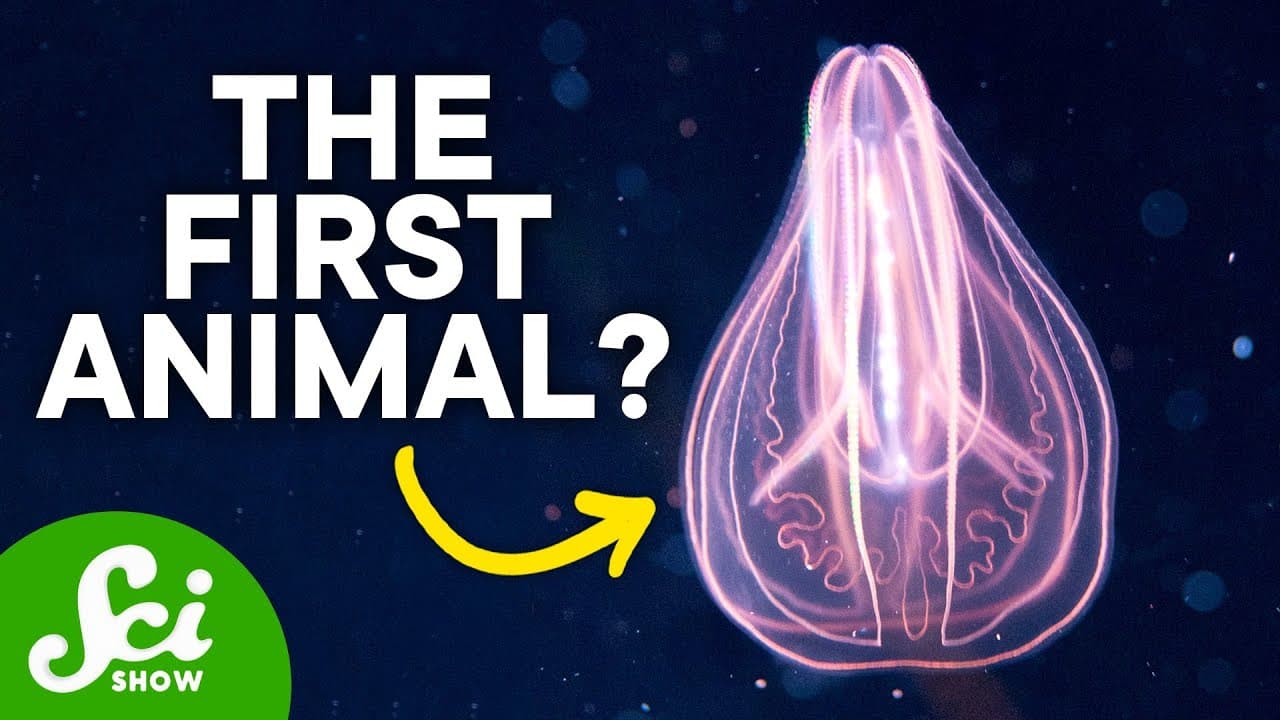
Others propose that comb jellies, with their more complex bodies, provide a better picture of the first animal.
-
The debate is fueled by conflicting evidence from morphology, genetics, and the fossil record.
Read in Other Languages (beta)
Share This Summary 📚
Summarize YouTube Videos and Get Video Transcripts with 1-Click
Try YouTube Summary with ChatGPT & Claude or YouTube Transcript Generator
Explore More Summaries from SciShow 📚


Summarize YouTube Videos and Get Video Transcripts with 1-Click
Try YouTube Summary with ChatGPT & Claude or YouTube Transcript Generator