12.3 Bending of Light
TL;DR
The bending of light, a consequence of general relativity, was experimentally confirmed in 1919 and made Albert Einstein famous.
Transcript
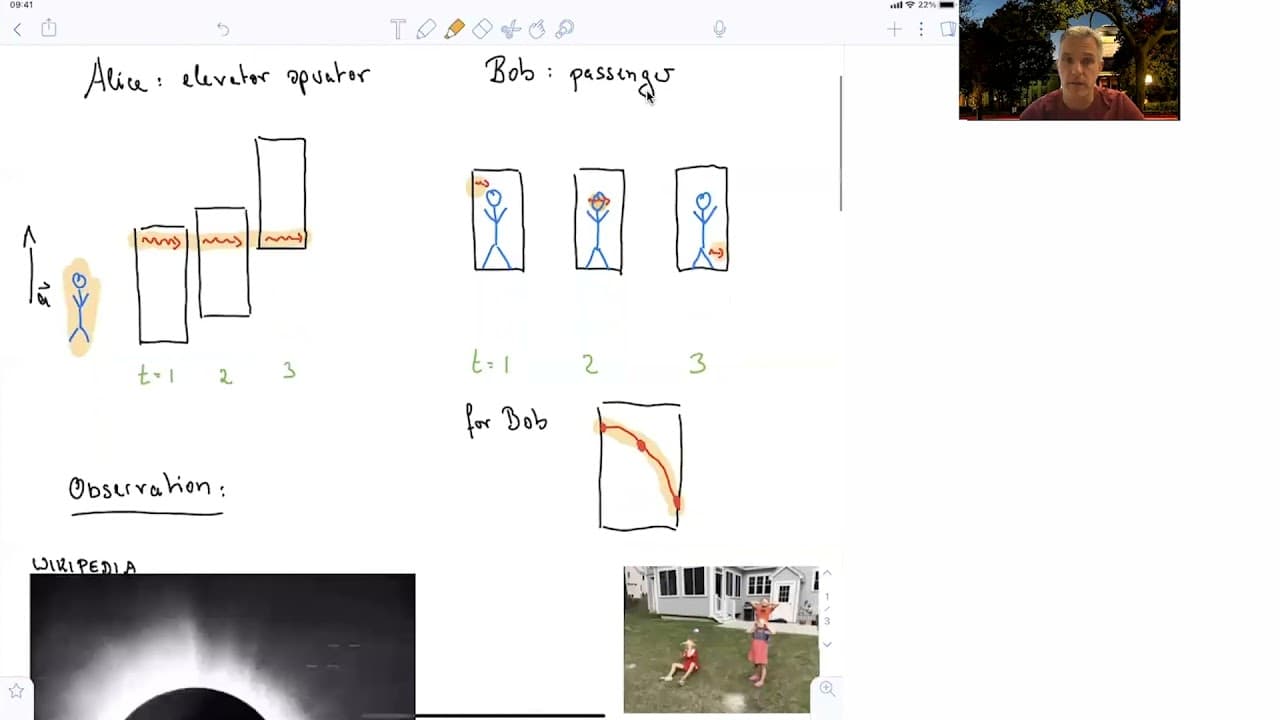
MARKUS KLUTE: Welcome back to special relativity. Bending of light is one of the spectacular consequences of general relativity, a prediction, if you want, [? of ?] [? general ?] relativity, which was experimentally confirmed. But let's analyze the situation first before we look at the actual evidence. They use Alice and Bob again, where Alice is a... Read More
Key Insights
- 🙂 Bending of light is a consequence of general relativity and was experimentally confirmed in 1919.
- 🙂 The bending of light can be observed in accelerating reference frames as well as in the presence of strong gravitational fields.
- 🥺 The measurement of starlight bending during a solar eclipse in 1919 led to Albert Einstein's fame and popularity.
- 🙂 The report of the bending of light by a former sports reporter in The New York Times contributed to Einstein's popularity.
Install to Summarize YouTube Videos and Get Transcripts
Explore YouTube Video Summarizer or Get YouTube Transcript Extractor
Questions & Answers
Q: What is the prediction of general relativity related to the bending of light?
General relativity predicts that light will bend when passing through a strong gravitational field or when observed from an accelerating reference frame.
Q: How was the bending of light experimentally confirmed?
During a solar eclipse in 1919, starlight passing close to the Sun was observed to be bent. This confirmed the prediction of general relativity.
Q: Why did the bending of light make Albert Einstein famous?
The experimental confirmation of the bending of light in 1919, as reported by a former sports reporter, gained widespread attention and made Einstein popular, leading to his fame.
Q: How did Einstein use his fame for political reasons?
Einstein's fame and popularity allowed him to make a tour in the United States, which he also used to promote his political beliefs and agenda.
Summary & Key Takeaways
-
Bending of light is a prediction of general relativity, and it was experimentally confirmed in 1919.
-
Bob, who is in an elevator, sees the light beam bending due to his accelerating reference frame.
-
The bending of starlight passing close to the Sun was measured during a solar eclipse in 1919, leading to Einstein's fame.
Read in Other Languages (beta)
Share This Summary 📚
Summarize YouTube Videos and Get Video Transcripts with 1-Click
Try YouTube Summary with ChatGPT & Claude or YouTube Transcript Generator
Explore More Summaries from MIT OpenCourseWare 📚



Summarize YouTube Videos and Get Video Transcripts with 1-Click
Try YouTube Summary with ChatGPT & Claude or YouTube Transcript Generator