Lap Winding | 4-Pole winding | DC generator | DC Machines | Lec-17
TL;DR
Wave winding in DC generators can lead to zero power when a brush is removed.
Transcript
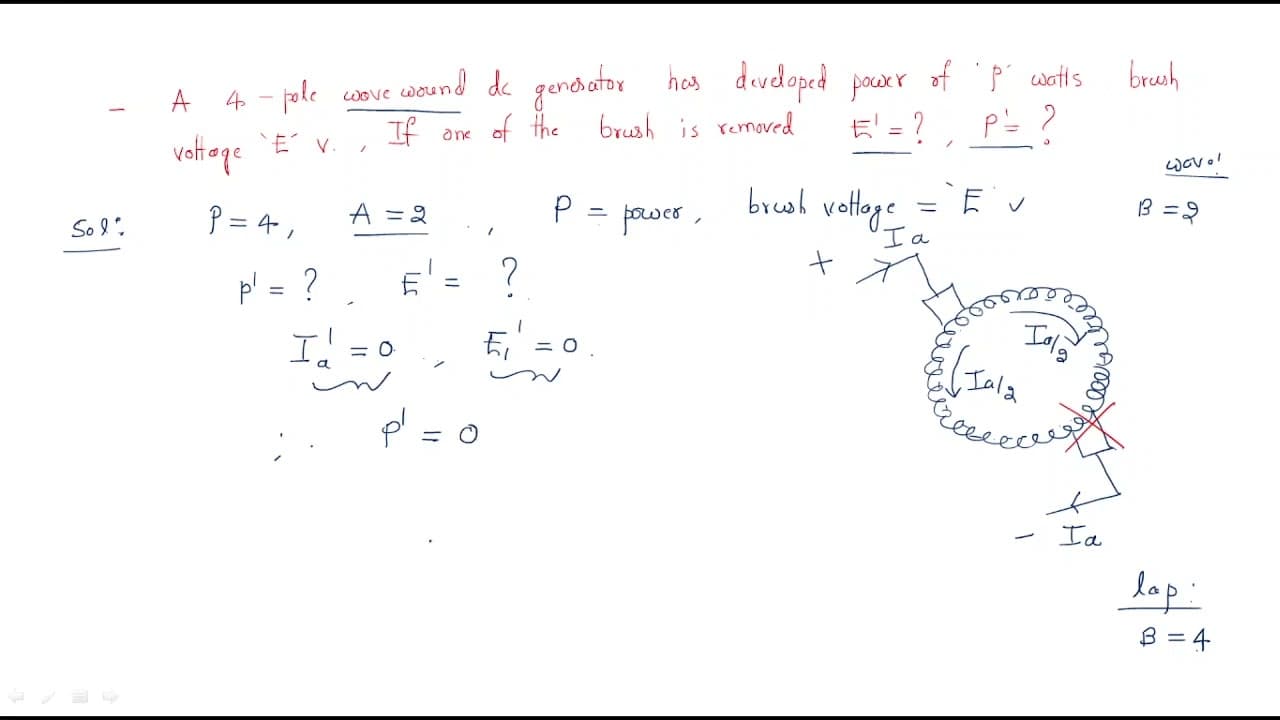
hello everyone in this session we will discuss about the next problem here the problem is a 4-pole waveone dc generator has developed a power of p watts so first write down the given data that is it is a four pole that's why p equal to four and it's a wave wound wave one means irrespective of the force the number of parallel paths a equal to 2 has ... Read More
Key Insights
- 💈 The number of poles in a DC generator, such as the 4-pole design, plays a significant role in determining the winding configuration and overall performance.
- 🥺 Wave winding's incomplete nature contrasts sharply with lap winding’s complete filling, which can lead to different mechanical and electrical characteristics.
- 👋 The introduction of dummy coils in wave winding ensures mechanical stability by managing the balance of weights, which can enhance operational reliability.
- 🥺 Circulating currents pose a challenge in lap windings due to flux unbalances, leading to significant efficiency losses and the need for careful design considerations to mitigate overheating.
- 🖌️ Brush design and positioning are critical for maintaining power output and voltage levels; even one faulty brush can lead to severe drops in performance.
- 💨 Understanding the differences in winding types helps engineers select appropriate designs based on application needs, focusing on efficiency and reliability.
- 🍻 The electrical properties of armature currents are inherently linked to the physical arrangement of windings, illustrating the interplay between design and functionality in generators.
Install to Summarize YouTube Videos and Get Transcripts
Explore YouTube Video Summarizer or Get YouTube Transcript Extractor
Questions & Answers
Q: What is the effect of removing a brush from a wave wound generator?
Removing a brush from a wave wound generator results in an open circuit, causing the total armature current to drop to zero. Consequently, both the brush voltage and power output become zero. This demonstrates the critical role of brushes in maintaining current flow and power generation in DC generators.
Q: How does wave winding differ from lap winding in DC generators?
Wave winding is characterized by having fewer parallel paths and slots filled with dummy coils, leading to an incomplete winding structure. In contrast, lap winding features complete filling of all slots without the need for dummy coils. This fundamental difference impacts current distribution and mechanical balance in the generator.
Q: Why are dummy coils used in wave winding?
Dummy coils are utilized in wave winding primarily for maintaining mechanical balance. Since wave winding often leaves some slots empty, these dummy coils help fill the gaps physically. They are similar in structure to working coils but are insulated and do not participate in the electrical circuit, ensuring even weight distribution.
Q: What causes circulating currents in lap winding?
Circulating currents in lap winding arise due to voltage unbalances among parallel paths when the generated flux differs slightly. This unbalance can lead to unwanted heating and losses within the winding as the current flows between windings, creating inefficiencies in the generator's operation.
Q: How do armature currents behave in a DC generator with wave winding?
In wave winding, the armature current is split into two equal parts due to the two parallel paths created by the brushes. This distribution helps maintain an efficient operation under normal conditions. However, if a brush is removed, this arrangement collapses, and the current drops to zero.
Q: What are the consequences of flux unbalance in lap winding?
Flux unbalance in lap winding results in circulating currents, which generate unwanted copper losses due to heat. This inefficiency can lead to overheating and potentially damage the generator. It emphasizes the importance of maintaining balanced conditions within the winding for optimal performance.
Q: How does the design of wave winding affect power output?
The design of wave winding, with its two parallel paths and the presence of dummy coils, allows for a more stable voltage and reduced risk of circulating currents. However, its incomplete nature can render the generator vulnerable to significant power loss if one brush is removed, demonstrating the system's dependency on all components.
Q: Why are wave winding generators preferred in some applications?
Wave winding generators are preferred for their reduced risk of circulating currents and better efficiency across certain loads. Their design allows for a simplified construction and beneficial characteristics in power generation, particularly in situations where a balanced distribution of magnetic flux is crucial.
Summary & Key Takeaways
-
The discussion revolves around a 4-pole DC generator, focusing on the effects of removing a brush on power development and voltage.
-
It distinguishes between wave winding and lap winding in terms of their configurations, consequences, and the handling of empty slots.
-
Special attention is given to the role of dummy coils in wave winding for mechanical balance, and the generation of circulating currents in lap winding due to flux unbalance.
Read in Other Languages (beta)
Share This Summary 📚
Summarize YouTube Videos and Get Video Transcripts with 1-Click
Try YouTube Summary with ChatGPT & Claude or YouTube Transcript Generator