Why Can't Kids Just Take Smaller Doses of Adult Meds?
TL;DR
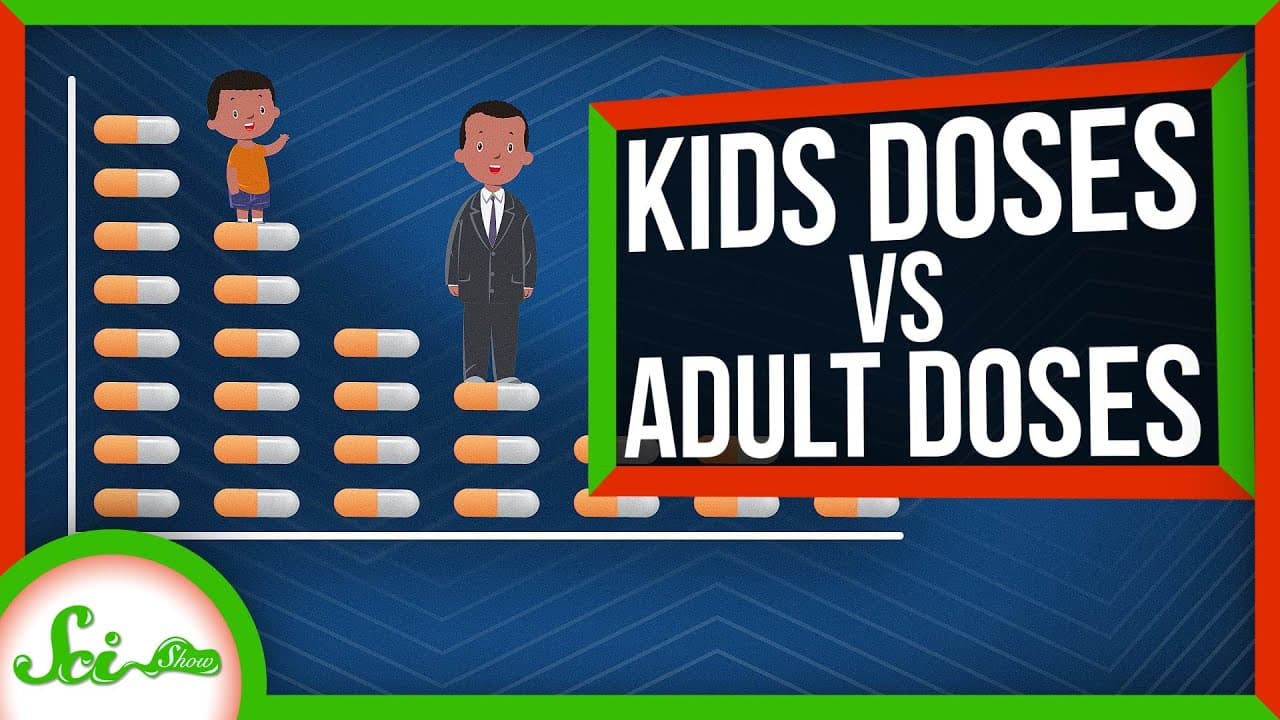
Children often require larger doses of medicine compared to adults due to their higher metabolic rates.
Transcript
thanks to brilliant for supporting this episode of scishow go to brilliant org slash scishow to learn how you can take today's lessons even deeper with their physics of the everyday course if you've ever strolled through a pharmacy in search of over-the-counter meds you might have noticed that lots of drugs have special children's formulas and you ... Read More
Key Insights
- 🖐️ Allometry is the study of changes in physiology with size and plays a crucial role in understanding drug dosing in children.
- ☠️ Metabolic rates decrease with increased body size, resulting in lower mass-specific metabolic rates for larger individuals.
- ✋ Allometric scaling impacts drug metabolism, meaning children may require higher doses to ensure drug effectiveness.
- 🔊 Surface area-to-volume ratios play a role in allometric scaling, with smaller bodies having higher metabolic rates to maintain core temperature.
- 🥶 The scaling of metabolic rates occurs not only in warm-blooded species but also in cold-blooded species like reptiles.
- 🩸 The length and branching of blood vessels in larger animals affect circulation, resulting in slower blood flow and oxygen delivery.
- 😄 Medications formulated for children are tailored to their weight, considering factors like ease of administration and potential side effects.
Install to Summarize YouTube Videos and Get Transcripts
Explore YouTube Video Summarizer or Get YouTube Transcript Extractor
Questions & Answers
Q: Why do children sometimes need larger doses of medicine compared to adults?
The higher metabolic rates in children result in faster drug metabolism, necessitating larger doses to ensure effectiveness.
Q: How does allometric scaling impact drug dosing?
Allometric scaling, influenced by metabolism, body size, and surface area-to-volume ratios, affects how the body processes drugs and determines appropriate dosing.
Q: Why can't weight-adjusted doses be given to animals?
Animals experience allometric scaling similar to humans, which means their metabolic rates and physiological processes are different from those of humans, making weight-adjusted doses inappropriate.
Q: Why are children's medicines formulated differently from adult formulations?
There are several reasons for separate children's formulations, including dosage customization based on weight, ease of administration, and safety concerns related to pill consumption.
Summary & Key Takeaways
-
Allometry refers to the study of how physiology changes with size, and it plays a significant role in determining the right dose of medicine for children.
-
Bigger bodies do not necessarily require larger doses of medicine as metabolism decreases with size, even at the cellular level.
-
Children may need higher doses of medicine to ensure the drug remains effective in their rapidly metabolizing bodies.
Read in Other Languages (beta)
Share This Summary 📚
Summarize YouTube Videos and Get Video Transcripts with 1-Click
Try YouTube Summary with ChatGPT & Claude or YouTube Transcript Generator
Explore More Summaries from SciShow 📚


Summarize YouTube Videos and Get Video Transcripts with 1-Click
Try YouTube Summary with ChatGPT & Claude or YouTube Transcript Generator