How to Use Moles to Calculate the Number of Atoms
TL;DR
To calculate the number of atoms using moles, first weigh the substance to find the number of moles by dividing its mass by the molar mass from the periodic table. Then, multiply the number of moles by Avogadro's number (6.02 x 10^23) to get the total number of atoms.
Transcript
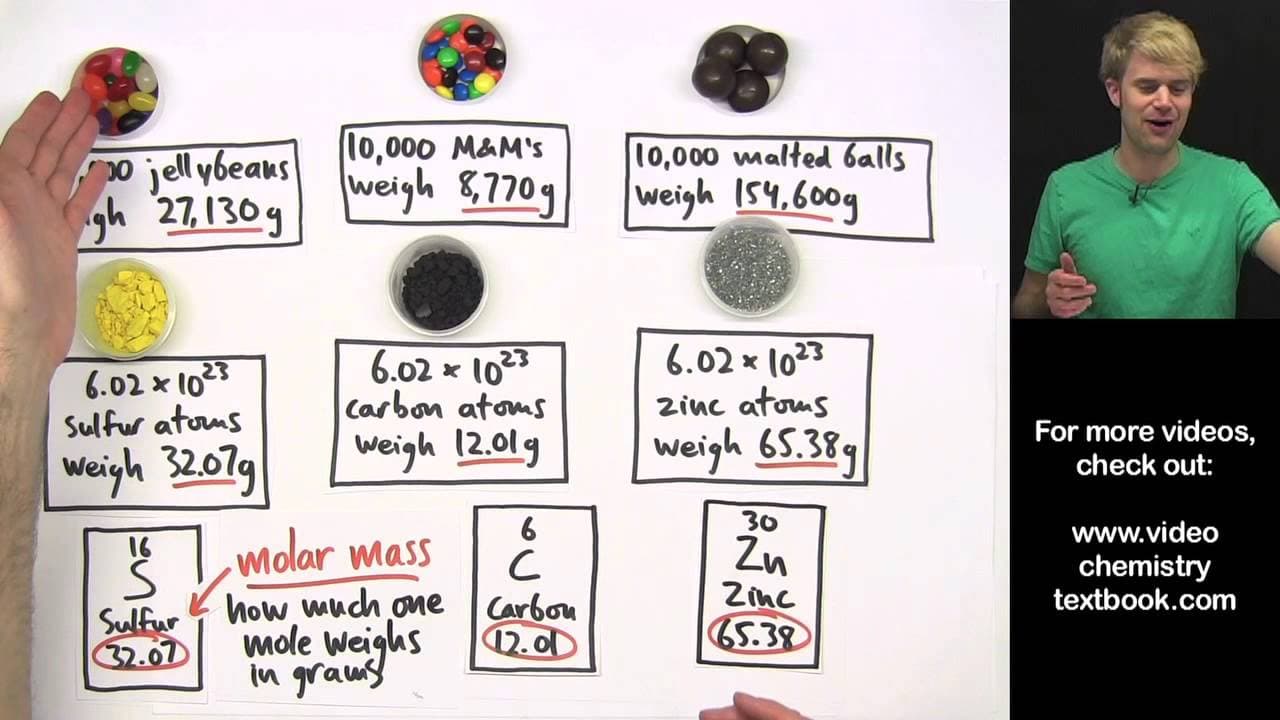
In this video, we are going to look at how we can use moles to count the number of atoms we have in something so for example here I've got a container with a bunch of chunks of Carbon in it, I want to know how many Carbon atoms do I have in here? You will learn how to figure that out here. So just a quick review of moles. A mole is kind of like a d... Read More
Key Insights
- 🫀 Moles provide a way to count atoms in a substance without manually counting each individual atom.
- 💆 The molar mass of an element is used to determine the weight of one mole of that element.
- #️⃣ The number of atoms in a substance can be calculated by multiplying the number of moles with the Avogadro's number.
- 😘 Elements with lower molar masses will have a larger number of atoms in one mole compared to elements with higher molar masses.
- 💆 Moles and the concept of molar mass are essential in stoichiometry and chemical reactions.
- 👻 Weighing substances allows for the determination of the number of moles present.
- 🌥️ Scientific notation is commonly used to simplify large numbers in calculations.
Install to Summarize YouTube Videos and Get Transcripts
Explore YouTube Video Summarizer or Get YouTube Transcript Extractor
Questions & Answers
Q: How can moles be used to count the number of atoms?
Moles provide a way to count the number of atoms in a substance by multiplying the number of moles with the Avogadro's number (6.02 x 10^23), which is the number of atoms in one mole.
Q: Why can't atoms be counted manually?
Atoms are too small to be seen even with powerful microscopes, making manual counting impossible. Additionally, the vast number of atoms in a mole would make it impractical to count them individually.
Q: How is the molar mass of an element determined?
The molar mass of an element is found on the periodic table. It represents how much one mole of that element weighs in grams.
Q: How can the number of atoms be determined using moles and the molar mass?
By weighing a substance and calculating the number of moles based on the molar mass, the number of atoms can be determined by multiplying the moles with the Avogadro's number.
Summary & Key Takeaways
-
Moles are used to count the number of atoms in a substance, similar to how dozens are used to count quantities.
-
Atoms are too small to be counted individually, and even if they were visible, the sheer number of atoms in a mole makes manual counting impractical.
-
The molar mass of an element, found on the periodic table, tells us how much one mole of that element weighs in grams.
Read in Other Languages (beta)
Share This Summary 📚
Summarize YouTube Videos and Get Video Transcripts with 1-Click
Try YouTube Summary with ChatGPT & Claude or YouTube Transcript Generator
Explore More Summaries from Tyler DeWitt 📚






Summarize YouTube Videos and Get Video Transcripts with 1-Click
Try YouTube Summary with ChatGPT & Claude or YouTube Transcript Generator