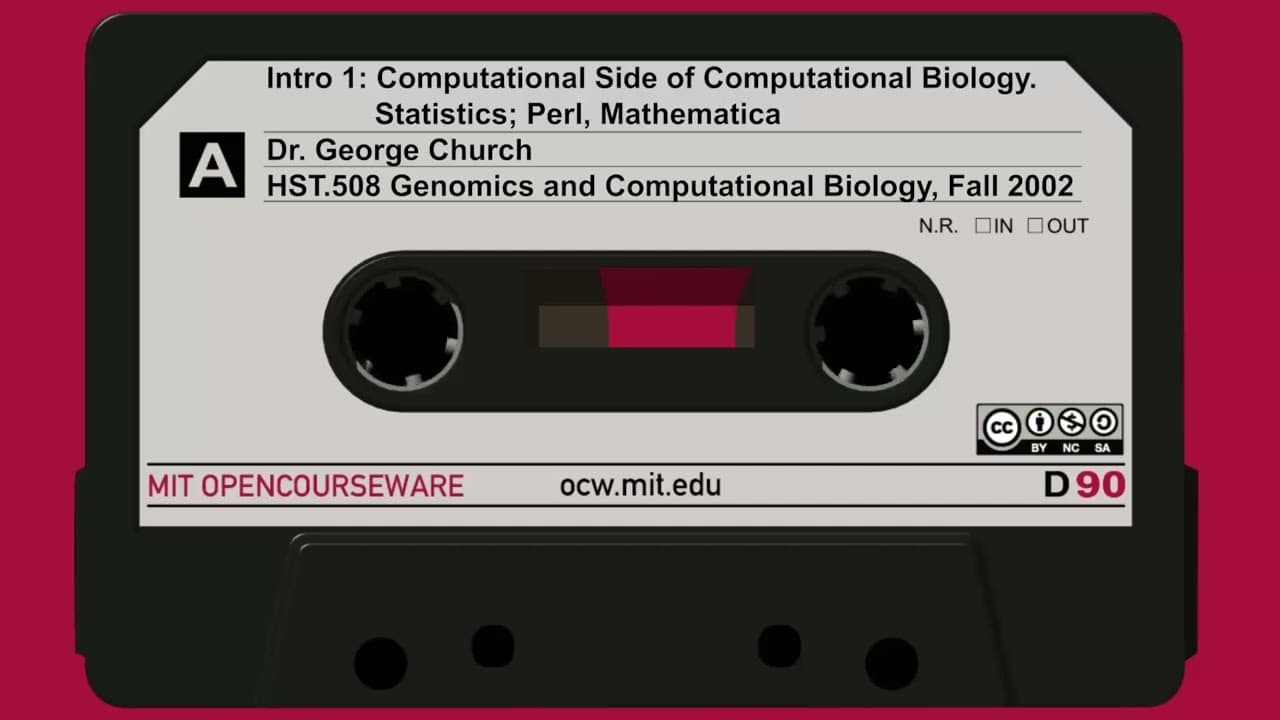
1A. Intro 1: Computational Side of Computational Biology. Statistics; Perl, Mathematica
TL;DR
The content provides an analysis of the similarities and differences between biological and computational systems, highlighting the importance of modeling, replication, complexity, and optimization.
Transcript
The following content is provided by MIT OpenCourseWare under a Creative Commons license. Additional information about our license and MIT OpenCourseWare in general is available at ocu.mit.edu. GEORGE CHURCH: OK. We're getting ready. And let's go. OK. So welcome to the first class of BIOE101 or biophysics 101 or HST.508 or Genetics 224. You can see... Read More
Key Insights
- 🏑 Collaboration and interdisciplinary knowledge are essential in the field of bioinformatics.
- 👻 Modeling allows us to analyze complex data, make predictions, and understand the underlying principles of biological and computational systems.
- ❓ Replication is crucial for growth and evolution in both biological and computational systems.
- 🖐️ Complexity plays a significant role in understanding the behavior and relationships within biological and computational systems.
- 🤩 Optimization is key for enhancing the functionality and adaptability of both biological and computational systems.
- ❓ Replication, complexity, and optimization are interconnected and influence each other in biological and computational systems.
- 🅰️ Both biological and computational systems rely on precise measurements, the acknowledgment of errors, and the integration of various data types.
Install to Summarize YouTube Videos and Get Transcripts
Explore YouTube Video Summarizer or Get YouTube Transcript Extractor
Questions & Answers
Q: Why is modeling important in understanding biological and computational systems?
Modeling allows us to analyze and interpret complex data, share and integrate information, and make predictions about the behavior of biological and computational systems. By using models, we can design modifications, check data, and understand the underlying principles of these systems.
Q: How does the concept of replication apply to both biological and computational systems?
Replication is a fundamental process in biology, where organisms reproduce and pass on their genetic information to the next generation. In computational systems, replication refers to the ability to create copies or simulate the behavior of a system. Both biological and computational systems rely on replication for growth, evolution, and the ability to replicate complex structures.
Q: What is the significance of complexity in biological and computational systems?
Complexity refers to the intricate and interconnected nature of biological and computational systems. It encompasses factors such as the number of components, functional relationships, and the ability to adapt to different environments. Understanding complexity helps us analyze and predict the behavior of these systems and identify patterns and relationships across different levels of organization.
Q: How does optimization play a role in both biological and computational systems?
Optimization refers to the process of maximizing or improving certain aspects of a system. In biological systems, natural selection acts as a form of optimization, favoring traits that increase an organism's fitness in a given environment. In computational systems, optimization refers to improving algorithms or designs to achieve better performance or efficiency. Both biological and computational systems can be optimized to enhance their functionality and adaptability.
Summary & Key Takeaways
-
The content discusses the interdisciplinary nature of a bioinformatics course and highlights the importance of collaboration and interdisciplinary knowledge in the field.
-
It introduces the concept of modeling and its relevance in understanding and analyzing biological and computational systems.
-
The content explores the significance of replication, complexity, and optimization in both biological and computational systems, highlighting their interplay and impact.
Read in Other Languages (beta)
Share This Summary 📚
Summarize YouTube Videos and Get Video Transcripts with 1-Click
Try YouTube Summary with ChatGPT & Claude or YouTube Transcript Generator
Explore More Summaries from MIT OpenCourseWare 📚



Summarize YouTube Videos and Get Video Transcripts with 1-Click
Try YouTube Summary with ChatGPT & Claude or YouTube Transcript Generator