Lecture 6.4: MVPA: Window on the Mind via fMRI, Part 2
TL;DR
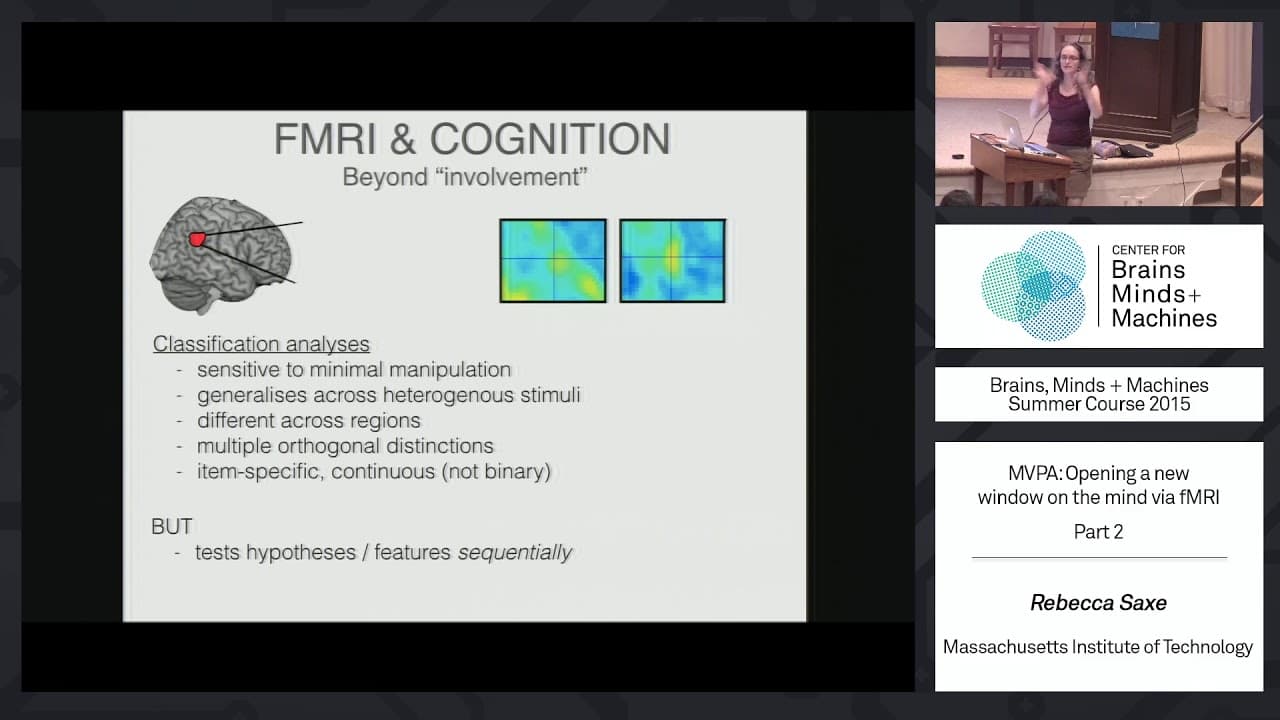
MVPA is a powerful tool used to analyze fMRI data by treating each voxel as a dimension in a multi-dimensional space, allowing researchers to decode and classify different stimuli and develop insights into brain representations.
Transcript
The following content is provided under a Creative Commons license. Your support will help MIT OpenCourseWare continue to offer high quality educational resources for free. To make a donation or view additional materials from hundreds of MIT courses, visit MIT OpenCourseWare at ocw.mit.edu. REBECCA SAXE: There's a whole bunch of limitations of Haxb... Read More
Key Insights
- 💁 The spatial correlations used in MVPA are stable and robust but only provide binary information about distinctions.
- 👻 Treating fMRI data as a multi-dimensional space allows for the application of machine learning techniques.
- 🤯 MVPA can classify and decode different stimuli, revealing brain representations for emotions and theory of mind.
- ❓ Representational dissimilarity matrices can show the distinctiveness of stimuli in neural representations.
- 💁 MVPA has limitations in capturing fine-scale neural representations and cannot make conclusions about the absence of encoded information.
- 👾 The idea of similarity space as points in multi-dimensional spaces is limited and cannot explain concept compositionality.
- 👾 MVPA can be used to study the temporal dynamics of brain representations and the unfolding of representational spaces over time.
Install to Summarize YouTube Videos and Get Transcripts
Explore YouTube Video Summarizer or Get YouTube Transcript Extractor
Questions & Answers
Q: What are the limitations of the Haxby-style correlations in fMRI data?
One limitation is that the tests are binary, only providing information on whether there is a distinction or not. Another limitation is the lack of continuous measures in the data.
Q: How can fMRI data be treated as a multi-dimensional space using MVPA?
Each voxel can be treated as a dimension in voxel space, and the response pattern to a stimulus can be represented as a vector in voxel space. This allows for the analysis of multi-dimensional data using machine learning techniques.
Q: What are some common applications of MVPA in fMRI data analysis?
One common application is the classification of different categories or dimensions of stimuli using linear classification techniques. Another application is the identification of clusters and dimensions in the data.
Q: Can representational dissimilarity matrices reveal the dimensionality of neural representations?
No, the dimensionality of the theory that generates the matrices does not impact the fit of the data. Representational dissimilarity matrices provide a parameter-free fit, showing the relative distances between stimuli.
Summary & Key Takeaways
-
MVPA involves treating each voxel in fMRI data as a dimension in a multi-dimensional space, allowing for the classification and decoding of stimuli.
-
MVPA can be used to analyze different brain representations, such as emotions and theory of mind, and uncover relationships between brain regions and cognitive processes.
-
Representational dissimilarity matrices provide a parameter-free fit to the data and can show the distinctiveness of different stimuli in neural representations.
Read in Other Languages (beta)
Share This Summary 📚
Summarize YouTube Videos and Get Video Transcripts with 1-Click
Try YouTube Summary with ChatGPT & Claude or YouTube Transcript Generator
Explore More Summaries from MIT OpenCourseWare 📚



Summarize YouTube Videos and Get Video Transcripts with 1-Click
Try YouTube Summary with ChatGPT & Claude or YouTube Transcript Generator