NVIDIA’s New AI: 20% Faster Game Graphics!
TL;DR
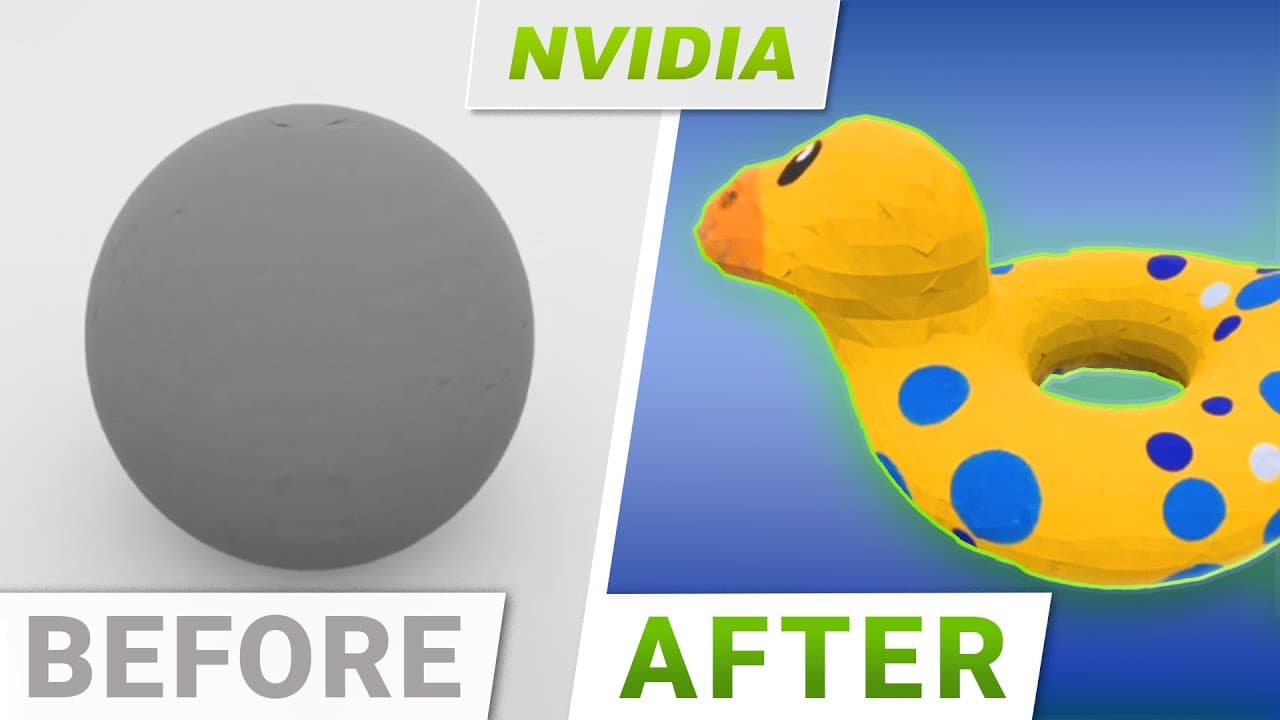
A new technique for reconstructing 3D objects from images offers improved generative modeling, physics simulation, and 3D printing capabilities.
Transcript
This paper has a ton of promise. Amazing promises. Get this: it promises to reconstruct 3D objects from a bunch of images. It promises better generative 3D modeling, even creating an animated 3D model of us moving, tetrahedral mesh geometry for physics simulation for squishy things, and can also recommend geometry models that are easier t... Read More
Key Insights
- 📰 The paper introduces a new technique for reconstructing 3D objects from images with improved results.
- ❓ The technique offers better generative 3D modeling, physics simulations, and recommendations for 3D printing.
- ⏮️ Previous techniques like Marching Cubes and Neural Dual Contouring had limitations in achieving desired shapes and flexibility.
- 👻 The new technique allows for the creation of high-quality 3D geometry and animations.
- 🔺 It offers memory and rendering efficiency by using fewer triangle elements.
- 😤 The new technique addresses issues in nose regions, making the generated geometry more suitable for 3D printing.
- 🎮 While not yet suitable for high-end video games, the paper highlights the significant value of this advancement.
Install to Summarize YouTube Videos and Get Transcripts
Explore YouTube Video Summarizer or Get YouTube Transcript Extractor
Questions & Answers
Q: What is the main focus of the paper?
The paper focuses on a new technique for reconstructing 3D objects from images and its potential applications in various fields.
Q: How does the new technique compare to previous methods like Marching Cubes?
While previous techniques like Marching Cubes had limitations in achieving desired shapes, the new technique offers a seemingly perfect reconstruction of the desired geometry.
Q: What additional capabilities does the new technique offer?
The new technique allows for physics simulations, generation of high-quality 3D geometry, animations, and 3D printing of models with fewer memory requirements.
Q: What are the potential limitations of the new technique?
Although the new technique offers significant advancements, the generated assets may not be suitable for high-end video games, and further improvements are expected in future research.
Summary & Key Takeaways
-
The paper introduces a new technique for reconstructing 3D objects from images, offering various promising applications.
-
The previous techniques, such as Marching Cubes and Neural Dual Contouring, had limitations in achieving desired shapes and flexibility.
-
The new technique enables the creation of high-quality 3D geometry, animations, and printable models with improved efficiency.
Read in Other Languages (beta)
Share This Summary 📚
Summarize YouTube Videos and Get Video Transcripts with 1-Click
Try YouTube Summary with ChatGPT & Claude or YouTube Transcript Generator
Explore More Summaries from Two Minute Papers 📚



Summarize YouTube Videos and Get Video Transcripts with 1-Click
Try YouTube Summary with ChatGPT & Claude or YouTube Transcript Generator