Curriculum Learning in Deep Neural Networks
TL;DR
Curriculum learning organizes training data by difficulty for improved neural network performance.
Transcript
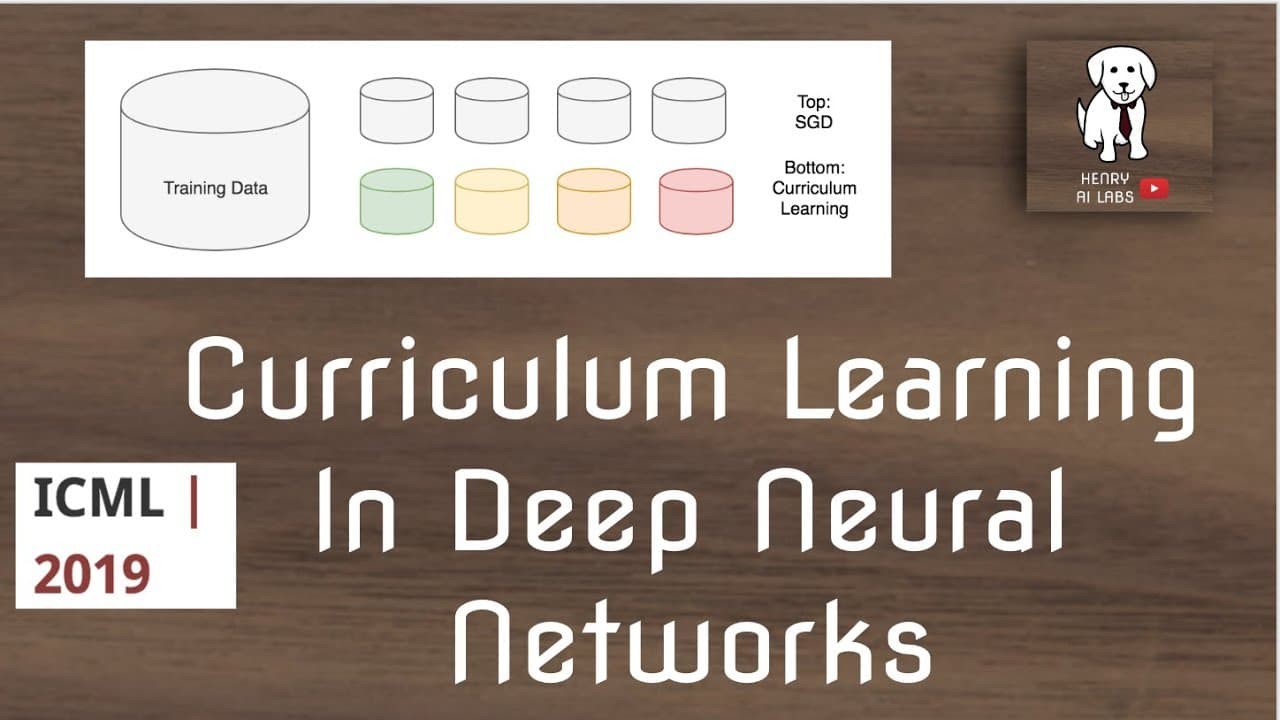
this video will present a study on curriculum learning and training deep neural networks this research paper was accepted into the ICML 2019 conference we'll begin the presentation by explaining the difference between curriculum learning in standard stochastic gradient descent in stochastic gradient descent mini-batches are randomly sampled from th... Read More
Key Insights
- 🎁 Curriculum learning mimics human educational practices by gradually increasing the complexity of tasks presented to a learning model.
- ⚾ Two distinct scoring functions for sample difficulty enhance the training process: one based on predefined networks and another using the same model’s architecture.
- 🈸 Pacing functions, which regulate how quickly harder samples are introduced, are critical for effective curriculum learning applications.
- 🥺 Even though curriculum learning led to improvement, the overall accuracy gains were modest, signaling room for further refinement.
- ❓ The comparative performance of various scoring and pacing methods indicated that while improvements exist, they are often marginal.
- 🏛️ Maintaining balance in the representation of classes within training samples is essential to prevent biases that may derail model training.
- ☠️ Future explorations could benefit from deeper investigations into hyperparameter tuning related to learning rates and sample ordering.
Install to Summarize YouTube Videos and Get Transcripts
Explore YouTube Video Summarizer or Get YouTube Transcript Extractor
Questions & Answers
Q: How does curriculum learning differ from traditional stochastic gradient descent?
Curriculum learning organizes training samples by ascending difficulty, unlike traditional stochastic gradient descent, where mini-batches are randomly sampled. This approach allows the model to learn easier concepts first, emulating the human learning process, and can lead to better performance in training deep neural networks.
Q: What are the two primary functions discussed in curriculum learning?
The two primary functions in curriculum learning are the scoring function, which ranks sample difficulty, and the pacing function, which determines how progressively harder samples are introduced to the model. These functions are crucial as they significantly impact the effectiveness of the training regimen.
Q: What were the findings regarding the anti-curriculum method?
The anti-curriculum method, which ranks samples in descending difficulty, performed poorly, yielding a 1% decrease in accuracy compared to standard stochastic gradient descent. This indicates that a careful selection and ordering of samples are essential for effective training of neural networks.
Q: How does class imbalance affect curriculum learning?
Class imbalance can introduce biases in curriculum learning, especially as samples progress from easier to harder ones. Ensuring a representative balance of class labels during sample selection helps maintain effective training and mitigates negative impacts on model performance.
Summary & Key Takeaways
-
Curriculum learning contrasts with standard stochastic gradient descent by organizing training mini-batches according to difficulty, facilitating gradual learning akin to teaching concepts in an ascending order of complexity.
-
The study introduced two scoring functions for ranking sample difficulty: one using transfer learning from a pre-trained network and another using the same architecture for bootstrapping, affecting how samples are introduced during training.
-
Results of the experiments indicated a slight improvement in accuracy, demonstrating that while curriculum learning can enhance training, its performance remains modest compared to traditional methods, with careful consideration required regarding class imbalance.
Read in Other Languages (beta)
Share This Summary 📚
Summarize YouTube Videos and Get Video Transcripts with 1-Click
Try YouTube Summary with ChatGPT & Claude or YouTube Transcript Generator
Explore More Summaries from Connor Shorten 📚
Summarize YouTube Videos and Get Video Transcripts with 1-Click
Try YouTube Summary with ChatGPT & Claude or YouTube Transcript Generator