Self excited generator | Critical Speed & Load resistance | Types of DC Machines | Lec-27
TL;DR
Understanding self-excited generators involves concepts like residual magnetism, critical speed, and load resistance.
Transcript
hello everyone we are in this session we discussed about some important points regarding the self-exited generator in that we already discussed about the first point residual magnetism and the second point is field flashing so what is the field flashing now whenever whenever the residual magnetism will become zero that time we will give small dc ex... Read More
Key Insights
- 🤳 Understanding residual magnetism is vital for self-excited generator operation and successful voltage buildup.
- 🛟 Field flashing serves as an essential technique for reviving generator magnetism when it becomes insufficient.
- 🐎 Critical speed is fundamental; generators must operate above this to ensure effective voltage generation.
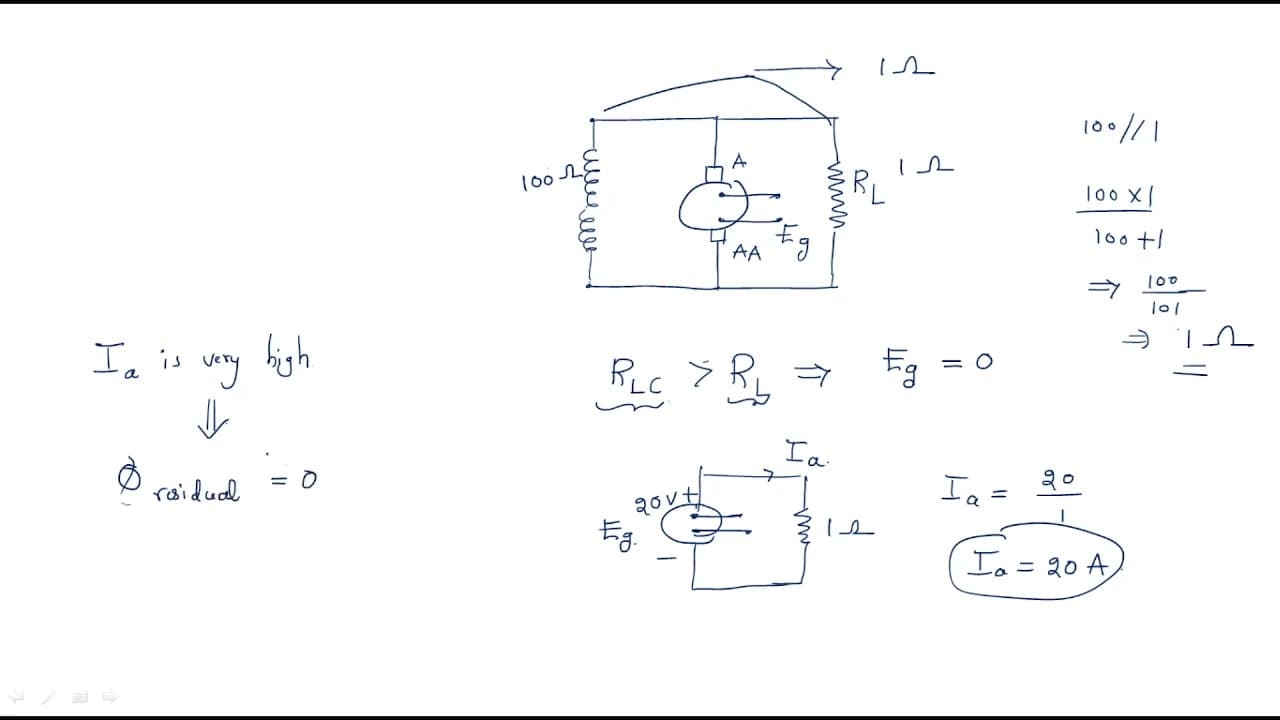
- ⚡ The load resistance should always exceed critical load resistance to maintain voltage and prevent generator failure.
- ❓ Armature current directly affects residual magnetism; excessive current can demagnetize the generator.
- 💨 The emf generated is determined by intricate factors, including speed, magnetic flux, and winding parameters.
- 🐎 The relationship between critical resistance and operating speed is vital for maintaining generator efficiency.
Install to Summarize YouTube Videos and Get Transcripts
Explore YouTube Video Summarizer or Get YouTube Transcript Extractor
Questions & Answers
Q: What is residual magnetism, and why is it important in self-excited generators?
Residual magnetism refers to the small magnetism remaining in the generator's core even when it's turned off. It is essential because it allows for initial voltage generation when the generator starts. Without sufficient residual magnetism, the generator may fail to produce voltage.
Q: How does field flashing assist in recovering residual magnetism?
Field flashing involves applying a small DC excitation to the generator’s windings when residual magnetism is low or absent. This process helps restore the magnetic field, allowing the generator to build up voltage and enabling operation.
Q: What factors determine the critical speed of a self-excited generator?
Critical speed is influenced by a combination of generator design, windings, and external resistances. It's the minimum speed required for the generator to maintain voltage generation without external assistance or resistances.
Q: How is critical load resistance related to voltage generation?
Critical load resistance is the threshold below which the generator cannot sustain voltage generation. If the load resistance falls below this critical level, the combination of current and resistance can demagnetize the residual magnetism, leading to zero voltage output.
Q: What is the formula for calculating generated emf in a self-excited generator?
The formula for the generated electromotive force (emf) is Eg = (P * Φ * N * Z) / 60A, where P is the number of poles, Φ is the magnetic flux, N is the speed in RPM, Z is the number of conductors, and A is the number of parallel paths.
Q: Can you explain the significance of armature current in relation to demagnetization?
High armature current can lead to demagnetization of residual magnetism. If armature current exceeds the capacity of the magnetic field, it can result in reduced magnetic flux, which in turn leads to insufficient voltage generation.
Q: How does varying the speed impact critical resistance in generators?
Critical resistance is proportionally related to the operating speed of the generator. As the speed increases, the critical resistance also increases, demonstrating the importance of maintaining sufficient speed for optimal generator performance.
Q: What problem was discussed concerning a generator with different speeds?
The session analyzed a problem involving a self-excited generator with critical resistance at different speeds. It determined that the critical resistance increases with speed, exploring the mathematical relationship between the two.
Summary & Key Takeaways
-
The session covered essential principles of self-excited generators, focusing on residual magnetism, field flashing, and critical speed. These concepts are crucial for ensuring proper operation and voltage buildup in generators.
-
Critical speed is defined as the minimum speed required for the generator to develop voltage. If the speed drops below this threshold, the generated electromotive force (emf) becomes ineffective.
-
The load resistance must exceed the critical load resistance to avoid voltage failure. If the load resistance is too low, it can demagnetize the generator's residual magnetism and prevent voltage generation.
Read in Other Languages (beta)
Share This Summary 📚
Summarize YouTube Videos and Get Video Transcripts with 1-Click
Try YouTube Summary with ChatGPT & Claude or YouTube Transcript Generator