How to Find the Inverse of Logarithmic Functions
TL;DR
To find the inverse of a logarithmic function, start by replacing the function with 'y' and switching the variables. Convert the logarithmic form to exponential form, then solve for 'y' using algebraic manipulations. Finally, replace 'y' with the inverse notation to express your final answer.
Transcript
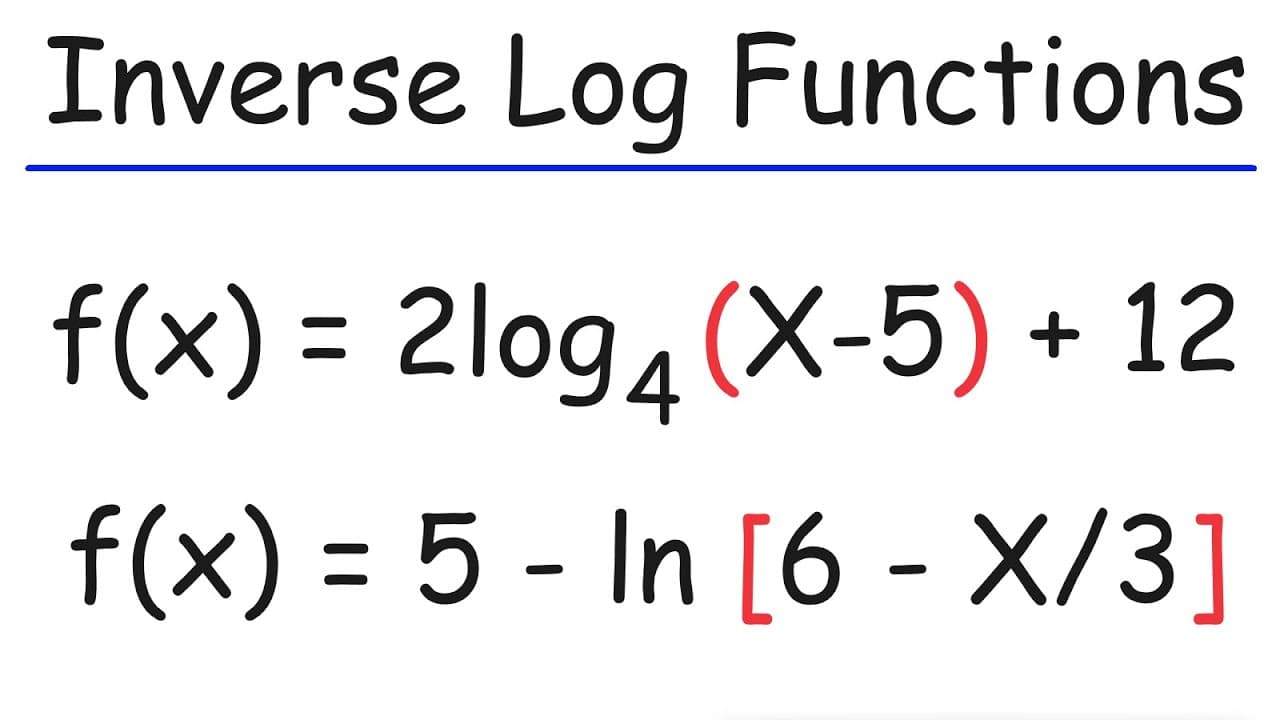
in this video we're going to talk about how to find the inverse of a logarithmic function so let's start with this one we have f of x is equal to log base 2 of x minus 3 minus 5. so the first thing we want to do is replace f of x with y now in the second step we need to switch X and Y third now we need to solve for the Y variable so in order to do ... Read More
Key Insights
- 😀 Finding the inverse of a logarithmic function involves replacing the function with "y" and switching the variables.
- 😑 Converting a logarithmic expression to exponential form is essential to solve for the inverse function.
- 😀 Algebraic operations, such as adding, subtracting, multiplying, or dividing, are used to isolate "y" in the equation.
Install to Summarize YouTube Videos and Get Transcripts
Explore YouTube Video Summarizer or Get YouTube Transcript Extractor
Questions & Answers
Q: How do you find the inverse of a logarithmic function?
To find the inverse of a logarithmic function, start by replacing the function with "y" and switching the variables. Then, convert the logarithmic expression to exponential form and solve for "y" using algebraic operations.
Q: What is the formula to convert a logarithmic expression to exponential form?
The formula to convert a logarithmic expression to exponential form is a^c = b, where "a" is the base of the logarithm, "c" is the exponent, and "b" is the number inside the logarithm.
Q: How can you solve for "y" in the inverse function?
To solve for "y" in the inverse function, manipulate the equation by applying algebraic operations. This may involve adding, subtracting, multiplying, or dividing certain terms until "y" is isolated on one side of the equation.
Q: How do you represent the inverse function?
The inverse function is represented by replacing "y" with the inverse notation, usually indicated as f^(-1)(x). This indicates that the function is the inverse of the original function.
Summary & Key Takeaways
-
The first step is to replace the function with "y" and switch the variables.
-
Convert the logarithmic expression to exponential form using the formula a^c = b, where a is the base, c is the exponent, and b is inside the log.
-
Solve for "y" by manipulating the equation and applying algebraic operations.
-
The inverse function is represented by replacing "y" with the inverse notation and expressing the final answer.
Read in Other Languages (beta)
Share This Summary 📚
Summarize YouTube Videos and Get Video Transcripts with 1-Click
Try YouTube Summary with ChatGPT & Claude or YouTube Transcript Generator
Explore More Summaries from The Organic Chemistry Tutor 📚



Summarize YouTube Videos and Get Video Transcripts with 1-Click
Try YouTube Summary with ChatGPT & Claude or YouTube Transcript Generator