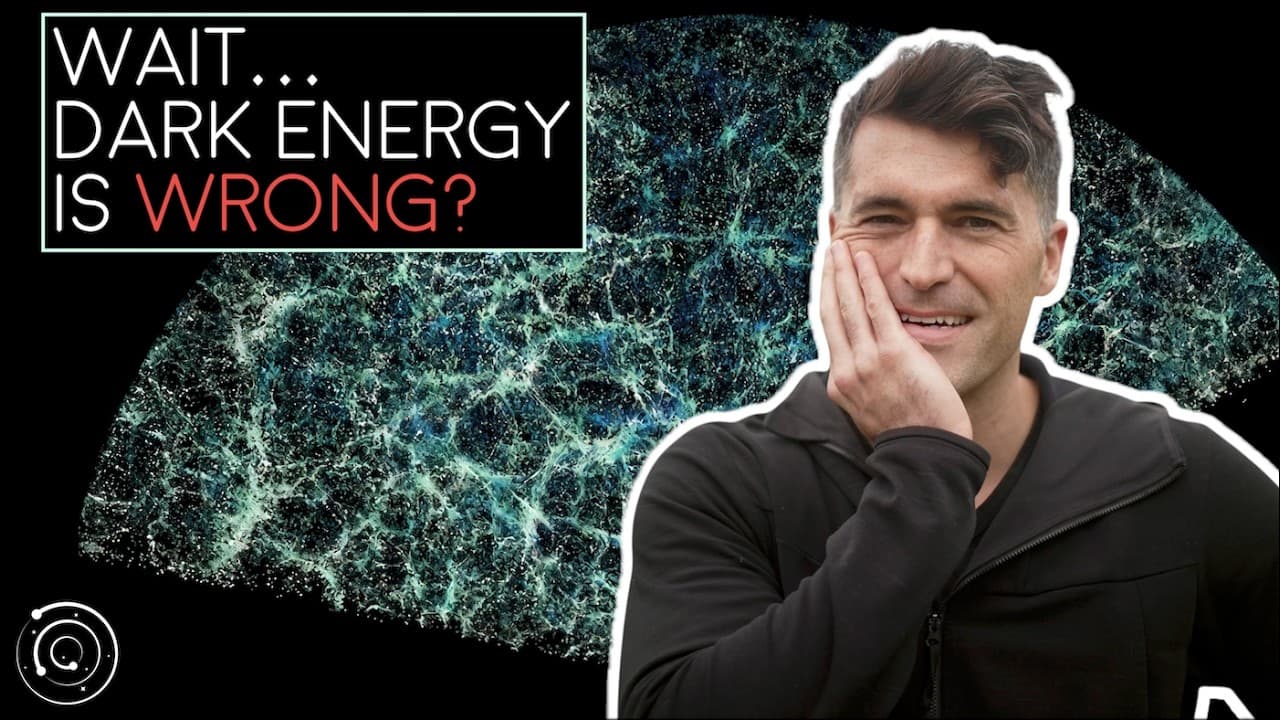
Did Astronomers Just Prove Dark Energy is an Illusion?
TL;DR
New theory suggests dark energy may be an illusion.
Transcript
the standard model of cosmology conceives of a universe which is made up of 68% Dark Energy a mysterious substance for which we know next to nothing about we've lived with this idea for decades now but new work suggest that this entire idea could be wrong that there is no Dark Energy it's all Just an Illusion created inart by subtle... Read More
Key Insights
- The standard cosmological model posits that 68% of the universe is made up of dark energy, a mysterious force causing accelerated expansion.
- The Timescape theory challenges the existence of dark energy, suggesting observed effects are due to subtle time dilation in general relativity.
- The 2011 Nobel Prize in Physics was awarded for discovering the universe's accelerating expansion, initially attributed to dark energy.
- Type 1A supernovae, used as standard candles, have been pivotal in measuring cosmic distances and supporting the accelerated expansion theory.
- Timescape theory, proposed by David Wiltshire, argues that voids in the universe expand faster, affecting light's redshift and creating an illusion of acceleration.
- Antonio Seifert's analysis of the Pantheon Plus supernova catalog found Timescape predictions align better than the Lambda CDM model.
- Despite intriguing results, Timescape theory is not yet definitive proof against dark energy, which remains a cornerstone of cosmological models.
- Scientists remain open to challenging established theories, as evidenced by the ongoing investigation into Timescape's validity across various observations.
Install to Summarize YouTube Videos and Get Transcripts
Explore YouTube Video Summarizer or Get YouTube Transcript Extractor
Questions & Answers
Q: What is the standard model of cosmology's view on dark energy?
The standard model of cosmology, known as Lambda CDM, posits that dark energy comprises about 68% of the universe. It is believed to be responsible for the accelerated expansion of the universe. However, dark energy remains a mysterious and poorly understood concept, essentially added to the model to account for observed phenomena.
Q: How does the Timescape theory challenge the concept of dark energy?
Timescape theory, proposed by physicist David Wiltshire, challenges the existence of dark energy by suggesting that observed cosmic acceleration is an illusion. This theory attributes the acceleration to time dilation effects in general relativity, where voids in the universe expand faster, affecting light's redshift and creating the appearance of acceleration without requiring dark energy.
Q: What role do Type 1A supernovae play in cosmology?
Type 1A supernovae are crucial in cosmology as they serve as standard candles with known intrinsic brightness. By measuring their apparent brightness and redshift, astronomers can determine cosmic distances and velocities. This data was pivotal in discovering the universe's accelerating expansion, initially credited to dark energy, and continues to test alternative theories like Timescape.
Q: What were the findings of Antonio Seifert's analysis regarding Timescape theory?
Antonio Seifert's analysis of the Pantheon Plus supernova catalog found that the Timescape theory's predictions align better with the data than the traditional Lambda CDM model. While not conclusive, this suggests that Timescape may offer a more accurate explanation for certain cosmic observations, challenging the need for dark energy in the standard cosmological model.
Q: Why is the Timescape theory not yet definitive proof against dark energy?
The Timescape theory, despite its intriguing alignment with supernova data, is not yet definitive proof against dark energy because it has not been tested across a wide range of cosmic phenomena. The Lambda CDM model, which includes dark energy, successfully explains a broader set of observations beyond just supernovae, making it a more established framework in cosmology.
Q: How does the scientific community view challenges to established theories like dark energy?
The scientific community welcomes challenges to established theories, as they are essential for progress and self-correction in science. The investigation into Timescape theory exemplifies this openness, as researchers seek to verify its predictions across various observations. This process ensures that cosmological models remain robust and reflective of the best available evidence.
Q: What implications would disproving dark energy have on our understanding of the universe?
Disproving dark energy would radically alter our understanding of the universe's structure and fate. It would require reevaluating the mechanisms driving cosmic expansion and could lead to new insights into fundamental physics. Such a paradigm shift would underscore the dynamic nature of scientific inquiry and the importance of continually testing and refining our models of the universe.
Q: What is the significance of the Nobel Prize awarded for the discovery of the universe's accelerated expansion?
The 2011 Nobel Prize in Physics was awarded for the discovery of the universe's accelerated expansion, a finding that revolutionized cosmology by introducing the concept of dark energy. This discovery highlighted the universe's dynamic nature and the need for new physics to explain the observed acceleration, prompting ongoing research into alternative theories like Timescape.
Summary & Key Takeaways
-
The standard model of cosmology includes dark energy to explain the universe's accelerated expansion, a concept challenged by the Timescape theory. Timescape suggests this acceleration is an illusion caused by time dilation effects in general relativity, with recent studies showing it may better fit certain observations.
-
Type 1A supernovae serve as crucial tools for measuring cosmic expansion. The 2011 Nobel Prize recognized their role in discovering the universe's acceleration. However, new research indicates that the Timescape theory might explain supernova data more accurately than the traditional Lambda CDM model.
-
Antonio Seifert's research analyzed supernovae data, finding the Timescape model's predictions align better than those of the standard cosmological model. While not definitive proof against dark energy, this suggests the need for further exploration of Timescape's potential to explain cosmic phenomena.
Read in Other Languages (beta)
Share This Summary 📚
Summarize YouTube Videos and Get Video Transcripts with 1-Click
Try YouTube Summary with ChatGPT & Claude or YouTube Transcript Generator
Explore More Summaries from Cool Worlds 📚
Summarize YouTube Videos and Get Video Transcripts with 1-Click
Try YouTube Summary with ChatGPT & Claude or YouTube Transcript Generator