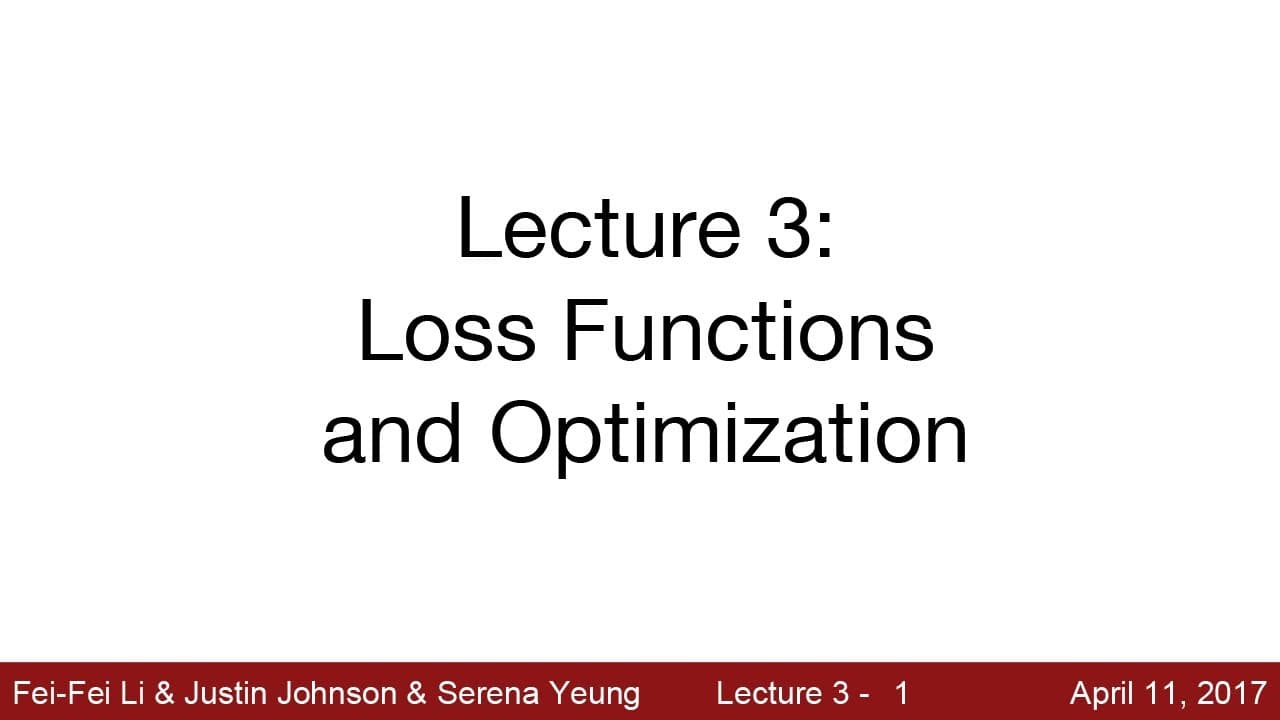
Lecture 3 | Loss Functions and Optimization
TL;DR
Lecture covers loss functions, optimization, and feature representations in image classification.
Transcript
- Okay so welcome to CS 231N Lecture three. Today we're going to talk about loss functions and optimization but as usual, before we get to the main content of the lecture, there's a couple administrative things to talk about. So the first thing is that assignment one has been released. You can find the link up on the website. And since we were a li... Read More
Key Insights
- The lecture introduces loss functions, specifically multiclass SVM and multinomial logistic regression, to quantify the accuracy of a model's predictions in image classification.
- Regularization is discussed as a method to prevent overfitting, with weight decay as a specific example of regularization.
- Optimization techniques, particularly stochastic gradient descent, are presented as methods to minimize loss functions and improve model accuracy.
- The lecture explains the importance of selecting appropriate step sizes or learning rates in gradient descent to ensure efficient convergence.
- Feature representations, such as color histograms and histograms of oriented gradients, are highlighted as crucial in improving image classification performance.
- The concept of gradient descent is explained through the analogy of navigating a landscape to find the lowest point, representing the optimal model parameters.
- The lecture emphasizes the role of calculus in deriving analytic expressions for gradients, which are essential for effective optimization.
- The transition from traditional feature-based methods to convolutional neural networks is briefly discussed, highlighting the shift towards learning features directly from data.
Install to Summarize YouTube Videos and Get Transcripts
Explore YouTube Video Summarizer or Get YouTube Transcript Extractor
Questions & Answers
Q: What is the purpose of a loss function in image classification?
A loss function in image classification serves to quantify how accurately a model's predictions align with the true labels. It provides a numerical measure of the 'badness' of the model's predictions, allowing for the optimization of the model parameters to minimize this loss. Two examples of loss functions discussed are the multiclass SVM loss and the multinomial logistic regression loss, each with different mechanisms for evaluating prediction accuracy.
Q: How does regularization help prevent overfitting in machine learning models?
Regularization is a technique used to prevent overfitting by adding a penalty term to the loss function, which discourages overly complex models. This penalty term, often based on the model's parameters, encourages the model to find a simpler hypothesis that generalizes better to new data. An example of regularization is weight decay, which penalizes large weights in the model, thus helping to maintain a balance between fitting the training data and keeping the model simple.
Q: What is stochastic gradient descent and why is it used in optimization?
Stochastic gradient descent (SGD) is an optimization technique used to minimize loss functions by iteratively updating model parameters. Unlike traditional gradient descent, which uses the entire dataset to compute gradients, SGD uses a small random subset (minibatch) of data at each step. This makes the optimization process faster and computationally efficient, especially for large datasets. The randomness introduced by minibatches can also help escape local minima, potentially leading to better solutions.
Q: Why is the choice of step size or learning rate crucial in gradient descent?
The step size, or learning rate, in gradient descent determines how far the parameters are adjusted in the direction of the negative gradient. If the step size is too large, the optimization process may overshoot the minimum, leading to divergence or oscillation. Conversely, if the step size is too small, convergence will be slow, prolonging the training process. Thus, selecting an appropriate step size is critical for efficient and effective optimization, ensuring the model converges to a good minimum in a reasonable time.
Q: What are feature representations, and why are they important in image classification?
Feature representations are transformations of raw image data into more meaningful and informative formats that a classifier can use. They capture essential characteristics of the image, such as color distributions or edge orientations, which are crucial for distinguishing between different classes. By providing a more structured and relevant input to the classifier, feature representations enhance the model's ability to accurately classify images, especially when dealing with complex visual data.
Q: How does the lecture describe the transition from traditional feature-based methods to convolutional neural networks?
The lecture describes the transition from traditional feature-based methods to convolutional neural networks (CNNs) as a shift from manually designing feature representations to learning features directly from data. In traditional methods, features like histograms of oriented gradients were manually engineered and then fed into a classifier. In contrast, CNNs automatically learn hierarchical feature representations from raw pixels, allowing for more flexible and powerful models that can adapt to complex visual patterns in the data.
Q: What role does calculus play in optimizing machine learning models?
Calculus plays a crucial role in optimizing machine learning models by providing the tools to compute gradients, which are essential for optimization algorithms like gradient descent. The gradient of a loss function indicates the direction of steepest ascent, and its negative points to the direction of steepest descent. By using calculus to derive analytic expressions for gradients, models can efficiently update their parameters to minimize loss, leading to better performance and accuracy.
Q: What is the significance of the softmax loss function in image classification?
The softmax loss function, also known as multinomial logistic regression, is significant in image classification because it transforms raw class scores into probabilities, providing a probabilistic interpretation of the model's predictions. By computing the negative log probability of the true class, the softmax loss encourages the model to assign high probabilities to the correct class, thus improving classification accuracy. This probabilistic approach is particularly useful in deep learning, where it aligns with the goal of predicting class probabilities.
Summary & Key Takeaways
-
The lecture introduces loss functions, particularly multiclass SVM and multinomial logistic regression, to quantify a model's prediction accuracy in image classification. Regularization techniques, like weight decay, are discussed to prevent overfitting. Optimization, especially stochastic gradient descent, is explored as a method for minimizing loss functions.
-
Gradient descent is explained as a process of iteratively improving model parameters by following the negative gradient direction. The importance of step size, or learning rate, is emphasized for efficient convergence. Feature representations, such as color histograms and histograms of oriented gradients, are highlighted for their role in enhancing image classification.
-
The lecture concludes with a brief discussion on the evolution from traditional feature-based methods to convolutional neural networks, emphasizing the shift towards learning features directly from data. The role of calculus in deriving gradients is underscored as vital for successful optimization in deep learning models.
Read in Other Languages (beta)
Share This Summary 📚
Summarize YouTube Videos and Get Video Transcripts with 1-Click
Try YouTube Summary with ChatGPT & Claude or YouTube Transcript Generator
Explore More Summaries from Stanford University School of Engineering 📚

Summarize YouTube Videos and Get Video Transcripts with 1-Click
Try YouTube Summary with ChatGPT & Claude or YouTube Transcript Generator