Hash Tables
TL;DR
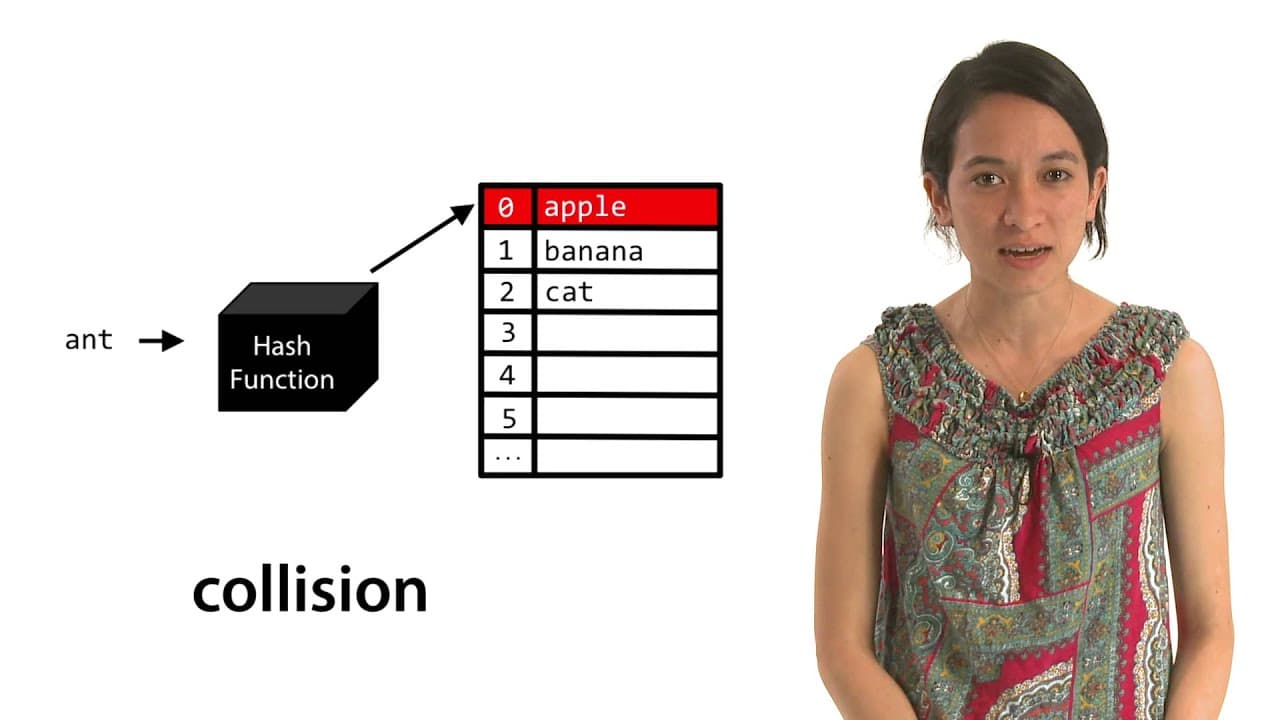
Hash tables are efficient data structures for quick insertion, deletion, and lookup of elements, but collisions can slow down performance.
Transcript
[NOISE]. Before diving into hash tables, let's first review the pros and cons of some simpler data structures, starting with arrays. Recall that arrays allow us to store elements of a single data type contiguously in memory. Because each element is associated with an index, or location, we have random access to all of the elements in an ... Read More
Key Insights
- ♿ Arrays provide random access but have a fixed size.
- 💗 Linked lists can grow dynamically but have slow lookup times.
- #️⃣ Hash tables offer speedy operations but require a hash function and handling collisions.
- 🥺 Linear probing can lead to clustering and slower performance.
- 💥 Separate chaining resolves collisions using linked lists.
- ⏲️ The worst-case lookup time for separate chaining is O(n/k), where k is the size of the hash table.
- #️⃣ A good hash function minimizes collisions and spreads hash values evenly across the table.
Install to Summarize YouTube Videos and Get Transcripts
Explore YouTube Video Summarizer or Get YouTube Transcript Extractor
Questions & Answers
Q: What are the advantages and disadvantages of using arrays as a data structure?
Arrays provide random access to elements, but their size is fixed, making it difficult to grow dynamically.
Q: How do linked lists differ from arrays?
Linked lists can grow dynamically but have slow lookup times as they require traversing the entire list to access a specific element.
Q: What is a hash table?
A hash table is an array coupled with a hash function that maps keys to specific indices in the array, allowing for speedy insertion, deletion, and lookup operations.
Q: What happens when two keys hash to the same index in a hash table?
Collision occurs, and there are various methods to resolve it, such as linear probing (assigning the next available slot) or separate chaining (using linked lists).
Key Insights:
- Arrays provide random access but have a fixed size.
- Linked lists can grow dynamically but have slow lookup times.
- Hash tables offer speedy operations but require a hash function and handling collisions.
- Linear probing can lead to clustering and slower performance.
- Separate chaining resolves collisions using linked lists.
- The worst-case lookup time for separate chaining is O(n/k), where k is the size of the hash table.
- A good hash function minimizes collisions and spreads hash values evenly across the table.
- The hash function should be efficient and employ quick operations to minimize run time.
Summary & Key Takeaways
-
Arrays allow random access to elements, but their size is fixed and cannot easily grow.
-
Linked lists can grow dynamically but have slow lookup times.
-
Hash tables offer speedy insertion, deletion, and lookup and use a hash function to map keys to indices in an array.
Read in Other Languages (beta)
Share This Summary 📚
Summarize YouTube Videos and Get Video Transcripts with 1-Click
Try YouTube Summary with ChatGPT & Claude or YouTube Transcript Generator
Explore More Summaries from CS50 📚






Summarize YouTube Videos and Get Video Transcripts with 1-Click
Try YouTube Summary with ChatGPT & Claude or YouTube Transcript Generator