How Long Can We Live?
TL;DR
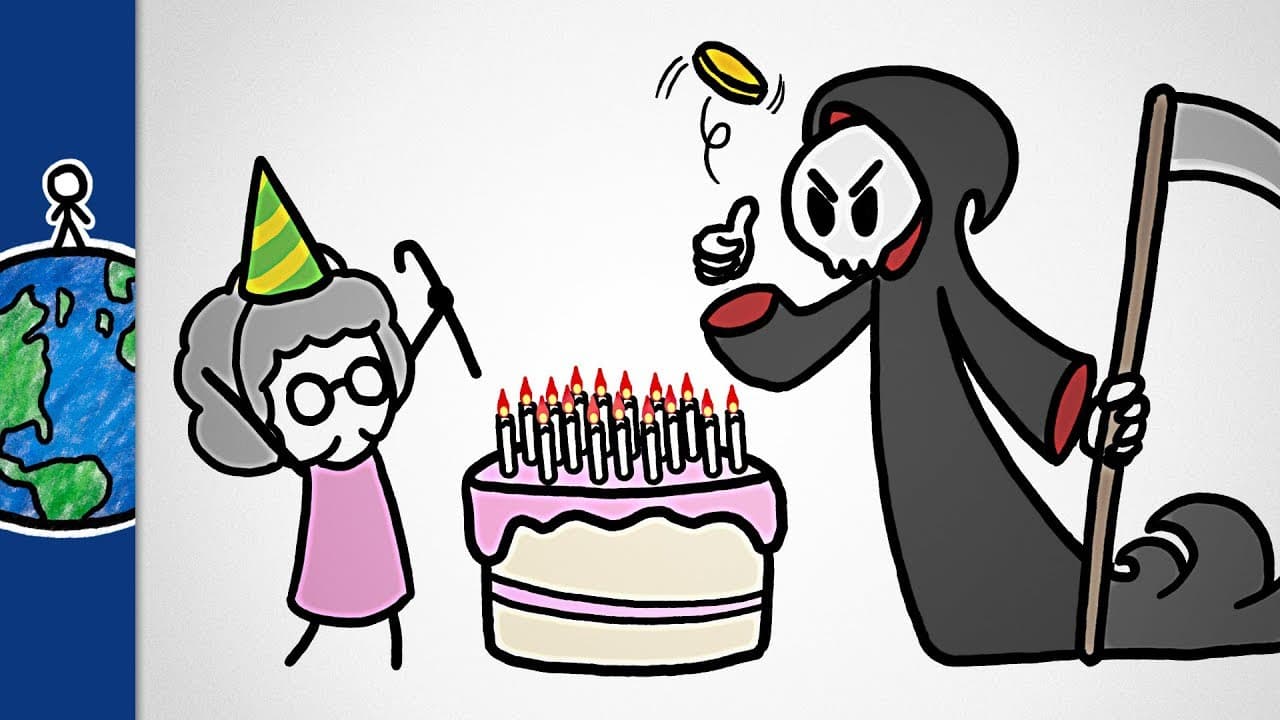
As people get older, their odds of dying increase, but there is evidence that the mortality curve levels off at a certain age, potentially due to natural selection and the ability to eliminate harmful genes.
Transcript
This video was sponsored by Squarespace. Hi, this is Emily from MinuteEarth. Not to sound super morbid, but with each passing second of life, the cells in our bodies accrue a little more damage, which is at least partly why, as people get older, their odds of dying increase: today, a 40 year-old has a .3% chance of dying in the next year, while a 6... Read More
Key Insights
- 🤕 Cells in our bodies accrue damage over time, contributing to the increased likelihood of death as we age.
- 🤕 The mortality curve levels off at a certain age, suggesting that natural selection plays a role in eliminating harmful genes.
- 🧓 Genes that prove fatal during childhood are more likely to be weeded out by natural selection than genes that kill older adults.
- 🤕 Natural selection's ability to eliminate harmful genes decreases as the age of gene impact increases.
- 🎚️ The mortality curve leveling off implies that there is a limit to human lifespan.
- 🧑🤝🧑 The number of people who can beat the old-age longevity records is a numbers game, with a higher population increasing the probability.
Install to Summarize YouTube Videos and Get Transcripts
Explore YouTube Video Summarizer or Get YouTube Transcript Extractor
Questions & Answers
Q: Why do the odds of dying increase as people get older?
The cells in our bodies accumulate damage over time, contributing to the increased likelihood of death as we age.
Q: What is the mortality curve?
The mortality curve refers to the graph depicting the probability of dying at different ages. It shows an exponential increase until a certain age, where the odds of dying level off.
Q: How does natural selection affect mortality rates?
Natural selection eliminates harmful genes that prove fatal during childhood, but it becomes less effective as the age of the gene's impact increases, leading to a flattening mortality curve.
Q: Can humans live indefinitely?
No, humans have a finite lifespan. While the mortality curve levels off at a certain age, there is still an upper limit to human lifespan due to biological constraints.
Summary & Key Takeaways
-
With each passing second of life, cells in our bodies accrue damage, contributing to the increase in the odds of dying as people get older.
-
The mortality curve, however, levels off at a certain age, suggesting that natural selection and the elimination of harmful genes play a role.
-
Natural selection can weed out gene mutations that prove fatal during childhood but has a lower chance of eliminating genes that kill older adults.
Read in Other Languages (beta)
Share This Summary 📚
Summarize YouTube Videos and Get Video Transcripts with 1-Click
Try YouTube Summary with ChatGPT & Claude or YouTube Transcript Generator
Explore More Summaries from MinuteEarth 📚





Summarize YouTube Videos and Get Video Transcripts with 1-Click
Try YouTube Summary with ChatGPT & Claude or YouTube Transcript Generator