What Are the Basics of MRI Physics?
TL;DR
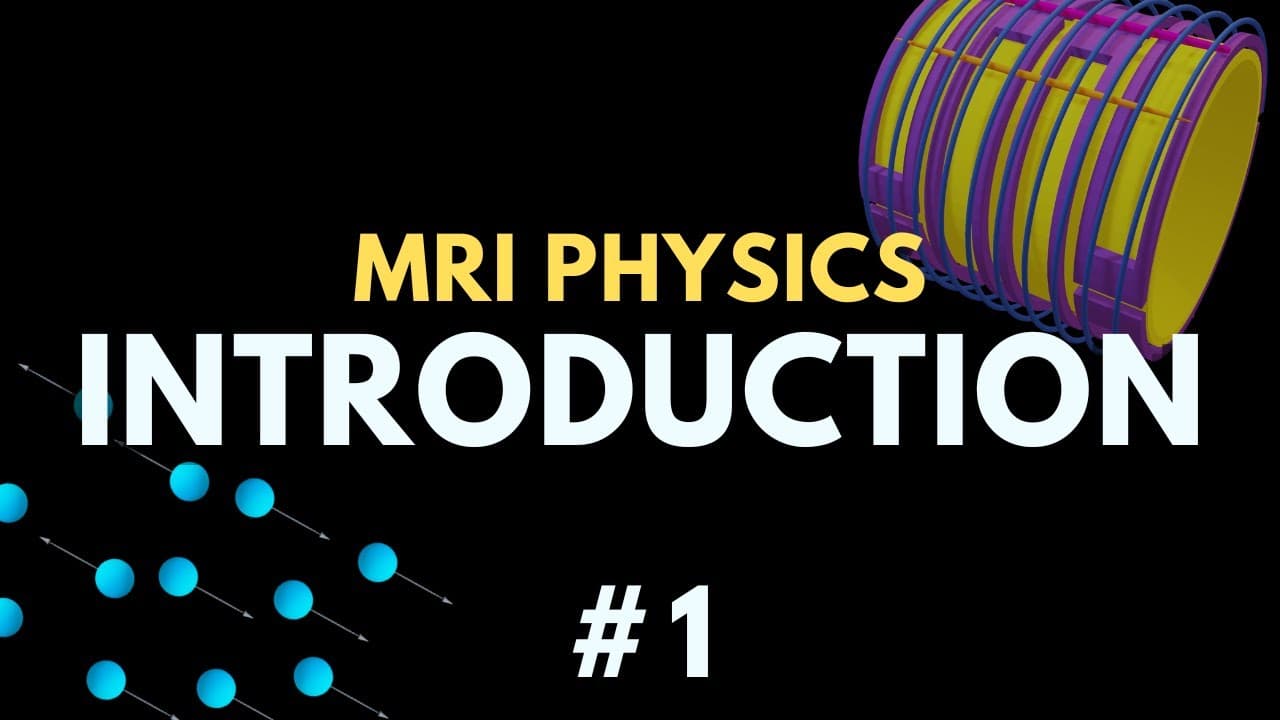
MRI physics involves understanding how hydrogen atoms within the body interact with magnetic fields to generate images. Critical concepts include the net magnetization vector and how variations in echo time and repetition time create contrast in MRI images. This foundational knowledge sets the stage for deeper explorations into MRI technology and techniques.
Transcript
hello everybody and welcome to the MRI physics module I can't wait to share the upcoming talks with you now this course consists of multiple different talks and each one dives into a fair amount of detail regarding that specific topic and it's my hope that by the end of this module you'll have a good conceptual understanding as to how exactly MRI p... Read More
Key Insights
- MRI physics is explained using a puzzle analogy to simplify complex concepts, focusing on building a comprehensive understanding through detailed exploration of individual components.
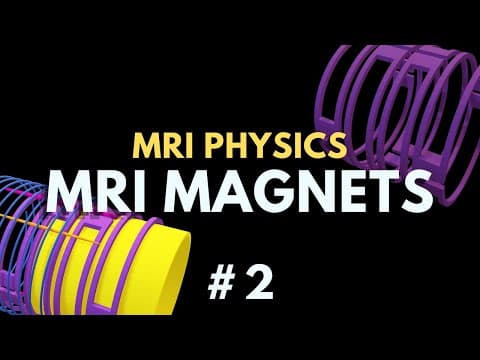
- The MRI machine uses multiple layers of magnets, and the imaging process relies on signals originating from within the patient, unlike X-ray or CT imaging.
- The Cartesian plane is used to localize signals in MRI, dividing the image into longitudinal and transverse planes for accurate imaging.
- Nuclear magnetic resonance is central to MRI, utilizing hydrogen atoms for imaging due to their abundance and magnetic properties.
- Hydrogen protons align and precess under a magnetic field, with processional frequency influenced by the magnetic field's strength.
- Net magnetization vector is crucial for MRI imaging, representing the combined magnetic moments of hydrogen atoms, which is influenced by external magnetic fields.
- Radio frequency pulses are used to manipulate the net magnetization vector, allowing the measurement of signals by flipping it perpendicular to the main magnetic field.
- Contrast in MRI images is generated by manipulating echo time and repetition time, exploiting differences in transverse and longitudinal relaxation rates between tissues.
Install to Summarize YouTube Videos and Get Transcripts
Explore YouTube Video Summarizer or Get YouTube Transcript Extractor
Questions & Answers
Q: What is the primary focus of the MRI physics course?
The primary focus of the MRI physics course is to provide a comprehensive understanding of how MRI physics works by exploring individual components in detail. The course uses a puzzle analogy to simplify complex concepts, aiming to build a clear conceptual framework for understanding the principles and techniques involved in MRI imaging.
Q: How does MRI imaging differ from X-ray or CT imaging?
MRI imaging differs from X-ray or CT imaging in that the signals used to generate images originate from within the patient. Unlike X-ray or CT, which rely on external sources, MRI uses the patient's own hydrogen atoms, manipulated by magnetic fields, to produce images. This internal signal generation allows for detailed imaging of soft tissues in the body.
Q: What role does the Cartesian plane play in MRI imaging?
The Cartesian plane is crucial in MRI imaging for localizing signals. It divides the image into three axes: the longitudinal axis (Z-axis) and the transverse plane (X and Y axes). This division helps in accurately determining the position of signals within the body, allowing for precise imaging and differentiation between different tissue types.
Q: Why are hydrogen atoms used in MRI imaging?
Hydrogen atoms are used in MRI imaging because they are abundant in the human body and possess magnetic properties due to their non-zero spin. This makes them ideal for generating signals when exposed to magnetic fields. The magnetic moments of hydrogen atoms can be manipulated to produce images, providing detailed insights into the body's internal structures.
Q: What is the net magnetization vector in MRI?
The net magnetization vector in MRI represents the combined magnetic moments of hydrogen atoms within the body. It is a crucial concept in MRI imaging, as it indicates the overall direction and magnitude of magnetization. This vector is influenced by external magnetic fields and is manipulated using radio frequency pulses to generate measurable signals for image creation.
Q: How are radio frequency pulses used in MRI imaging?
Radio frequency pulses in MRI imaging are used to manipulate the net magnetization vector. By applying these pulses at a frequency matching the processional frequency of hydrogen atoms, the vector is flipped perpendicular to the main magnetic field. This allows for the measurement of signals, as the movement of the vector induces a current in the receiver coil, which is used to generate images.
Q: What determines contrast in MRI images?
Contrast in MRI images is determined by manipulating echo time (TE) and repetition time (TR). These parameters affect the rates of transverse and longitudinal relaxation in different tissues. By adjusting TE and TR, MRI can exploit differences in relaxation rates to enhance contrast between tissues, allowing for detailed differentiation and visualization of various anatomical structures.
Q: What future topics will be covered in the MRI physics course?
Future topics in the MRI physics course will include detailed discussions on pulse sequences such as spin echo, inversion recovery, and gradient echo sequences. The course will also cover advanced imaging techniques, MR spectroscopy, angiography, artifacts, image quality, and safety in MRI. Additionally, the course will explore k-space and its role in image creation, providing a comprehensive understanding of MRI imaging.
Summary & Key Takeaways
-
This introductory lecture on MRI physics covers the basic principles of magnetic resonance imaging, focusing on the role of hydrogen atoms and magnetic fields in generating images. The course aims to build a comprehensive understanding through detailed exploration of individual components, likened to assembling a puzzle.
-
The lecture explains the importance of the net magnetization vector in MRI imaging, which is influenced by external magnetic fields. It discusses how radio frequency pulses are used to manipulate this vector, allowing the measurement of signals and the creation of images based on transverse and longitudinal magnetization.
-
Contrast in MRI images is achieved by adjusting echo time and repetition time, which affect the rates of transverse and longitudinal relaxation in different tissues. The lecture introduces the concept of pulse sequences and the use of k-space for image creation, setting the stage for more detailed discussions in future modules.
Read in Other Languages (beta)
Share This Summary 📚
Summarize YouTube Videos and Get Video Transcripts with 1-Click
Try YouTube Summary with ChatGPT & Claude or YouTube Transcript Generator
Explore More Summaries from Radiology Tutorials 📚
Summarize YouTube Videos and Get Video Transcripts with 1-Click
Try YouTube Summary with ChatGPT & Claude or YouTube Transcript Generator