How To Make a Relative Frequency Distribution Table
TL;DR
This video demonstrates how to create a relative frequency distribution table by listing values, calculating frequencies, and determining relative frequencies.
Transcript
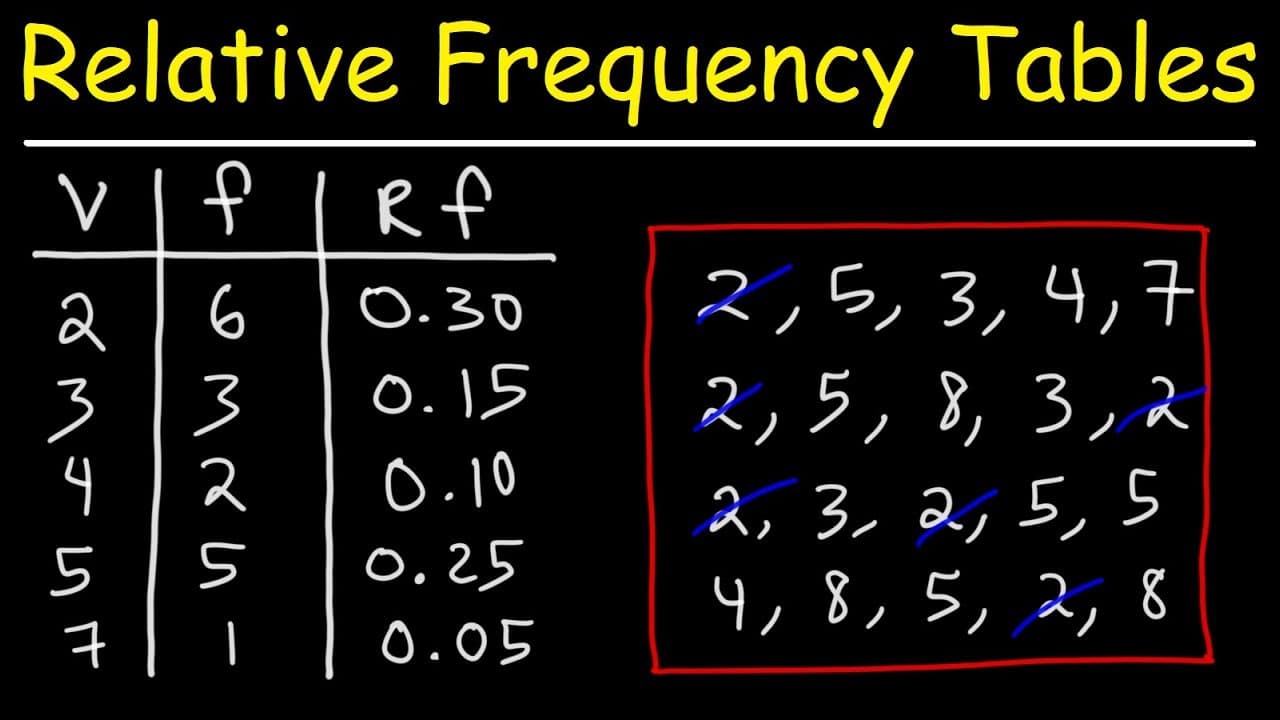
in this video we're going to talk about how to make a relative frequency distribution table so first let's write down a few numbers in our data set so let's say we have the numbers 2 five three four seven two five eight three two two and then let's say three two five five four eight five two eight so with these numbers what can we do in order to ma... Read More
Key Insights
- 🚰 The process of creating a relative frequency distribution table involves creating a frequency table and calculating relative frequencies.
- ⌛ The frequency of each value is determined by counting the number of times it appears in the dataset.
- 🗂️ Relative frequency is obtained by dividing the frequency of each value by the total frequency.
- 🍹 Adding up all the relative frequencies should result in a sum of 1, indicating a correct relative frequency table.
Install to Summarize YouTube Videos and Get Transcripts
Explore YouTube Video Summarizer or Get YouTube Transcript Extractor
Questions & Answers
Q: What is the first step in creating a relative frequency table?
The first step is to create a frequency table, listing all the values in the dataset and their corresponding frequencies.
Q: How is the frequency of each value determined?
The frequency of a value is determined by counting the number of times that value appears in the dataset.
Q: How is the relative frequency calculated?
The relative frequency is calculated by dividing the frequency of each value by the total frequency.
Q: How can you check if the relative frequency table is correct?
To check, add up all the values of the relative frequency. It should sum up to exactly 1.
Summary & Key Takeaways
-
The video explains the steps to make a relative frequency distribution table using a given dataset.
-
It starts by creating a frequency table, noting the values and their respective frequencies.
-
The relative frequency is then calculated by dividing the frequency of each value by the total frequency.
Read in Other Languages (beta)
Share This Summary 📚
Summarize YouTube Videos and Get Video Transcripts with 1-Click
Try YouTube Summary with ChatGPT & Claude or YouTube Transcript Generator
Explore More Summaries from The Organic Chemistry Tutor 📚


Summarize YouTube Videos and Get Video Transcripts with 1-Click
Try YouTube Summary with ChatGPT & Claude or YouTube Transcript Generator