induction proof for the nth derivative of x*e^x
TL;DR
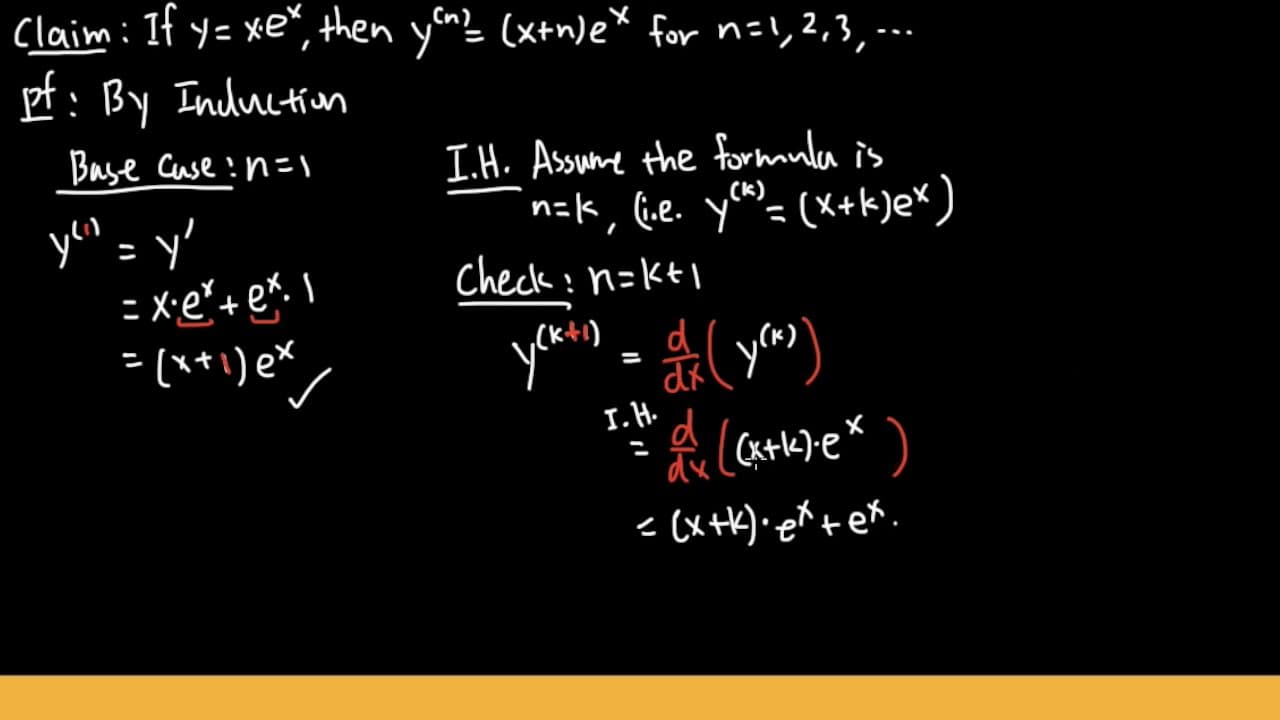
This video provides a step-by-step demonstration of a mathematical induction proof for the formula Y = X * e^X.
Transcript
okay in this video I'm gonna show you guys how to prove that if Y is equal to x times e to the X then the N star of T of Y is equal to X plus n in the parentheses and then times e to the X for n is equal to 1 2 3 4 5 and so on namely all the parts of the whole numbers N and because we're trying to show that this is true for all parts of the whole n... Read More
Key Insights
- 😒 The proof uses mathematical induction to show the validity of the formula Y = X * e^X for all whole number values of n.
- 🥹 The base case is established by considering n = 1, but the formula is also shown to hold true for n = 0.
- 🤢 The inductive hypothesis assumes the formula is true for n = k and uses it to prove the formula for n = k+1.
- 📏 The proof involves differentiating the function Y and using the product rule.
Install to Summarize YouTube Videos and Get Transcripts
Explore YouTube Video Summarizer or Get YouTube Transcript Extractor
Questions & Answers
Q: What is the purpose of this video?
The purpose of this video is to show how to prove the formula Y = X * e^X using mathematical induction.
Q: How is the base case established in the proof?
The base case is established by considering n = 1, and showing that the formula holds true for this value.
Q: What is the inductive hypothesis?
The inductive hypothesis assumes that the formula is true for n = k, and uses this assumption to prove the formula for the next term, n = k+1.
Q: What is the significance of the formula X + n * e^X?
The formula X + n * e^X represents the n-th derivative of Y, and the proof demonstrates that it holds true for all whole number values of n.
Summary & Key Takeaways
-
The video demonstrates a proof that if Y = X * e^X, then the n-th derivative of Y is equal to X + n * e^X, for n = 1, 2, 3, etc.
-
The base case is established by considering n = 1.
-
The inductive hypothesis is assumed for n = k, and the formula is shown to hold true.
-
The proof is then extended to the next term, n = k+1, using the inductive hypothesis.
Read in Other Languages (beta)
Share This Summary 📚
Summarize YouTube Videos and Get Video Transcripts with 1-Click
Try YouTube Summary with ChatGPT & Claude or YouTube Transcript Generator
Explore More Summaries from blackpenredpen 📚
Summarize YouTube Videos and Get Video Transcripts with 1-Click
Try YouTube Summary with ChatGPT & Claude or YouTube Transcript Generator