Monostable Multivibrator | Designing | Example-2 | Pulse Digital Circuits ( PDC ) | Lec-62
TL;DR
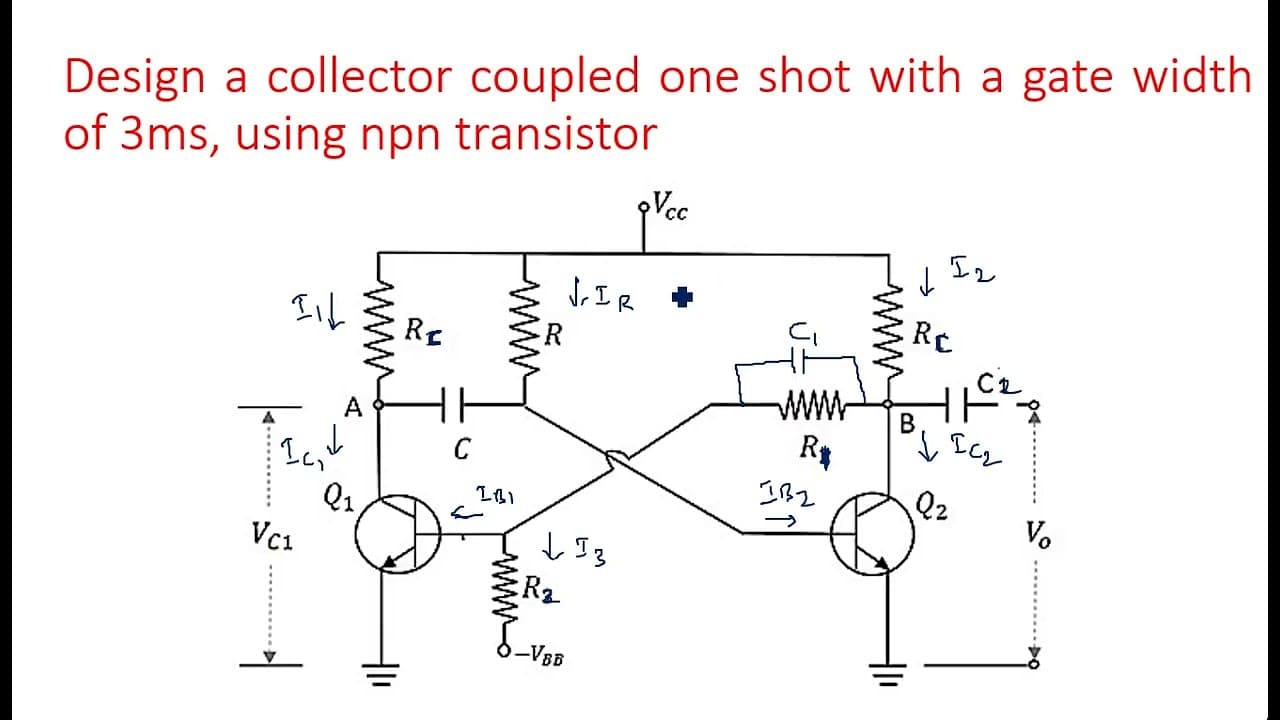
This video explains designing a collector coupled one-shot multivibrator with specified parameters.
Transcript
hi everyone in this video let us see the designing of monasterical multivibrator is second type so the question is given like this design a collector coupled one shot with a gate width of 3 milliseconds using npn transistor another name of monostable multivibrator is one shot okay so one shot is known as monostable multivibrator now this is the cir... Read More
Key Insights
- 💗 Monostable multivibrators are integral in generating specific pulse widths for various electronic applications.
- ⌛ The design emphasizes understanding circuit behavior in stable versus quasi-stable states, crucial for timing accuracy.
- 💗 Resistor and capacitor values significantly influence the charge and discharge times, directly affecting pulse width.
- ⚡ Transistor parameters, including saturation current and voltage, are critical to ensuring proper operation and reliability of the circuit.
- 🎨 Circuit assumptions allow flexibility in designs; different assumed values can lead to valid yet varying designs based on specific requirements.
- ⚡ The mathematical relationships among voltage, current, and resistance are fundamental in determining the performance of transistor-based circuits.
- 🎨 Experience in calculating component values enhances proficiency in designing complex electronic circuits.
Install to Summarize YouTube Videos and Get Transcripts
Explore YouTube Video Summarizer or Get YouTube Transcript Extractor
Questions & Answers
Q: What is a monostable multivibrator and how is it used in circuits?
A monostable multivibrator, also known as a one-shot, is a circuit that generates a single output pulse in response to a triggering input. It is used in applications where a temporary output signal is required, such as timers, pulse width modulation, and other timing applications. It has one stable state and one quasi-stable state, transitioning between them upon receiving a trigger.
Q: What are the main components of a collector coupled monostable multivibrator?
The primary components of a collector coupled monostable multivibrator include two NPN transistors, capacitors for coupling between the collector and base, resistors for controlling current and biasing, and a supply voltage (VCC). These components are essential for ensuring the desired pulse width and stability of the output signal.
Q: How does the design process for the monostable multivibrator prioritize assumptions?
In designing the multivibrator, making assumptions about parameters like supply voltage, transistor characteristics, and resistance values is crucial. These assumptions guide the calculations needed for components. The focus is less on the final numerical values and more on the procedural steps taken to arrive at a functional circuit design.
Q: Can you explain how to calculate the capacitance needed for the desired pulse width?
To calculate the capacitance (C) for achieving a particular pulse width (T), the formula used is T = 0.693 * RC. Rearranging gives C = T / (0.693 * R). For a desired pulse width of 3 milliseconds and a calculated resistance (R), substituting these values allows for finding the necessary capacitance to ensure the multivibrator outputs the expected pulse duration.
Summary & Key Takeaways
-
The video details the design of a collector coupled monostable multivibrator (one-shot) using NPN transistors, emphasizing the coupling, stable states, and quasi-stable states.
-
Key calculations include determining component values such as collector resistance, biasing supply, and capacitance necessary for achieving a pulse width of 3 milliseconds.
-
The design process emphasizes the importance of procedural understanding and assumptions made in calculating parameters like voltage, current, and time constants for effective circuit design.
Read in Other Languages (beta)
Share This Summary 📚
Summarize YouTube Videos and Get Video Transcripts with 1-Click
Try YouTube Summary with ChatGPT & Claude or YouTube Transcript Generator