Radar block diagram | Pulse Radar | PPI Display | Radar Systems | Lec-06
TL;DR
Pulse radar systems utilize short pulse waveforms for object detection and include various key components.
Transcript
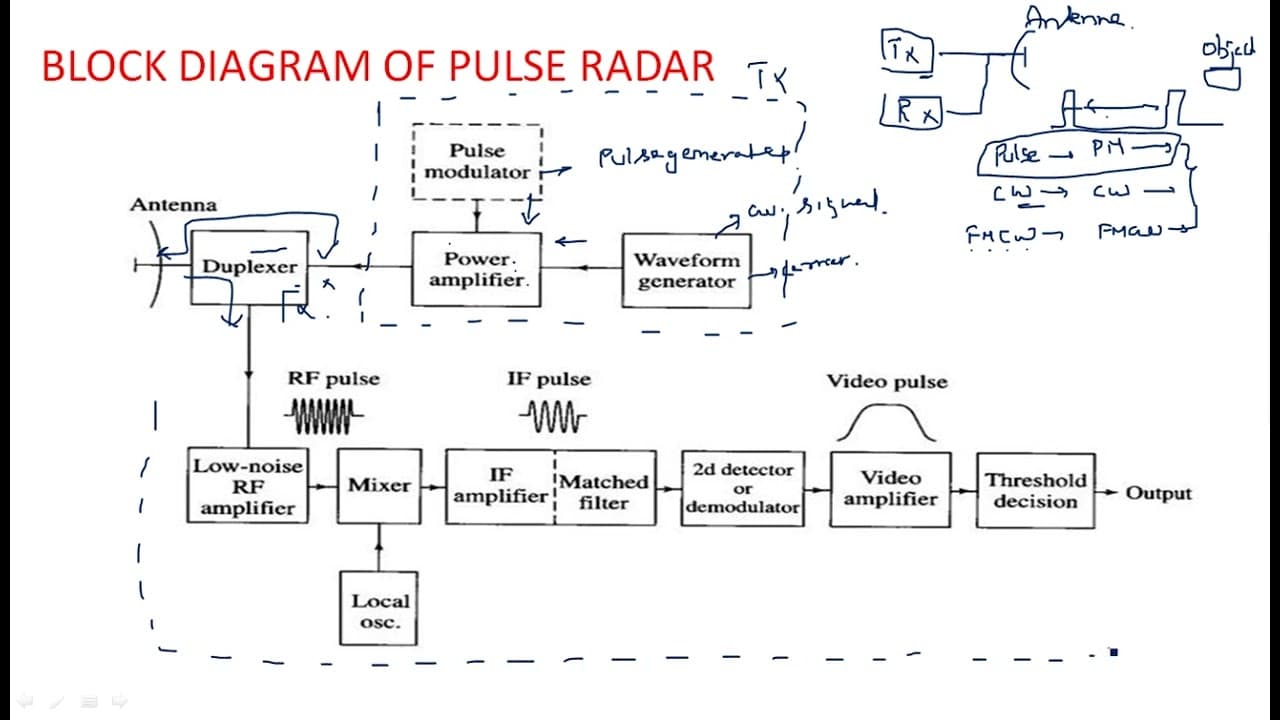
hi everyone in this video I am going to explain about the complete block diagram of pulse radar system so pulse radar system it is the first and first radar system where the pulse waveforms are being used to detect the object I already told you how the pulsive waveforms are helping us to detect the object so pulse is having very shortest duration i... Read More
Key Insights
- 💗 Pulse radars utilize very short pulse transmissions to maximize detection efficiency and minimize overlapping noise during signal processing.
- 👋 Understanding the difference between pulse, continuous wave (CW), and frequency modulated continuous wave (FMCW) radars is crucial for selecting the appropriate radar system based on specific operational needs.
- 💗 The transmitting section encompasses several components including pulse generators and modulators, essential for converting signals into a form suitable for effective transmission.
- 📞 The receiver section integrates devices like mixers and demodulators that convert the received RF signal into intermediate frequencies for further processing.
- 🎯 Threshold decision devices are important for distinguishing relevant moving targets from stationary objects, enhancing the radar's operational effectiveness.
- 🎯 Output visualization is achieved through displays such as PPI and scope displays, making tracking and target acquisition more intuitive for the operator.
- 🧡 High power requirements for transmission can reach up to megawatts, indicating the strength necessary to ensure the radar's effectiveness over long ranges.
Install to Summarize YouTube Videos and Get Transcripts
Explore YouTube Video Summarizer or Get YouTube Transcript Extractor
Questions & Answers
Q: What is the primary function of a pulse radar system?
A pulse radar system's main function is to detect objects by transmitting brief pulse waveforms that reflect off targets, allowing for distance calculation based on the time delay of the returned signal. This system operates under a low-duty cycle, maximizing the efficiency of the radar in tracking and identifying various objects.
Q: How does the duty cycle affect the operation of a pulse radar system?
The duty cycle in a pulse radar system, which can be as low as 0.001, determines how long the radar transmits signals relative to when it expects to receive echoes. A low duty cycle maximizes the off time during which the radar can listen for returning signals, improving detection capabilities while minimizing interference from the transmitted wave.
Q: What role does a duplexer play in a radar system?
The duplexer is crucial for separating the transmitting and receiving signals in a radar system, ensuring that high-power signals do not interfere with the receiver. It allows signals to travel in one direction for transmission while keeping the incoming signals directed solely toward the receiver, thus preserving the integrity of the received data.
Q: Why are amplifiers necessary in radar systems?
Amplifiers in radar systems, particularly power and low-noise RF amplifiers, are essential for boosting the strength of transmitted and received signals. The power amplifier ensures that the radar's signal can travel long distances, while the low-noise RF amplifier enhances weak echo signals, ensuring clarity and precision in detection and imaging.
Summary & Key Takeaways
-
Pulse radar systems transmit brief pulse waveforms to detect objects, utilizing a duty cycle as low as 0.001, ensuring signals can return and be analyzed.
-
The system comprises essential components: a transmitter, receiver, and antenna, each playing a critical role in sending and capturing radar signals.
-
Key elements such as duplexers and amplifiers are vital for separating signals and enhancing weak echoes to facilitate clear detection and analysis of targets.
Read in Other Languages (beta)
Share This Summary 📚
Summarize YouTube Videos and Get Video Transcripts with 1-Click
Try YouTube Summary with ChatGPT & Claude or YouTube Transcript Generator